Awards

Three ICMAB graduates, awarded with the UAB PhD Extraordinary Award

Three ICMAB graduates will receive next November 6 the PhD Extraordinary Award for their doctoral thesis. It is given by the UAB to theses developed during the period 2022-2025. Congratulations to Nerea González Pato, Pol Sallés Perramon and Amanda Muñoz-Juan.

Three former PhD researchers from the Institute of Materials Science of Barcelona (ICMAB-CSIC) have been recognized with the PhD Extraordinary Awards granted by the Universitat Autònoma de Barcelona (UAB).

The awards distinguish outstanding doctoral theses defended in different academic years and recognize the scientific achievements and contributions of young researchers.

In the latest list of awardees, Nerea González Pato, Pol Sallés Perramon and Amanda Muñoz-Juan have received this distinction for their doctoral research carried out at ICMAB. They will receive their award next November 6 at the UAB.

Nerea González Pato

2023, PhD Programme in Materials Science

Nerea González Pato defended her PhD thesis, Smart nanomaterials based on organic radicals for electronic and biological applications, on 2 June 2023 at ICMAB. Her thesis was supervised by Imma Ratera, from the Nanomol-Bio research group at ICMAB-CSIC.
Abstract

Design, synthesis, and characterization of smart nanomaterials based on organic trityl derivative radicals for electronic and biological applications. The multifunctional properties of trityl radicals, including optical, electronic, magnetic, and chiral properties are explored after their nanostructuration. The first part discusses the nanostructuration of PTM radical derivatives using self-assembled monolayers (SAMs) for their applications in molecular electronics and to control bacteria adhesion. The second part focuses on nanostructuration into nanoparticles (ONPs) for their applications as nanothermometers in the infrared-region, which excitation is shifted towards the “first biological window” using two-photon absorption (TPA) to optimize the excitation wavelengths for improved biocompatibility. Finally, is explored the chiral properties of trityl radicals and the preparation of chiral ONPs.

Read more about Nerea's PhD thesis.

Pol Sallés Perramon

2023, PhD Programme in Materials Science

Pol Sallés Perramon defended his PhD thesis, Unfolding the challenges to prepare epitaxial complex oxide membranes by chemical methods, on 25 April 2023 at ICMAB. His thesis was supervised by Mariona Coll, from the Superconducting Materials and Large Scale Nanostructures (SUMAN) research group at ICMAB-CSIC. He was also recognized with the CSIC Relevant Doctoral Thesis Award in 2025.
Abstract
The development of fabrication approaches to prepare freestanding epitaxial complex oxides has opened a myriad of new opportunities to freely manipulate the oxides rising huge interest to be integrated in versatile next-generation electronic devices and envisaging distinct and novel properties to deliver performance improvement. This thesis explores the frontiers of cost-efficient chemical deposition methodologies to broaden the freestanding epitaxial oxide library prepared from Sr3Al2O6-based sacrificial layer. Cation engineering in Sr3Al2O6 has been thoroughly investigated to provide a robust approach to successfully prepare a variety of freestanding oxides including CoFe2O4, La0.7Sr0.3MnO3 and BiFeO3 to ultimately deliver an all-oxide functional device.

Read more about Pol's PhD thesis.

Amanda Muñoz-Juan

2024, PhD Programme in Biotechnology

Amanda Muñoz-Juan defended her PhD thesis, Assessment of bacterial nanocellulose on Caenorhabditis elegans, on 16 January 2024 at ICMAB. Her thesis was supervised by Anna Laromaine, from the Nanoparticles and Nanocomposites (NN) research group at ICMAB-CSIC.

Abstract
The modern era has reshaped our diets rising the obesity-related health issues. Dietary fibers (DF), undigestible polysaccharides by humans, are explored to mitigate these problems. Among the DF, cellulose is the most abundant polysaccharide. It is usually obtained from plants, but new sources have been explored. We focused on evaluating Bacterial nanocellulose (BNC) produced by a gram-negative bacteria. BNC is chemically identical to plant cellulose but with distinctive properties. Despite proven biosafety and associated benefits, its full potential in the food industry remains untapped. This thesis evaluates bacterial nanocellulose fibers (BNCf) in the model organism Caenorhabditis elegans, shedding light on its biological interactions at the organism, tissue, and cellular levels, with implications for understanding and maximizing its benefits. We identified the reduction of lipid markers and positive effects in the immunological response upon ingestion.


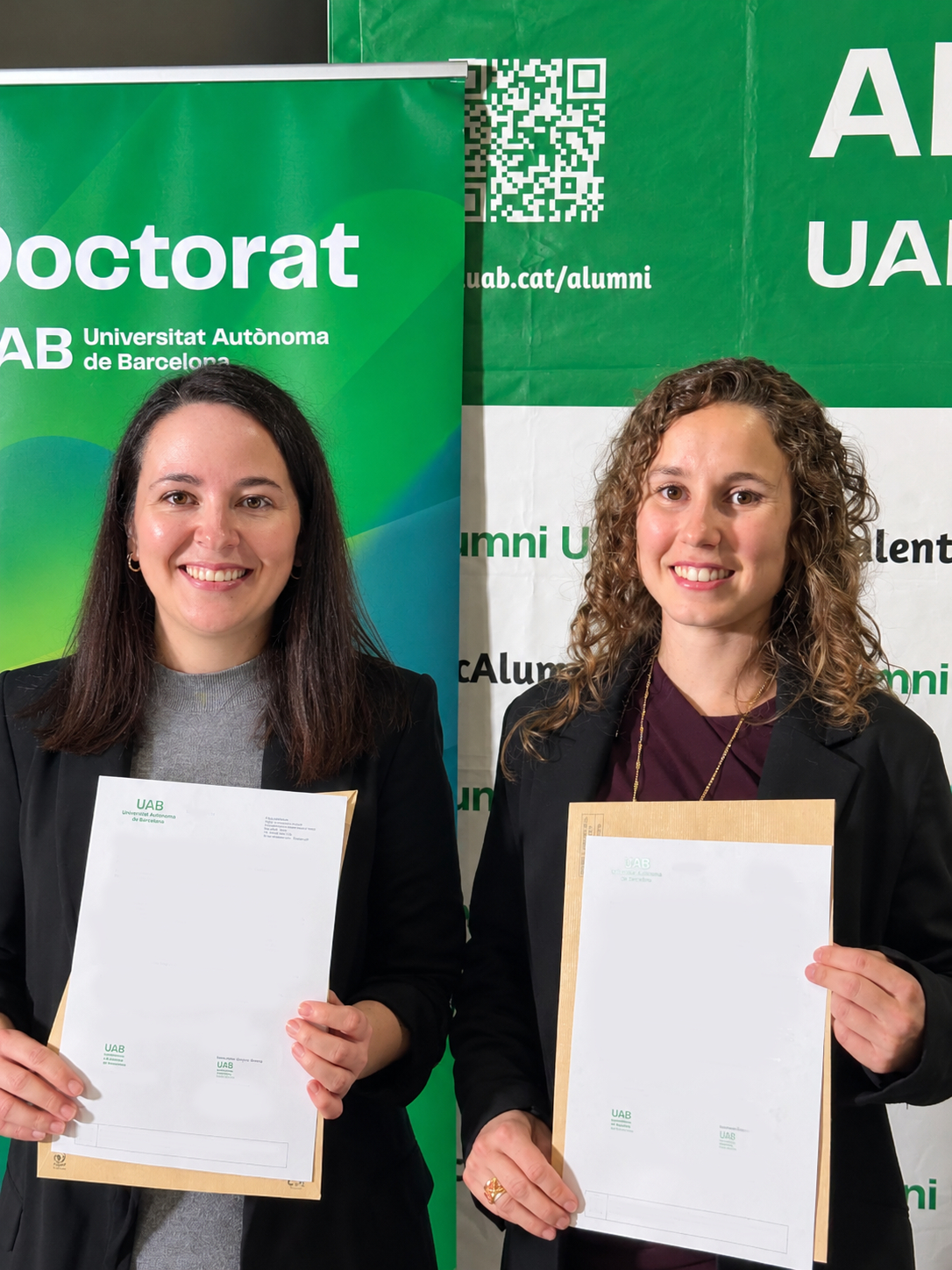
Amanda Muñoz-Juan (left) and Nerea González Pato (right) with their awards at the end of the eventAmanda Muñoz-Juan (left) and Nerea González Pato (right) with their awards at the end of the event

Recognition for a former ICMAB postdoctoral researcher

We would also like to congratulate Ana Vila Costa, who has received a PhD Extraordinary Award in the Physics programme for the 2022/2023 academic year. Although she completed her PhD research outside ICMAB, Ana later joined the institute as a postdoctoral researcher. She stayed at the Nanocomposites and Nanoparticles Group between 2023 and 2025.

About the awards

The School for Doctoral Studies, in collaboration with UAB Alumni, organises an event every semester to award PhD degrees and PhD Extraordinary Awards. With 66 PhD programmes, the UAB is one of the leading Catalan universities in the production of theses, generating approximately a third of the doctoral theses defended in the Catalan university system each year.

With the PhD degree and PhD Extraordinary Award ceremonies, which are held twice during the academic year (around May and November), the UAB demonstrates its appreciation for the effort and dedication of young researchers and their contributions to the generation of knowledge. The main value of the UAB is its human capital and the new doctors are an essential element for the continuation of excellent lines of research. That excellence is based on the quality of the PhDs as a distinctive indicator.

The PhD Extraordinary Awards confer value to theses which have received the qualification of excellence Cum Laude and which, having been proposed by the Admissions Committee of each academic programme, stand out for their contribution and advance in the different areas of our University. The prizes are awarded per academic year, in accordance with PhD regulations and with the criteria specified in each PhD programme.

Read more

Daniel Rodríguez Urbano
05 November 2026