


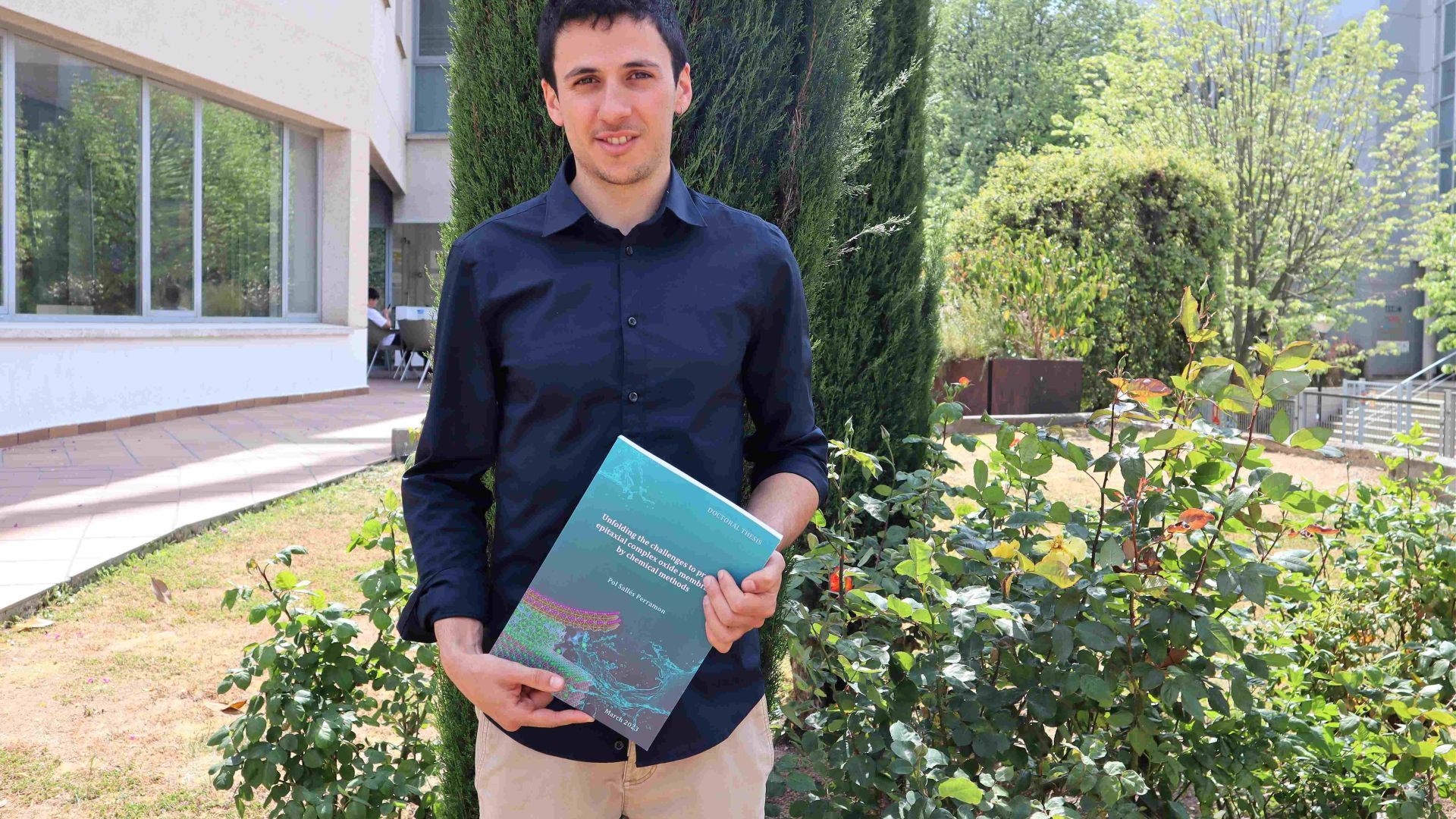
The PhD thesis was supervised by Mariona Coll, SUMAN group, from ICMAB-CSIC.
The PhD Committee that evaluated the Thesis was formed by Maarit Karppinen, Aalto University, Finland (President), David Pesquera Herrero, ICN2, Spain (Secretary) and Francisco Rivadulla Fernandez, Universidad de Santiago de Compostela, Spain (Vocal).
Doctor Poll Sallés' PhD thesis was part of the PhD in Materials Science from the Universitat Autònoma de Barcelona (UAB). He had a "la Caixa" INPhINIT Doctoral Fellowship that started in 2019.
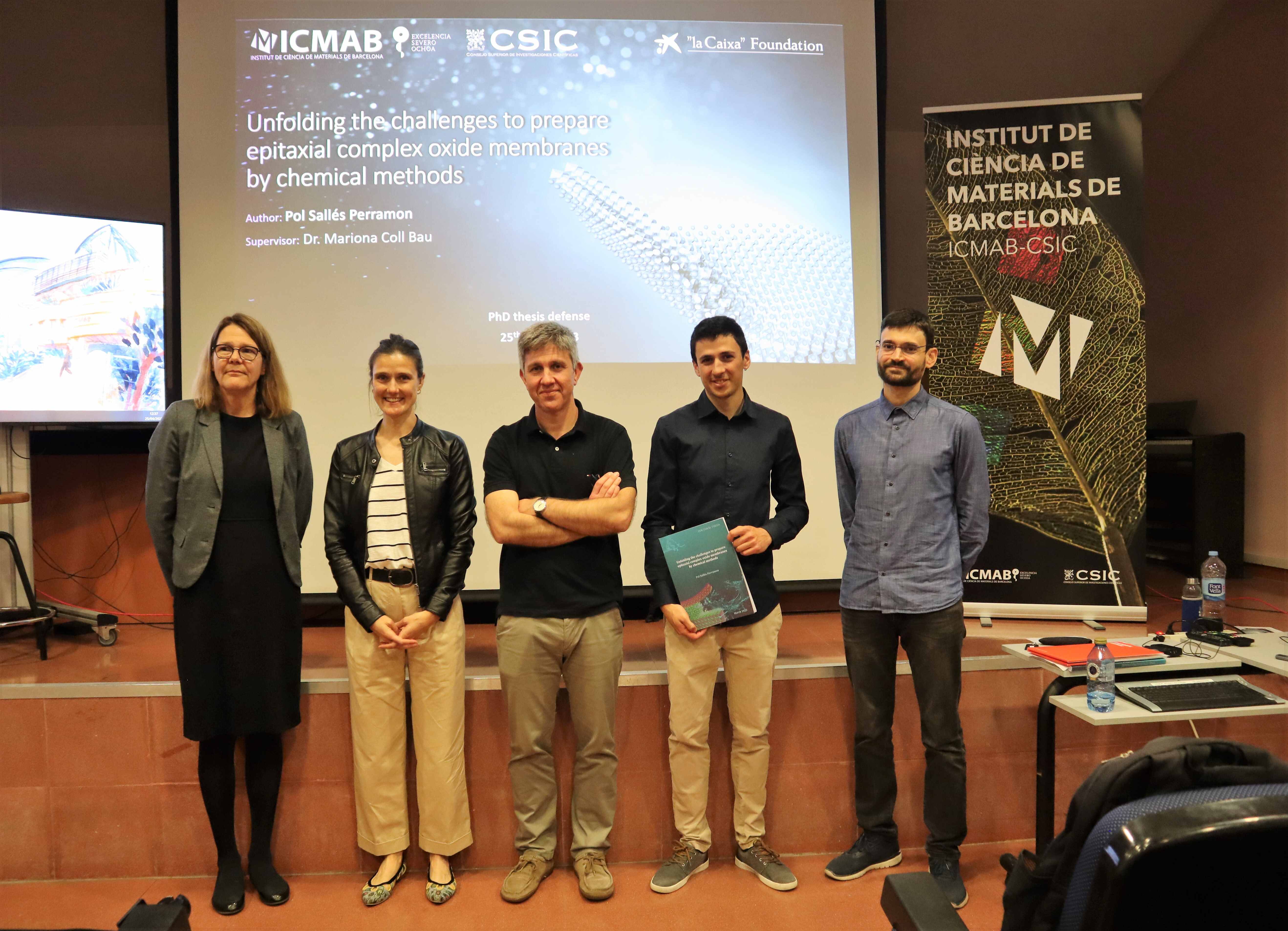
Pol Sallés with the PhD Committe and the supervisor | ICMAB, CSIC
Why did you choose ICMAB for your PhD?
I was interested in doing research on material science for energy applications and the topic offered by Mariona Coll draw my attention. Also, as I had done my bachelor final project with Anna Roig, I knew the atmosphere here and I liked the idea of being back.
How would you explain your research to a non-scientific audience?
There is a family of materials so-called complex oxides with atypical properties that make them very appealing for next-generation electronic and energy applications. However, to prepare these materials with high quality in the form of thin film, you need to use a specific substrate which hinders their applicability because it is very expensive, rigid and fragile. Recently, there have been proposed different approaches to detach the complex oxide thin films from their substrate widening the range of possibilities that these materials can offer, from their integration into flexible and wearable devices to the freely manipulation to further tune their unique properties. In this thesis I have aimed to introduce chemical methods as an alternative to conventional methods in order to prepare these released complex oxide thin films in a low cost, sustainable and potentially scalable approach.
What are the main applications of your research? Could you give us an example?
Electronic and energy applications in general as it depends on the complex oxide composition used and the range of properties offered is endless. A visual and simple example is using a piezoelectric membrane to be integrated on a wearable device as a sensor to monitor the movement of who is wearing it.
From the lessons learnt here, which one do you value the most?
Science tends not to be a direct path to your goal, so learn along the way and make the best of every step.
What will you miss the most from ICMAB?
Its familiar atmosphere and all the people who form it.
How do you think this experience will contribute to your training and to your future?
I hope that making me more prepared for the challenges ahead.
What are your plans once you finish your PhD?
For the moment there's a long trip I have pending, and after that I still have to decide whether to do a postdoc or what to do with my life.
What do you wish you had known at the beginning of your PhD, that you can recommend to the ones who are starting?
Take it easy.
Why did you become a scientist? Who have been your role models?
Ever since I was a child I have been more interested in science subjects because of my curiosity to understand the unknown. No role models that I recall, but our former director Xavier Obradors was who convinced me to study the BSc in Nanoscience and Nanotechnology (UAB).
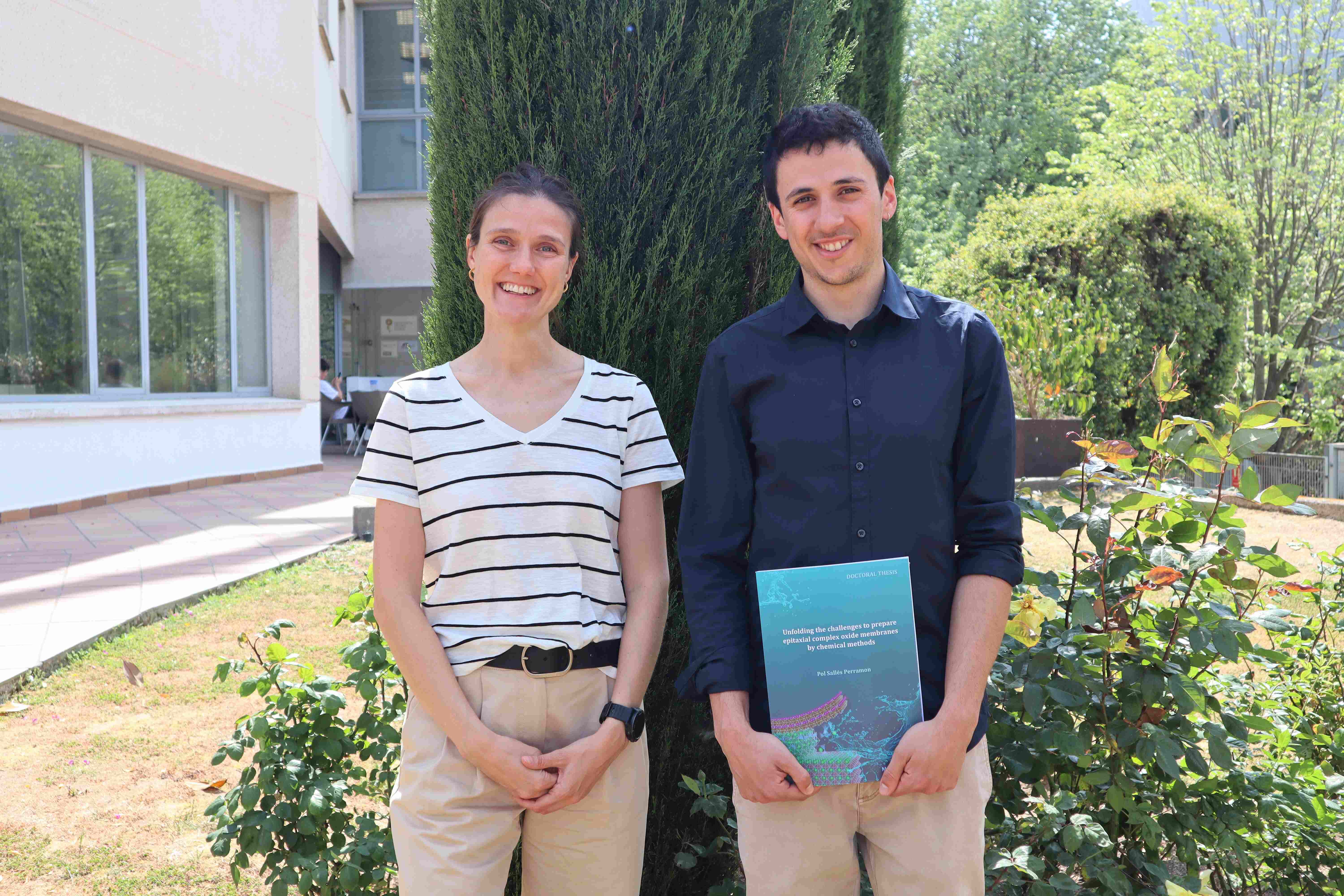
Pol Sallés with the supervisor Mariona Coll | ICMAB, CSIC
Congratulations, Doctor Pol Sallés!
More information and photos.