


The PhD Extraordinary Awards is an accreditation given by the Universitat Autònoma de Barcelona to PhDs defended in the last 3 academic years, and 5 Awards are given in each of the 66 PhD programmes. Besides the accreditations, the awarded researchers are exempt of the payment attached to the title application.
The Accademic Committee of each programme has decided to give five of these Awards to ICMAB PhD Graduates from the academic year 2021/2022. The accolades went to:
Juan Forero Saboya
2022, PhD programme in Materials Science
Saboya defended his thesis, Electrolytes and Interfaces in Calcium and Magnesium Rechargeable Batteries, on the 5th of April, 2022. He was supervised by Patrik Johansson (Chalmers University of Technology) and Alexandre Ponrouch (ICMAB-CSIC).
Abstract
Among the different next-generation battery chemistries, the ones based on Ca or Mg metals stand out as attractive candidates given their high energy density and high availability. However, the development of electrolytes capable of sustaining the operation of Ca or Mg metal batteries is still an open challenge. In this thesis, a study of the electrolyte formulation for Ca metal batteries is presented, with parallelisms to Mg application.
The electrolyte is studied from three complementary points of view: production of high-purity salts, macroscopic physicochemical properties, and electrochemical compatibility with Ca or Mg metallic electrodes. The solvation shell of the cation in the electrolyte is highlighted across the thesis as an important parameter for the development of high-performance electrolytes in these systems.
Read more here.
Adrián Tamayo
2022, PhD programme in Materials Science
Tamayo defended his thesis, Printing of organic semiconductors: morphology, crystal structure and interfaces, on the 3rd of June, 2022. He was supervised by Marta Mas-Torrent (ICMAB-CSIC).
Abstract
In this thesis, we are focusing on the processing of small molecules organic semiconductors (OSCs) to study the relationship between film morphology, small molecule crystal structure and the electrical performance of the organic devices. Aiming at enhancing the electrical performance and stability of the organic field effect transistors based on p-type OSCs blended with an insulating polymer deposited by solution shearing techniques, namely Bar Assistance Meniscus Shearing (BAMS). In addition, we have also explored the application of the OFETs as X-ray photodetectors for imaging application and, the electrolyte-gated OFETs to study interface events on the gate electrode/electrolyte interface.
Read more here.
Adara Babuji
2022, PhD programme in Materials Science
Babuji defended her thesis, Significance of molecular and crystal structure on organic semiconductor doping, on the 26th of July, 2022, She was supervised by Esther Barrena and Carmen Ocal, both from ICMAB-CSIC.
Abstract
Organic semiconductor devices are gaining importance by opening a wide variety of applications nowadays. A key strategy for developing better performing organic electronic devices is via molecular doping, where a dopant molecule is introduced to increase charge carriers. Despite the advances in the field, very few studies have focused on understanding the structural-property relationships in molecular doping. It is well known that the structure of OSC molecules affect the crystallinity of the films but its implications on the doping mechanism and efficiency of doping have not been fully explored.
Read more here.
Wenchao Duan
2022, PhD programme in Materials Science
Duan defended his thesis, Metal nanoparticle carbon nanocomposites to produce electrochemical devices for environmental water monitoring, on the 8th of September, 2022. He was supervised by César Fernández (IMB-CNM) and Martí Gich (ICMAB-CSIC).
Abstract
With the development of industry and agriculture, large amounts of wastewater are produced and discharged. The increasing awareness that water is a finite, vulnerable resource calls for increased monitoring and treatment of the produced pollutants. The main objective of this thesis was the development of novel sustainable electrochemical sensors for the sensitive analysis of water pollutants.
In particular, we focused on the measurement of Chemical Oxygen Demand (COD), and the quantitative detection of organohalides and heavy metals. To this aim, metal nanoparticle-modified porous carbon nanocomposites were synthesized and further processed to manufacture miniaturized thick-film and thin-film electrochemical devices by screen printing and microfabrication techniques. A full assessment of the analytical performance of the different devices was carried out.
Read more here.
Tingfeng Song
2022, PhD programme in Materials Science
Song defended his thesis, Doping and interface effects on the ferroelectric properties of epitaxial HfO2-based thin films, on the 19th of September of 2022. He was supervised by Florencio Sánchez and Ignasi Fina (both from ICMAB-CSIC).
Abstract
Ferroelectric HfO2-based thin films have aroused great interest in the research field of memory devices, because it is a complementary metal oxide semiconductor compatible material with excellent scalability. However, it is needed to further clarify the nature of ferroelectricity and enhance the ferroelectric properties. Epitaxial thin films, with more controlled microstructure than polycrystalline films, can help to achieve this objective. This thesis is focused on epitaxial HfO2-based thin films, investigating new deposition conditions, the use of different substrates and doping elements and their impact on basic functional properties. Switching and fatigue mechanisms in epitaxial HfO2-based thin films are also investigated.
Read more here.
About the awards
The School for Doctoral Studies, in collaboration with UAB Alumni, organises an event every semester to award PhD degrees and PhD Extraordinary Awards. With 66 PhD programmes, the UAB is one of the leading Catalan universities in the production of theses, generating approximately a third of the doctoral theses defended in the Catalan university system each year.
With the PhD degree and PhD Extraordinary Award ceremonies, which are held twice during the academic year (around May and November), the UAB demonstrates its appreciation for the effort and dedication of young researchers and their contributions to the generation of knowledge. The main value of the UAB is its human capital and the new doctors are an essential element for the continuation of excellent lines of research. That excellence is based on the quality of the PhDs as a distinctive indicator.
The PhD Extraordinary Awards confer value to theses which have received the qualification of excellence "Cum Laude" and which, having been proposed by the Admissions Committee of each academic programme, stand out for their contribution and advance in the different areas of our University. The prizes are awarded per academic year, in accordance with PhD regulations and with the criteria specified in each PhD programme.
Award ceremony
The Doctoral School, together with Alumni UAB, organized a new degree award ceremony in which the UAB recognized the effort and dedication of its youngest researchers and their contribution to the generation of knowledge. This ceremony took place this year on Friday, 7 November 2025, at 6 PM.
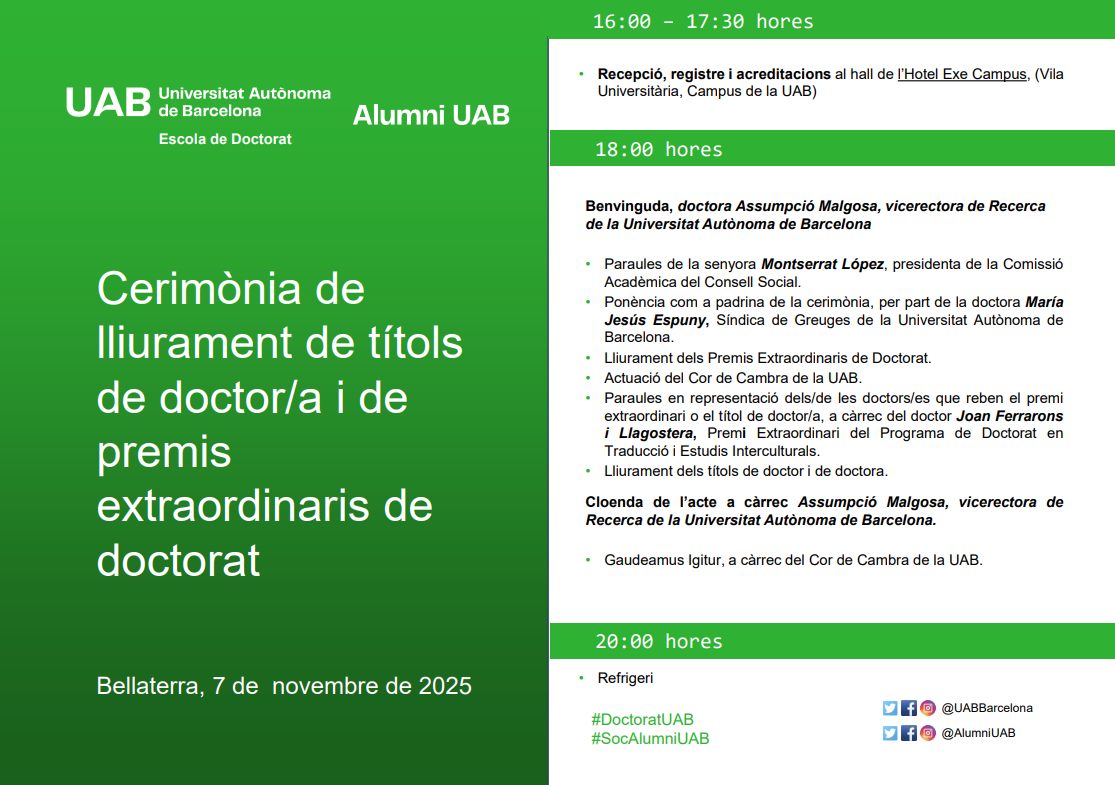
Event program | UAB
You can watch the full event here.
Read more
- Check here all the PhD Extraordinary Awards (2025)
- Five UAB PhD Extraordinary Awards go to ICMAB graduates (2022)
- PhD Extraordinary Awards go to four ICMAB Graduates (2020)
- Five ICMAB graduates in Materials Science received the PhD Extraordinary Award (2018)
- PhD Extraordinary award for three ICMAB graduates: Justo Cabrera, María de la Mata Fernández and Manuel Souto (2018)
