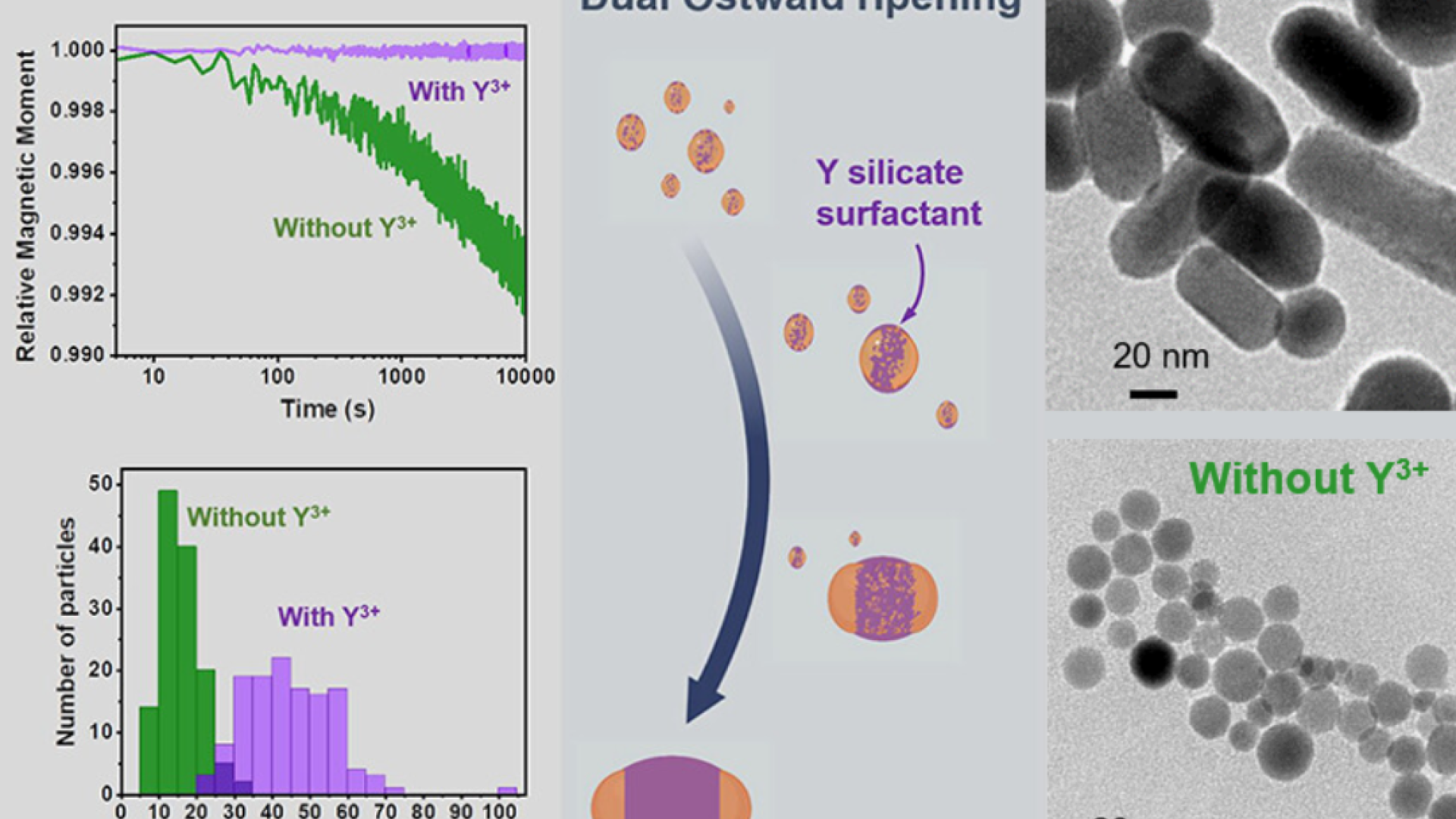
A research team from the Institute of Materials Science of Barcelona (ICMAB-CSIC) has developed a novel method to control the growth of nanocrystals under high temperatures. The study, published in the Journal of the American Chemical Society, demonstrates how rare-earth silicates can act as high-temperature surfactants, enabling the synthesis of ε-Fe₂O₃ nanorods with rare control over size and shape.
Nanocrystals often need precise shapes and sizes to perform optimally in applications such as wireless communication technologies. However, controlling their morphology is sometimes very difficult, since some materials are prepared at very high temperatures—conditions under which conventional surfactants decompose. ε-Fe₂O₃ is an iron oxide with magnetic properties that can be useful in information technologies, but it is synthesised at 1100 °C. Until now, this meant little control over size and shape, which are crucial for magnetic performance.
The researchers' novel method adds yttrium (Y³⁺) or other rare earths, such as lanthanum (La³⁺) and dysprosium (Dy³⁺), to the initial mixture of silica and iron compounds. When the material is heated to very high temperatures, these elements form an amorphous silicate layer that sticks only to certain faces of the growing iron oxide crystals. By covering some surfaces and leaving others exposed, this layer forces the crystals to grow preferentially along one direction (a process called anisotropic growth), creating bigger, rod-shaped ε-Fe₂O₃ particles, rather than the small, round particles that could be obtained so far with analogous methods compatible with scaling up.
The resulting nanorods are large enough to maintain a stable magnetisation, unlike their smaller counterparts. This discovery introduces a new method for controlling nanostructures at high temperatures. “Rare-earth silicates give us a tool to shape nanomaterials where traditional methods fail. This could transform how we design materials for extreme environments,” says Martí Gich, ICMAB researcher at the NN group and corresponding author of the paper.
Research done entirely at the ICMAB
All stages of the research were carried out at ICMAB, a sample of the institute’s strength in combining expertise under one roof.
Reference
Rare-Earth silicates as High-Temperature surfactants for the controlled synthesis of ε-Fe2O3 nanoparticles
Naureen Khanam, Zheng Ma, Sergi Ortiz Ropero, Nico Dix, Ana Vila Costa, Judit Oró-Solé, José Luis García-Muñoz, Jordi Faraudo, Martí Gich
Journal of the American Chemical Society. 2025
DOI: 10.1021/jacs.5c05058
More