What was the focus of your PhD research? Can you explain it to a non-scientific audience?
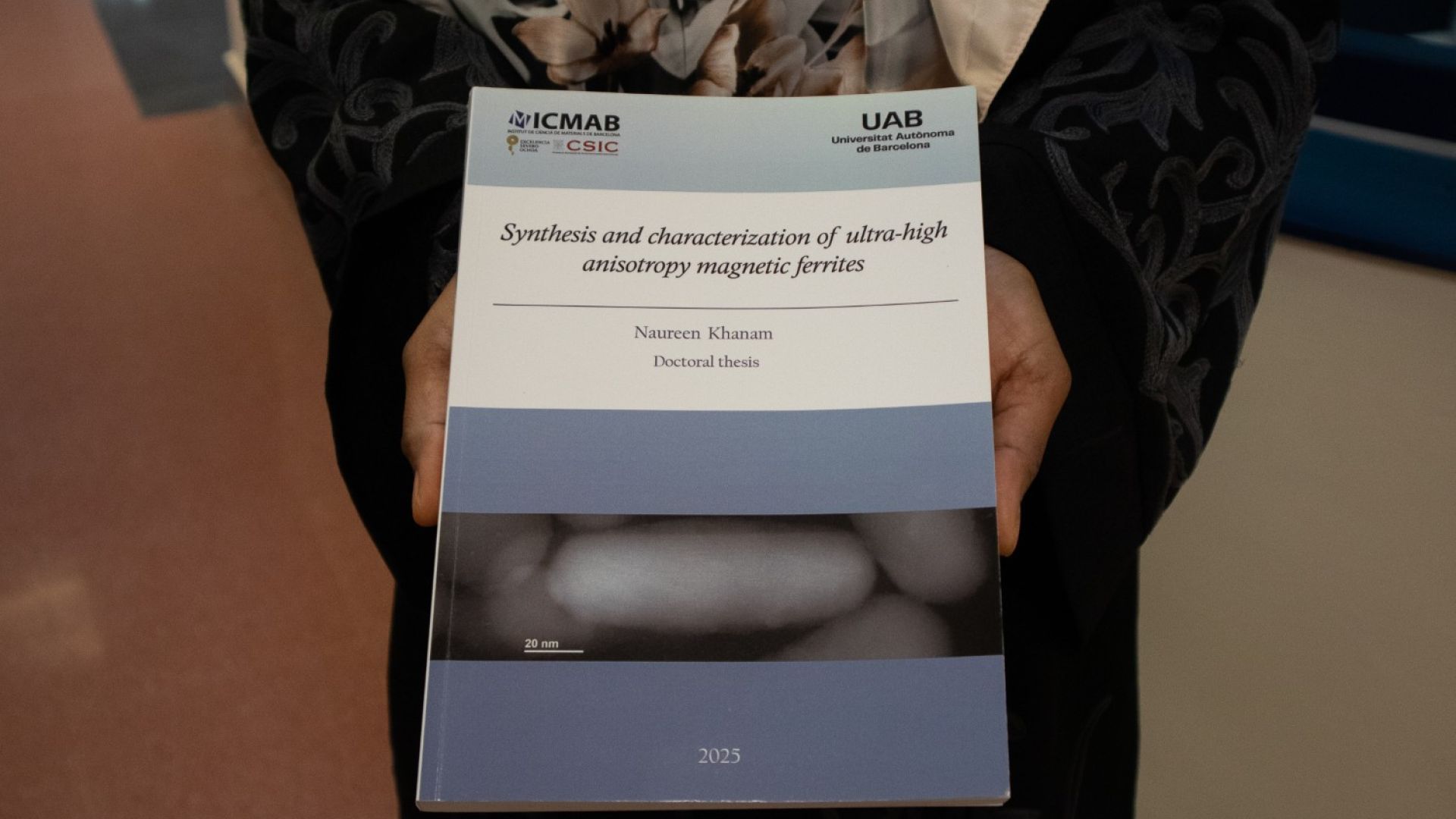
The focus of my PhD was to synthesize ferrite nanoparticles that are interesting for future information technology applications. Certain magnetic ferrite nanoparticles seem promising for the next generation of communication devices and high-density data storage systems, which are difficult to synthesize in pure form while maintaining the properties suitable for these applications. I focused on preparing these nanoparticles in pure form and performing basic characterizations to evaluate their potential for the mentioned applications throughout my PhD.
Can you briefly summarize the main findings or contributions of your research? You can give us some examples.
In my PhD research, I focused on synthesizing and characterizing ferrites with ultra-high magnetic anisotropy with a goal to prepare these ferrites for future applications and to understand the origin of the large anisotropy. A large fraction of my work was related to the synthesis of ε-Fe2O3 nanoparticles by the sol-gel method, where we tried to achieve more control over the synthesis parameters to gain control over the polymorph purity and prepare large-sized particles, which are necessary for device applications, by an up-scalable and more sustainable method. I also evaluated the effect of several transition metal ion substitutions of the Fe3+ ion in this ferrite, which gave us a deeper understanding of the underlying magnetic properties. As a complementary project, we prepared hexaferrites to understand the origin of the large anisotropy. We achieved the set goals of preparing these ferrites in pure form with a much deeper knowledge about the syntheses and magnetic properties than before.
Why do you think your research is important, and how could it impact your field or society?
The ultra-high anisotropy ferrites have gained research attention over the past decades. Despite the high potential, the syntheses of these nanoparticles are pretty difficult, and fundamental aspects have not been studied fully. My thesis contributes to a deeper understanding of these synthesis conditions that are sometimes overlooked but can have a significant impact on the functional properties. Also, this thesis contributes a step further to understanding the large anisotropy observed in these specific ferrites, unlike their polymorphs.
What was one of the most challenging aspects of your PhD journey, and how did you overcome it?
The easiest part of my PhD journey was the actual research work. The challenges that I faced were outside of work, specifically over the last two years, due to the ongoing genocide in Gaza and some personal issues. I had the most emotional breakdowns in these two years. The only thing that kept me going was my Faith or belief in God. Also, I had a very supportive supervisor who allowed me to express my concerns and views without hesitation. This helped me finish this PhD with sanity.
Why did you end up at ICMAB? And what do you think you will miss the most from this institute?
I looked for PhD positions while I was doing my master's in another European country, and I got in contact with my supervisor, seeing a PhD vacancy in his project. I checked ICMAB´s website and saw that the facilities align with what I sought. I chose Spain, specifically, for some personal preferences, and I am happy that it proved to be a good decision. So, that´s how I ended up at ICMAB. I will miss most the kind, supportive, and compassionate gestures from the people of this institute.
What’s next for you after completing your PhD? Do you have any upcoming projects or goals?
I am looking for job positions.
How has completing this PhD changed you, either professionally or personally?
I knew that doing a PhD is an uncertain journey that gives many opportunities to grow, professionally and personally. The ultimate product of a PhD is the person you become at the end of this journey. So, I focused on that always and took every opportunity to grow my skills in research work, growing emotional intelligence through working and interacting with people from different backgrounds, and personally, I grew to be more resilient and a bit more flexible.
What advice would you give to someone just starting their PhD journey?
Take it as an opportunity to GROW. Growth can have different meanings for everyone. Everyone has different strengths and weaknesses. Know your limits and try to improve one at a time, slowly but steadily.
Why did you become a scientist? Which have been your role models that inspired you to pursue a PhD?
If I were asked at the beginning of my bachelor's, I would never say I am going to be a scientist. I had an intrinsic drive to observe everything, but it was not until very late that I learned to use this capacity in a structured way. I always tried to read and learn, and somehow, going with the flow, I loved research and ended up doing a PhD.
Who or what helped you the most during your PhD journey, and is there anyone you'd like to thank?
Above everything, I thank Allah (Arabic translation of the one and only God). I am always driven by my faith, and Alhamdulillah (All praise be to Allah alone) was a journey in which I tried my best to focus on my spirituality besides doing other things. In Islam, there is a term called IHSAN. The simplest meaning of this is to strive for Excellence. I intend to achieve this in every aspect of my life and have tried to do the same in every part of this PhD journey. It was a blessed and fruitful journey, Alhamdulillah!
After that, I thank my family, who sacrificed countless moments that I could not be with them when they needed me, my friends, who kept my spirit high, and my supervisor and the group I worked with for their support.
Abstract
The rapid transition to a “Data-centric society” and the emergence of the new Internet of Things requires revolutionary changes in wireless communication and data storage systems. In this context it is crucial to develop new functional materials for devices operating above 100 GHz and high-density magnetic memories suitable for data storage applications. Research interests grew in novel rare-earth free materials that show potential for these applications and thus, ultra-hard ferrites exhibiting large-magneto-crystalline anisotropy and natural ferromagnetic resonance at frequencies above 100 GHz are very attractive. Two ferrites, ε-Fe2O3 and Sr1-(x/12)Ca(x/12)AlxFe12-xO19, exhibit such properties and have been studied in this thesis. The research has focused on the up-scalable synthesis of large size ε-Fe2O3 phase by a sustainable and economical route and in the study of its magnetic properties by transition metal substitutions of Fe3+. For the second system of interest, Sr1-(x/12)Ca(x/12)AlxFe12-xO19, we have studied the influence of the Fe3+ substitution by Al3+ using Synchrotron and neutron diffraction studies with the aim of understanding the origin of the high magnetic anisotropy in these ferrites.
Supervisors
- Martí Gich, ICMAB-CSIC, Spain
PhD Committee
- President: Jiří Tuček, University of Pardubice, Czech Republic
- Secretary: Marta Estrader Bofarull, University of Barcelona, Spain
- Vocal: Matilde Saura Múzquiz, Universidad Complutense de Madrid, Spain