


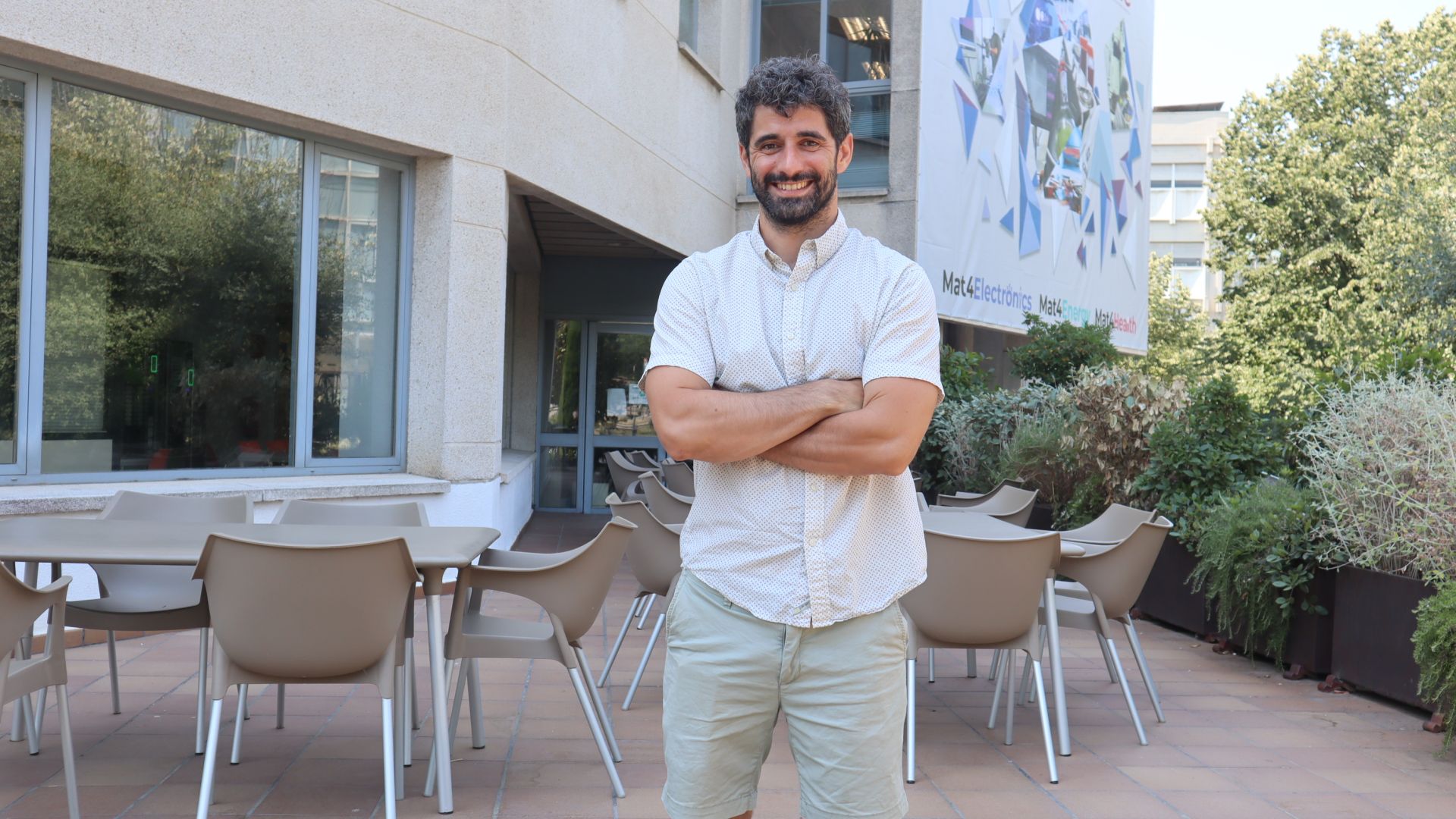
ICMAB-CSIC is launching the project "Organic photovoltaics for citizens", in collaboration with the Fundación Ciudad de la Energía (CIUDEN), a public foundation attached to the Ministry for the Ecological Transition and the Demographic Challenge, and with the support of the Spanish Foundation for Science and Technology (FECYT) under the Ministry of Science, Innovation and Universities through funding awarded through the I+P call. The project aims to study the performance of organic photovoltaic modules under real-world conditions and generate scientific evidence to help inform public policies for the energy transition. The initiative responds to the need to develop renewable technologies that can be integrated into both rural and urban environments in a sustainable, inclusive and adaptable way.
Organic photovoltaics is one of the main research lines of the NANOPTO group, where Sergi Riera-Galindo, the project's principal investigator, carries out his research. The group studies photovoltaic devices based on organic compounds that convert sunlight into electricity, unlike conventional solar panels, which are based on silicon. These devices offer unique properties, such as flexibility, partial transparency and low weight, opening the door to new applications in buildings, urban furniture and other spaces where conventional solar panels are difficult to integrate.
After years of research focused on the synthesis and characterisation of these materials in the laboratory, this project will make it possible to move towards studying their potential applications. The project will run for two years and will combine scientific, technical, environmental and sociological studies.
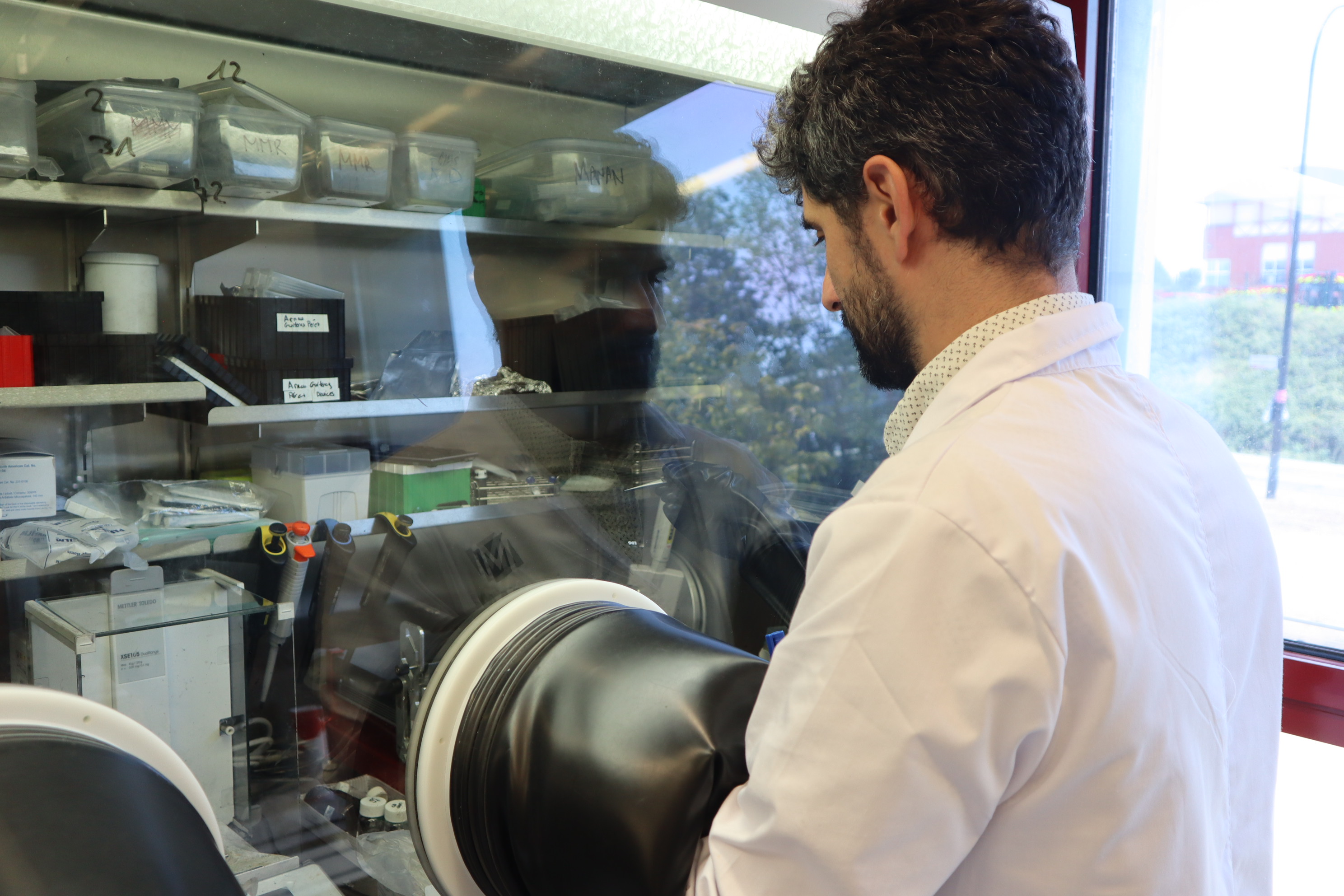
Sergi Riera-Galindo working inside a glovebox with an organic photovoltaic sample fabricated at ICMAB-CSIC. In the background, the blade coating system used to fabricate the active layers of the experimental devices
In a first stage, the samples will be designed and fabricated at ICMAB-CSIC. The organic photovoltaic modules will then be installed in Cubillos del Sil (León, Spain). The collaboration with CIUDEN will facilitate contact with energy communities from across Spain, which will be key to bringing the research closer to the future users of the technology and understanding the real needs of different territories. At the same time, the CIUDEN team, which includes a sociologist specialising in this field, will lead the study on the social perception of this technology.
Once the panels have been installed, stability studies will be carried out to analyse the impact of different lighting conditions depending on the weather, the time of day and the different angles of solar incidence.
"We will fabricate a wide range of different samples that we will be able to test under real-world conditions, exposed to sunlight and to the environmental variations that cannot be reproduced in the laboratory," explains Sergi Riera-Galindo, principal investigator of the project. "Studying how these devices behave during operation requires large amounts of data and long observation periods, and this project will allow us to make progress in that direction."
Finally, the project will include a post-mortem analysis of the degraded devices. The aim will be to understand how and why they degrade under real operating conditions, identifying the mechanisms responsible for the loss of performance. This knowledge will be key to designing future generations of more stable devices. In parallel, a life cycle assessment will also be carried out to study the environmental impact of the materials and their recycling options.
A complementary alternative to silicon
The NANOPTO group works on the development of organic photovoltaics, a technology that complements silicon-based photovoltaics. Although these devices are still not widely available on the market, they offer several advantages over conventional solar panels. First, they are flexible and can be manufactured in different colours and degrees of transparency. They also perform well under diffuse light, such as on cloudy days, in urban environments and indoors.
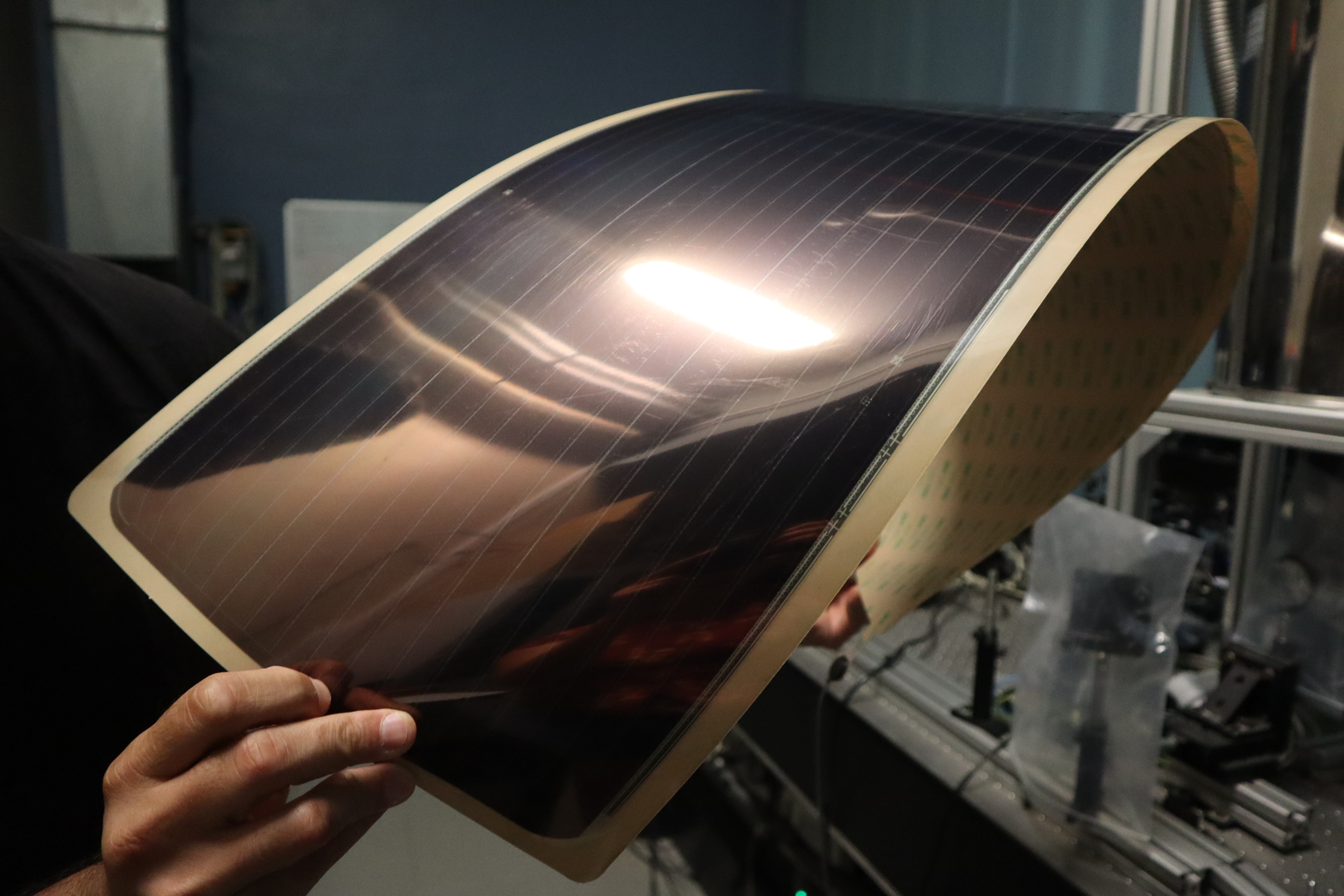
One of the organic photovoltaic layers to test
Urban integration is one of the applications with the greatest potential for organic photovoltaics. Their properties make it possible to integrate them into façades, windows and urban furniture, opening the door to a form of energy generation that is better integrated into the built environment. With this goal in mind, the NANOPTO group is investigating how to adapt this technology to real applications and overcome the limitations that still make its implementation difficult.
"Organic photovoltaics allow us to imagine surfaces that, besides fulfilling their usual function, can also generate electricity. The challenge now is to demonstrate that these applications are technically, economically and viable from a regulatory point of view," says Riera-Galindo. Along these lines, the NANOPTO group has taken part in the Terra project, where it is studying the integration of organic photovoltaics into urban furniture to demonstrate the potential of this technology under real-world conditions.
Beyond urban integration, the group is also investigating other applications where organic photovoltaics may offer advantages over conventional technologies. One of the most promising is indoor energy generation, where these devices can be designed to make very efficient use of the spectrum of artificial lighting.
Applications in agrivoltaics are also being studied. In this field, the semitransparency of the devices and the possibility of tuning their spectral response make it possible to combine electricity generation with crop growth. Finally, the group is exploring space applications, where the low weight, flexibility and resistance of organic photovoltaic cells to proton irradiation could make it possible to transport large rolled-up surfaces and deploy them once in orbit.
Bringing research closer to public policy
This project builds on Sergi Riera-Galindo's work in the field of scientific advice for public policy. He has taken part in initiatives such as the pairing programme run by the Office of Science and Technology of the Spanish Congress of Deputies, which brings together researchers and Members of Parliament, and in the drafting of one of the reports published by the same office, “Materiales y materias primas críticas en la transición energética” (Critical materials and raw materials in the energy transition), together with more than twenty experts. He also contributed to one of the reports promoted by the National Office of Scientific Advice (ONAC), which brings together proposals from the scientific community to help inform decision-making, through scientific evidence, within the framework of the State Pact on the Climate Emergency.
"All these initiatives help us understand how scientific evidence is translated into public policy, and what kinds of advice and research are useful for decision-makers," concludes Riera-Galindo. "In recent years, there have been more and more initiatives of this kind, but it will take time to see whether these proposals are effectively implemented."
You can download the press release in Catalan, Spanish and English.
Related references
Fundación Ciudad de la Energía – CIUDEN
Podcast on the Pairing Scheme programme of the C Office of the Spanish Congress of Deputies
TERRA: New project on organic photovoltaics on Barcelona's bus stops
