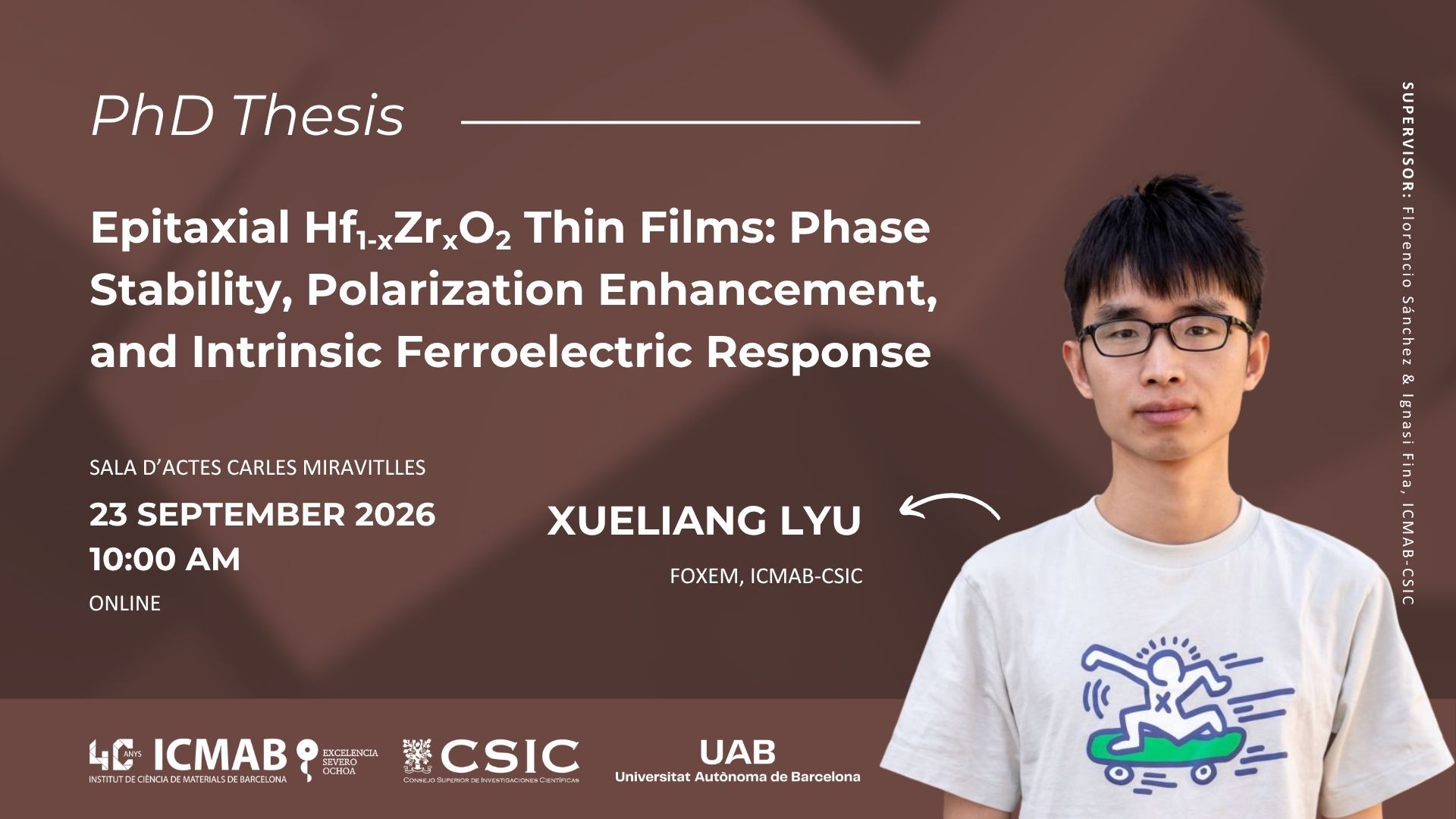
Epitaxial Hf1-xZrxO2 Thin Films: Phase Stability, Polarization Enhancement, and Intrinsic Ferroelectric Response
PhD Candidate: Xueliang Lyu
Date: Wednesday, 23 September 2026
Time: 10.00 AM
Venue: Sala d'Actes Carles Miravitlles & ONLINE (Register here)
Abstract
Ferroelectric HfO₂ is a leading candidate for CMOS-compatible non-volatile memory, yet the mechanisms governing its phase stability, polarization enhancement, and the distinction between intrinsic and extrinsic contributions remain unresolved. This thesis addresses these questions using high-quality epitaxial Hf₁₋ₓZrₓO₂ thin films grown by pulsed laser deposition on SrTiO₃ substrates with La₀.₆₇Sr₀.₃₃MnO₃ electrodes. First, the orthorhombic ferroelectric phase, once formed during growth, is shown to be structurally robust and largely insensitive to post-growth cooling atmosphere, unlike in polycrystalline films. Second, systematic control of substrate orientation, redox conditions, and thickness reveals that interface symmetry and reduced oxidation—rather than strain—govern polarization, which peaks at 6–10 nm and exceeds 30 μC/cm². Third, across the full Hf₁₋ₓZrₓO₂ composition range, anomalously high polarization in Zr-rich and ZrO₂ films is identified, through combined electrical and piezoresponse measurements, as an extrinsic resistive-switching artifact rather than genuine ferroelectricity, establishing criteria for its reliable evaluation.
Supervisors
- Florencio Sánchez, ICMAB-CSIC, Spain
- Ignasi Fina, ICMAB-CSIC, Spain
PhD Committee
-
President: César Magén, INMA, Spain
-
Secretary: Mireia Bargallo, IMB-CNM, Spain
-
Vocal: Rubén Alcalá, NaMLab gGmbH, Germany
University: Universitat Autònoma de Barcelona (UAB)
PhD Programme: Materials Science