


A new paper has been published in the journal Advanced Energy Materials:
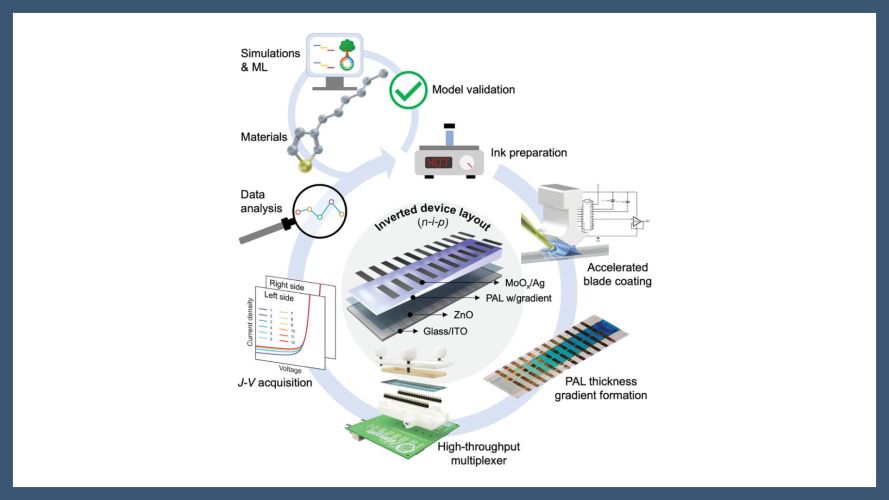
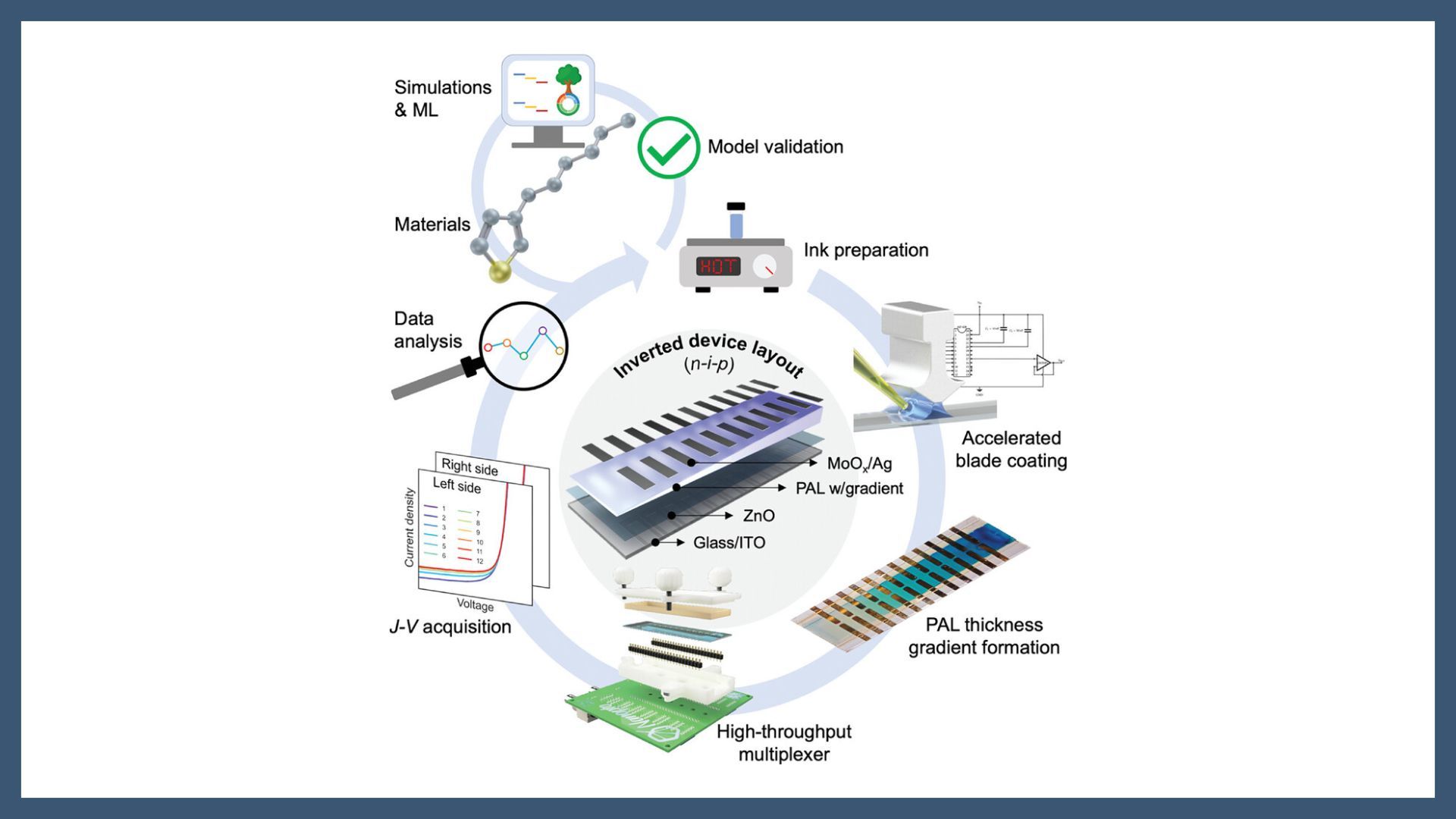
Relatively thick-film organic photovoltaics (OPVs) are desirable to spark commercialization through mass-printing methods. Thickness-resilient donor:acceptor blends are, however, scarce and not fully understood. The interplay between electronic, optical, and microstructural properties of the photoactive layer (PAL) generates a multi-parametric space where rationalization is far from trivial. In this work, high-throughput experimentation, simulations, and machine learning (ML) methods are leveraged to provide material and device insights toward thickness-resilient OPVs. From a database of 720 inverted devices and 20 different donor:acceptor blends, two main blend families are identified in terms of their resilience against increased PAL thickness (>200 nm). These are archetypically represented by PBDB-T:ITIC (thickness-sensitive) and PTQ10:Y6 (thickness-resilient). Kinetic Monte Carlo (kMC) simulations elucidate that the blend morphology alone, either in the form of an effective medium or energy cascade, can explain the experimental short-circuit current density and open-circuit voltage trends without tweaking the recombination parameters (cf. drift-diffusion, DD). High fill factors (FFs) in thick-film devices cannot, however, be reproduced by the kMC or DD simulations. ML models show that complementary absorbing donors and acceptors (shifted absorption onsets) mixed in balanced weight ratios provide a favorable hole back-transfer efficiency to increase the FF in thick-film devices.
M4NRG Clean Energy
What Makes Thickness-Tolerant Organic Solar Cells?
Rodriguez-Martinez, Xabier; Tormann, Constantin; Sanz-Lleo, Marta; Doerling, Bernhard; Gibert-Roca, Marti; Harillo-Banos, Albert; Torimtubun, Alfonsina Abat Amelenan; Pascual-San-Jose, Enrique; Jurado, Jose P.; Lopez-Mir, Laura; Kemerink, Martijn; Campoy-Quiles, Mariano
DOI: 10.1002/aenm.202405735

