



A new study led by ICMAB researchers Riccardo Rurali and Lourdes Fàbrega with the participation of Martí Raya-Moreno (postdoctoral researcher at ICMAB) and in collaboration with Bradley Kavanagh (IFCA-Institute of Physics of Cantabria, CSIC-University of Cantabria), introduces a novel theoretical analysis of phonon dynamics in the quest to detect dark matter particles. Their work, supported by the Severo Ochoa ICMAB Frontier Interdisciplinary Project (FIP) PD4DM: Phonon dynamics as ruling factor for detecting ultralight dark matter with quantum sensors (2021 call), was recently published in Physical Review D.
Phonon-based detection: A new frontier
The research highlights a novel approach to detect sub-GeV dark matter particles (with masses below 1 giga-electronvolt), a promising direction after decades of unsuccessful searches for heavier dark matter particles. The detection scheme involves phonon excitation within a semiconductor target caused by a dark matter particle. These phonons—a type of lattice vibration—are transmitted to a superconductor sensor operating at extremely low temperatures, enabling detection.
By leveraging state-of-the-art fully quantum simulations, the study demonstrates the feasibility of this detection mechanism and provides essential design rules for future experiments.
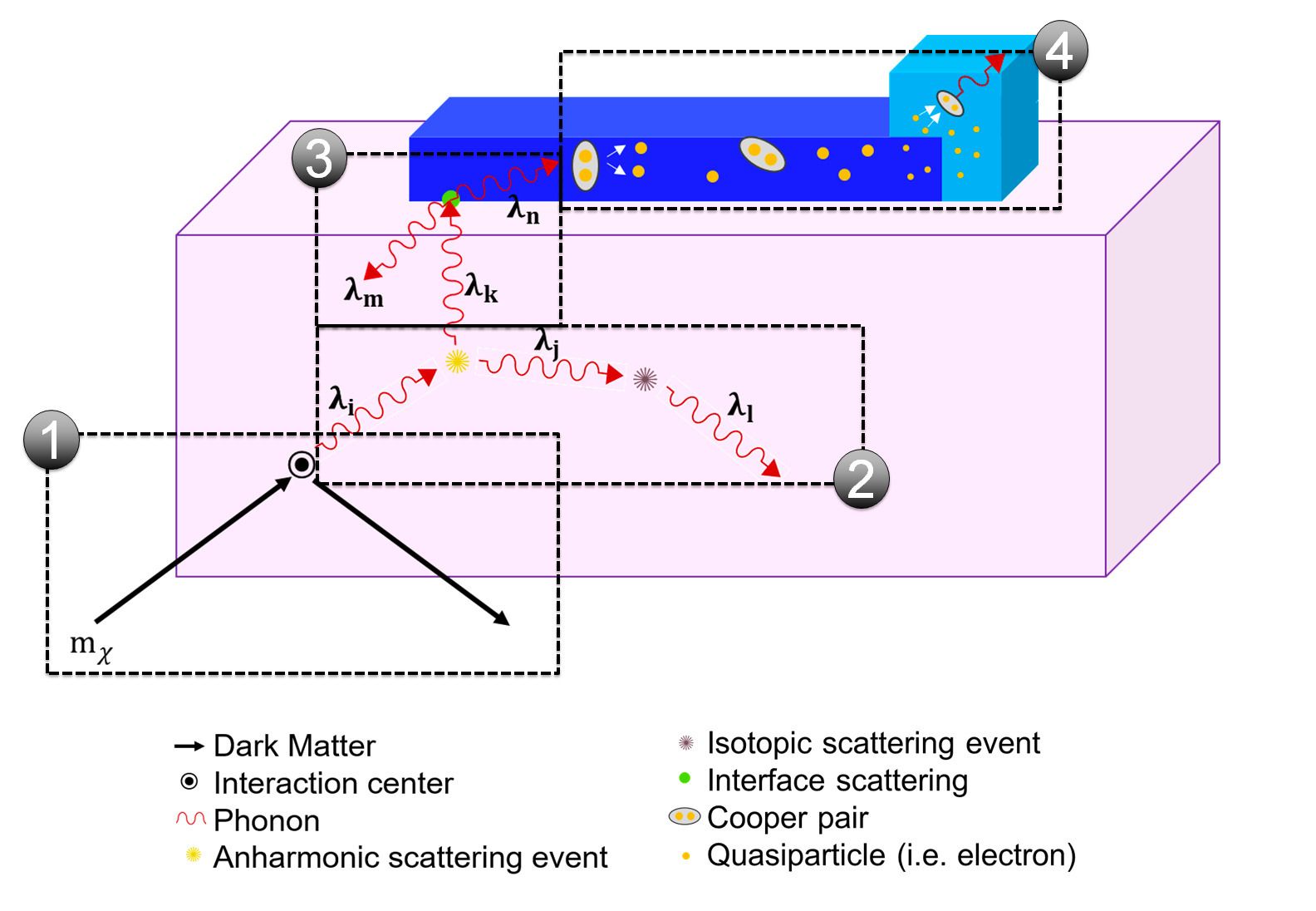
Scheme of a phonon-based dark matter detector: A dark matter particle generates phonons in the semiconductor target, which travel to the backsurface and are transmitted to a superconducting thin film. Detection occurs via a Transition-Edge Sensor (TES).
Interdisciplinary collaboration
“This is a highly interdisciplinary work,” explains Lourdes Fàbrega. “Not only because of the collaboration between ICMAB researchers Riccardo Rurali and myself from different research groups, but also because a cosmologist expert in dark matter was involved in the project.
Why does this matter?
Dark matter remains one of the most elusive challenges in modern astrophysics. Although its existence is strongly supported by indirect evidence, such as galaxy rotation curves and cosmic microwave background fluctuations, it has yet to be detected directly.
“This study marks the first analysis of phonon dynamics for dark matter detection using state-of-the-art quantum simulations,” affirms Riccardo Rurali. By addressing key questions about the energy transmission and sensor performance, it paves the way for future experimental developments in cryogenic detectors.
Implications for the field
If dark matter particles possess sub-GeV masses looks promising. The results are expected to stimulate a significant experimental push in developing cryogenic thermal detectors capable of single phonon detection.
This study exemplifies the strength of interdisciplinary research and its potential to tackle some of the most pressing questions in modern science.
Publication and reference
The work, titled “Phonon dynamics for light dark matter detection,” was authored by Martí Raya-Moreno, Bradley J. Kavanagh, Lourdes Fàbrega, and Riccardo Rurali. It is published in Physical Review D (Vol. 110, Article 112007, 2024).
Link to the article: doi.org/10.1103/PhysRevD.110.112007