


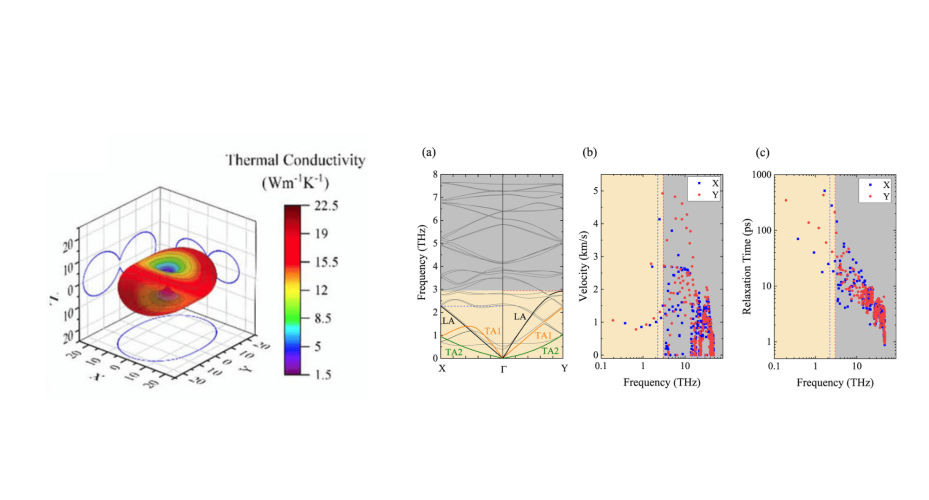
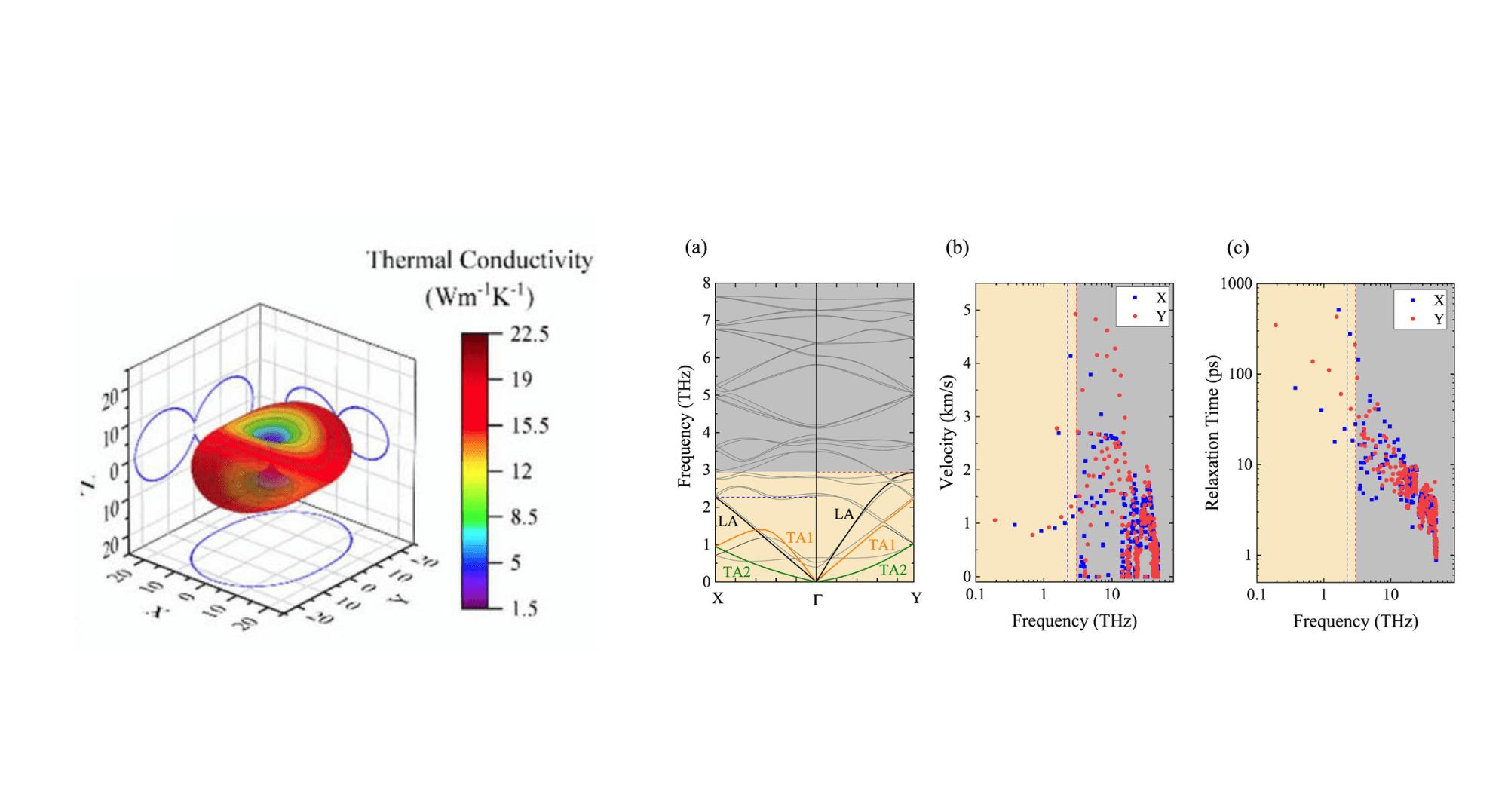
Two-dimensional (2D) materials featuring anisotropic structural, vibrational, and thermal properties offer new and exciting opportunities to enable efficient energy conversion and thermal management. Beyond the most apparent anisotropy in 2D materials, due to distinct in-plane and out-of-plane (intralayer and interlayer) thermal transport, certain systems also present in-plane thermal anisotropy, whose origin may be more subtle. Here, we report on the vibrational and thermal properties of PdSe2 crystals, obtaining the complete (diagonal) elements of the thermal conductivity tensor (κij), and their low-frequency (GHz, Brillouin) and high-frequency (THz, Raman) lattice vibrations. Remarkably, we observe substantial anisotropy for the in-plane directions with ηyxexp = κy/κx = 1.38. By performing ab initio calculations of the vibrational modes, we demonstrate that this anisotropy arises from the strong lattice anharmonicity. This is reflected by the enhanced coupling between acoustic and low-energy optical branches along the [100] crystallographic direction (x-axis), where vibrational anharmonicity is larger than in the [010] direction (y-axis).
Hits: 1446
M4NRG Clean Energy
Unravelling the origin of thermal anisotropy in PdSe2
Kai Xu, Luis Martínez Armesto, Josef Světlík, Juan F. Sierra, Vera Marinova, Dimitre Dimitrov, Alejandro R Goñi, Adam Krysztofik, Bartlomiej Graczykowski, Riccardo Rurali, Sergio O. Valenzuela* and Juan Sebastián Reparaz*.
2D Materials, 11, 045006

