


Press
Tuning spin lifetimes in graphene-based heterostructures through material anisotropy
Researchers from ICN2 and ICMAB-CSIC, in collaboration with the Institute of Optical Materials and Technologies (Bulgarian Academy of Science), have demonstrated a tenfold modulation of spin lifetimes in graphene/PdSe₂ heterostructures. Their study, published in Nature Materials, highlights how the anisotropic properties of PdSe₂ enable precise control over spin transport. This breakthrough paves the way for more efficient spin-based memory, logic devices, and quantum technologies.
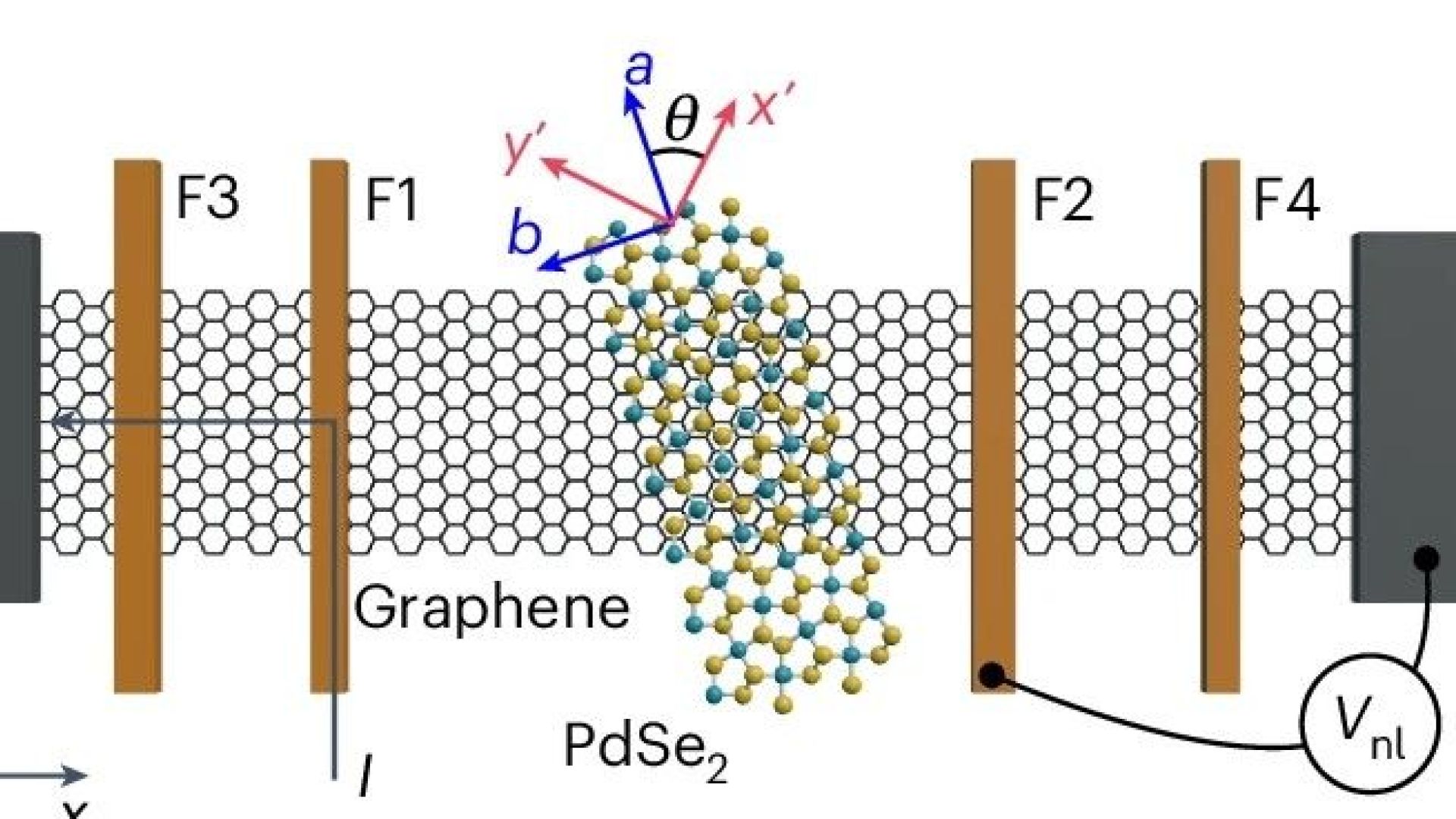
A recent study published in Nature Materials presents a major advancement in spintronics: a tenfold modulation of spin lifetimes at room temperature in graphene/PdSe₂ heterostructures. This discovery, achieved by researchers from the Catalan Institute of Nanoscience and Nanotechnology (ICN2) and the Institute of Materials Science of Barcelona (ICMAB-CSIC), in collaboration with researchers from the Institue of Optical Materials and Technologies (Bulgarian Academy of Science), opens new possibilities for controlling spin transport, a key aspect of developing efficient spin-based memory and logic devices for next-generation electronics and quantum technologies.
Spintronics exploits the spin of electrons to store and process information, offering faster and more energy-efficient alternatives to conventional electronics. One of the main challenges has been achieving precise control over spin lifetimes—the duration for which spin information is retained. Now, this study, led by researchers at ICN2, shows that by integrating graphene with the layered material PdSe₂, it is possible to dynamically tune spin lifetimes based on spin orientation, a crucial step toward practical spintronic applications.
The key to this discovery lies in the unique anisotropic properties of PdSe₂. Unlike hexagonal transition metal dichalcogenides, which maintain isotropic in-plane spin lifetimes due to their threefold symmetry, PdSe₂ introduces an in-plane anisotropic spin texture in graphene. This leads to a directional dependence of spin lifetimes and enables their modulation by an order of magnitude. Such control could be instrumental in designing ultra-fast, low-power spin logic devices and stable spin-based quantum computing architectures.
ICMAB researchers Kai Xu and Sebastián Reparaz (from the Nanostructured Materials for Optoelectronics and Energy Harvesting (NANOPTO) group) contributed to the study by analyzing the crystallographic orientations of the material in relation to the magnetic field. Using angular-resolved polarized Raman spectroscopy, they identified the structural characteristics responsible for the observed spin anisotropy. This research also builds on a previous study led by Reparaz, published in 2D Materials, which investigated the in-plane thermal anisotropy of PdSe₂. The same anisotropic properties that influence its thermal behavior also impact its electrical properties, ultimately shaping the spintronic behavior observed in graphene.
By demonstrating how material anisotropy can be harnessed to control spin dynamics, this study paves the way for new strategies in the design of spintronic and quantum materials.
Reference Articles
Read the full article in Nature Materials.
Room-temperature anisotropic in-plane spin dynamics in graphene induced by PdSe₂ proximity
Juan F. Sierra, Josef Světlík, Williams Savero Torres, Lorenzo Camosi, Franz Herling, Thomas Guillet, Kai Xu, Juan Sebastián Reparaz, Vera Marinova, Dimitre Dimitrov, Sergio O. Valenzuela
Nature Materials (2025)
DOI: 10.1038/s41563-024-02109-2
The previous study on PdSe₂ thermal anisotropy is available in 2D Materials.
Unravelling the origin of thermal anisotropy in PdSe₂
Kai Xu, Luis Martínez Armesto, Josef Světlík, Juan F. Sierra, Vera Marinova, Dimitre Dimitrov, Alejandro R. Goñi, Adam Krysztofik, Bartlomiej Graczykowski, Riccardo Rurali, Sergio O. Valenzuela, Juan Sebastián Reparaz
Journal: 2D Materials, Volume 11, Number 4 (2024), Article 045006
DOI: 10.1088/2053-1583/ad64e3
Read here the related news post at ICN2 web: Graphene Spintronics Gets a Boost in a Novel 2D Material Combination
Figure Caption: Device schematic: monolayer graphene spin channel with four ferromagnetic contacts along y^ (F1–F4, dark orange) and two normal metal contacts (grey). The non-local device defined by F1 and F2 probes the proximity effect generated by PdSe2 on graphene. A current I (black arrow) through F1 injects spins into graphene parallel to the F1 magnetization. The spins precess under an external magnetic field and diffuse to detector F2. Two reference devices (F1–F3 and F2–F4) characterize pristine graphene. The blue arrows indicate PdSe2 crystalline axes a and b; the red arrows denote in-plane spin directions x^′ and y^′ for the longest and shortest spin lifetimes, respectively. Angle θ characterizes the rotation between x^′ and a. [Adapted from Figure 1, DOI: 10.1038/s41563-024-02109-2, Nature Materials]