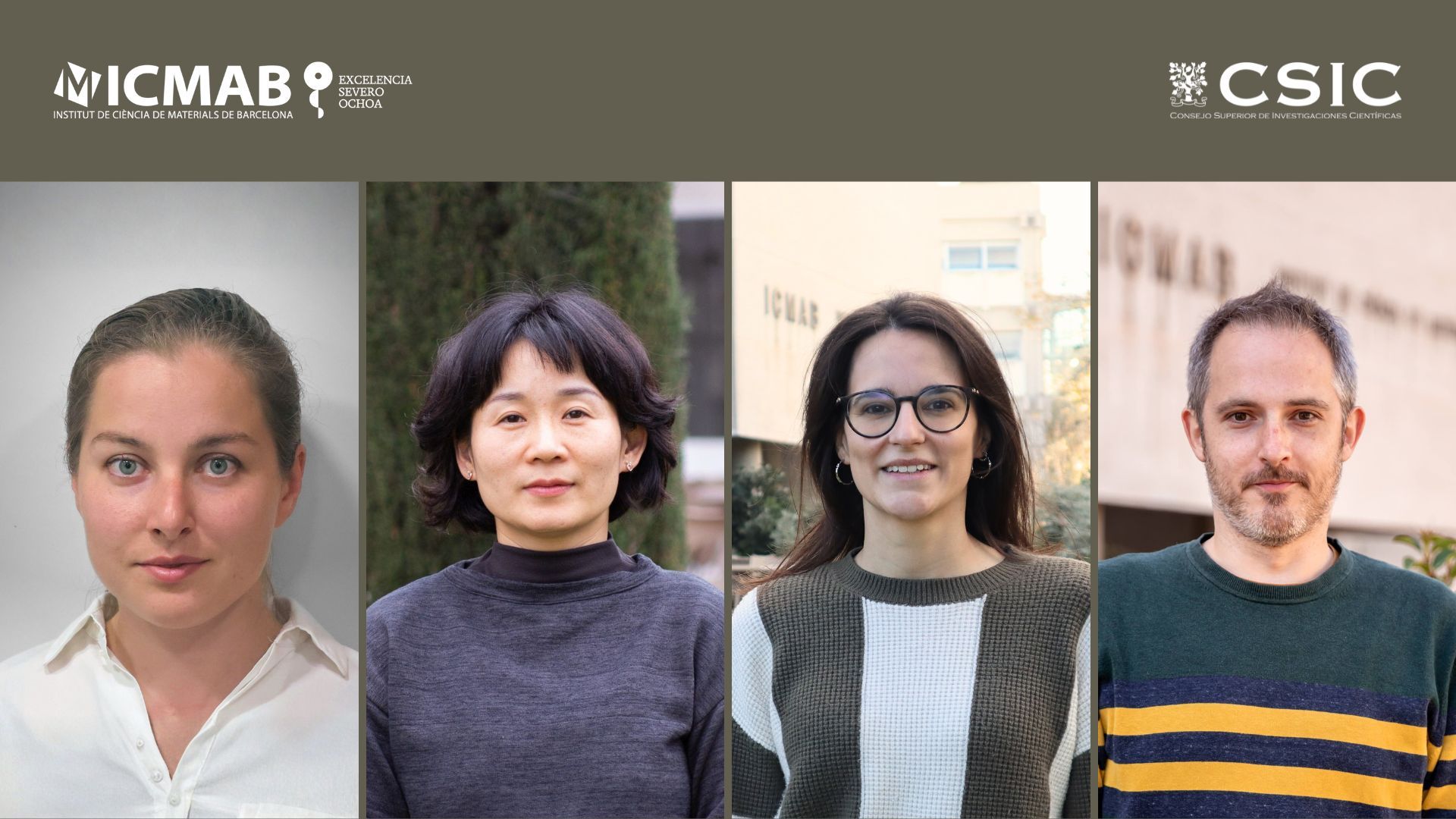
The three new Ramón y Cajal at ICMAB
Muling Zeng, NN research group
Muling Zeng will stay at the Nanoparticles and Nanocomposites Group (NN Group) at ICMAB-CSIC, with researcher Anna Roig. Her research is titled "Multicatalytic Nanozymes for the Treatment of Fatty Liver Disease and Liver Cancer: An Integrated, Versatile Single-Treatment Approach (LiverZymes)".
As an independent researcher with nearly 10 years of experience, Zeng has built a dynamic and diverse career across Spain, the UK, and China, expanding interdisciplinary research in chemistry, materials science, biomedicine, and nanotechnology. During her PhD at ICMAB-CSIC in Spain, funded by a competitive China Scholarship Council (CSC) fellowship, she established a new research line on bacterial cellulose, leading to three publications and earning her cum laude degree in just three years. As a postdoctoral researcher at Leeds University in the UK, she contributed to high-impact projects, including the EU and EPSRC Platform Grant, resulting in five publications in PNAS, Small, and others, managing international collaborations, and leading a synchrotron beam time project. Later, she was recruited by a local government high-talent program for a PI position in China, where she co-led the
Applied Nano-biomaterials Group. There, Zeng established a laboratory from scratch, secured 6 projects as PI worth over 3 million RMB, authored 26 publications, handled administrative duties, taught 6 courses, organized one international conference, and developed sustainable materials, including reusable antimicrobial healthcare products, which led to the founding of a spin-off company. In October 2024, she rejoined the NN group.
"I would like to thank the Ramón y Cajal program for this fellowship. It is a great honor to receive it, and it is a transformative opportunity for my career, providing the independence and stability to pursue my research. On a personal level, this achievement is a moment of immense pride and gratitude—for my mentors, my family, and for my own perseverance through the challenges of this path. I am grateful and excited for the journey ahead", says Muling Zeng.
Judit Morlà, Nanomol-Bio research group
Judit Morlà will join the Nanomol-Bio group working with Mariana Köber and her team. She will primarily work on a project aimed at enhancing cancer immunotherapy using nanoparticle-based photodynamic therapy.
Her research has focused on developing nanomaterials for biomedical applications. During her PhD (URV–Medcom Advance, Spain), she created ultrasensitive SERS-based cancer diagnostic tools, enabling direct quantification of epigenetic DNA modifications and detection of K-Ras mutations. After a research stay at Nanyang Technological University (Singapore), she worked as Innovation Manager at Beauty Cluster Barcelona, strengthening her ability to build academia–industry collaborations. In 2018, she joined Prof. Kevin Belfield’s group (NJIT, USA) and later the Nanomol-Bio Group (ICMAB-CSIC) through a Marie Curie Tecniospring+ fellowship, developing ultrabright quatsome nanoprobes for bioimaging and photodynamic therapy, resulting in compelling scientific contributions and a patent.
In 2021, she joined the Nanomedicine Lab at Mount Sinai Hospital (New York City), leading nanoparticle-based PDT development, establishing the institute’s first Laser Lab, contributing to non-human primate translational studies, and co-teaching a graduate nanomedicine course. After taking maternity leave, she returned to ICMAB-CSIC in 2024, under the EU Nano4Rare project at the Nanomol-Bio Group, where she helped advance the nanomedicine called nanoGLA toward its first-in-human trials.
She describes herself as being passionate about science outreach, having delivered multiple public talks, organized Researcher’s Night workshops, and participated in FameLab contest as science monologuist.
About the Ramón y Cajal grant she said: "I’m truly excited to open this new scientific chapter. After years of hard work, strengthened by meaningful collaborations and the support of those who care about me, it’s inspiring to begin this promising new adventure."
Ekaterina Khestanova, NN research group
Ekaterina Khestanova will work in the NN group at ICMAB-CSIC, with researcher Martí Gich. Her research will focus on cryogenic THz spectroscopy of quantum materials.
She obtained her PhD from the University of Manchester in 2017, where she worked on superconductivity in 2D materials. Then she moved to St. Petersburg to work on exciton-polaritons in 2D semiconductors. It was a bit of a bold move, because during her PhD she mostly did electron transport, but during her postdoc it was pure optics.
After that, she moved to ICFO to work on a project which merged optics and superconductivity – THz SNOM of superconducting materials. It turned out to be a great challenge due to the complexity of the equipment, but again, plenty of learning opportunities, which she loves!
"This is an exceptional opportunity designed to help early-stage researchers consolidate their scientific careers. After careful consideration, I selected ICMAB as my host institution, drawn by its long-standing track record of high-impact research, its flexible and collaborative environment, and its genuinely welcoming atmosphere." says Khestanova about the Ramón y Cajal grant.
Daniel Martín to join our neighbors at ICN2
Daniel Martín, researcher at ICMAB-CSIC at the SURFACES group, obtained as well a Ramón y Cajal grant. His host institution will be ICN2, where he will begin this new stage next year with great enthusiasm.
Practically speaking, his work will unfold on the UAB campus (Universitat Autònoma de Barcelona), within a shared ecosystem that includes ICMAB-CSIC, ICN2, and the ALBA synchrotron (CELLS–ALBA). His main activity, though, will take place at ALBA, specifically in the SM02–03 laboratory, which hosts two multipurpose AFM systems for which he is currently responsible. This facility was inaugurated on 24 November 2025, just before the AMatS conference.
From the joint commitment of ICMAB-CSIC, ICN2, and ALBA emerged the collaborative InCAEM project, a clear example of how coordinated efforts between institutions can strengthen and expand scientific capabilities. He now finds himself in an intermediate position, acting as a link between these three major centres. This role carries significant responsibility, but it also offers the unique opportunity to observe and understand scientific progress from three complementary perspectives, all aligned toward a common goal: conducting excellent science.
About getting this Ramón y Cajal grant, he said: "Receiving the Ramón y Cajal 2024 fellowship (RyC24) marks a decisive step toward consolidating my research career and establishing an independent research line. My project focuses on the development of advanced AFM (Atomic Force Microscopy) techniques and on the correlative characterization of samples comprising materials for energy applications, combining AFM measurements with synchrotron radiation and high-resolution electron microscopy."
Ramón y Cajal 2025 call is now open
The Ministry of Science has opened the 2025 Ramón y Cajal call, offering 494 positions, of which 10% are reserved for people with disabilities and 7 for OPIS.
The contracts are full-time and aimed at PhD researchers, Spanish or international, most of whom must have completed at least 24 months of postdoctoral experience. The salary is €36,720 gross per year in the first phase and €43,400 in the second.
Applications are open until 11 December 2025 at 14:00 CET.
More information and application details are available here.
Read more
ICMAB - Congratulations to all the new Ramón y Cajals researchers at ICMAB
ICMAB - Gabriele De Luca, new Ramón y Cajal researcher at ICMAB in complex oxides
ICMAB - Pablo Guardia and Raphael Pfattner awarded with a Ramón y Cajal grant #RyC
ICMAB - Judith Guasch, Arántzazu González and Ignasi Fina awarded with a Ramón y Cajal grant #RYC