


A paper has been published in the journal Acta Crystallographica Section A: Foundations and Advances:
This paper is dedicated to the memory of Professor Carles Miravitlles.
The general equation of δ direct methods
Here, the general equation〖 δ_M (r)=ρ(r)+g(r) of δ direct methods (DM) is derived and solved in its various forms . The simplest is
ρ(r)=δ_M (r)-g(r) (1)
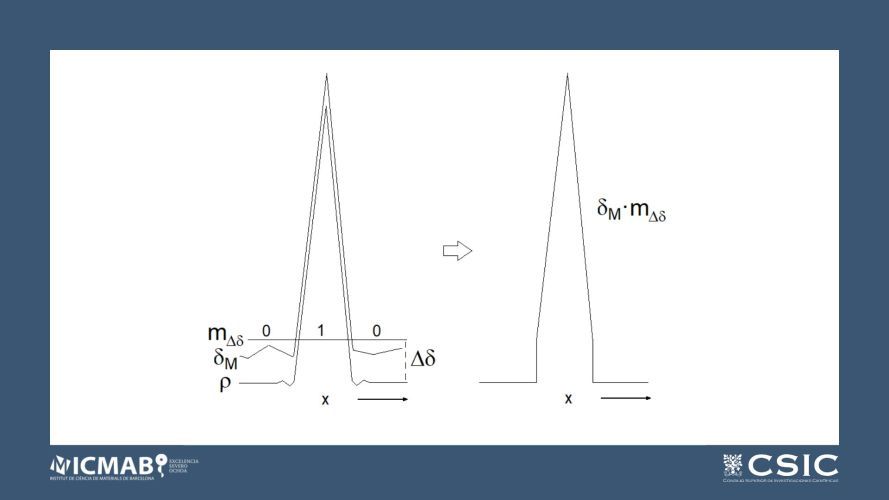
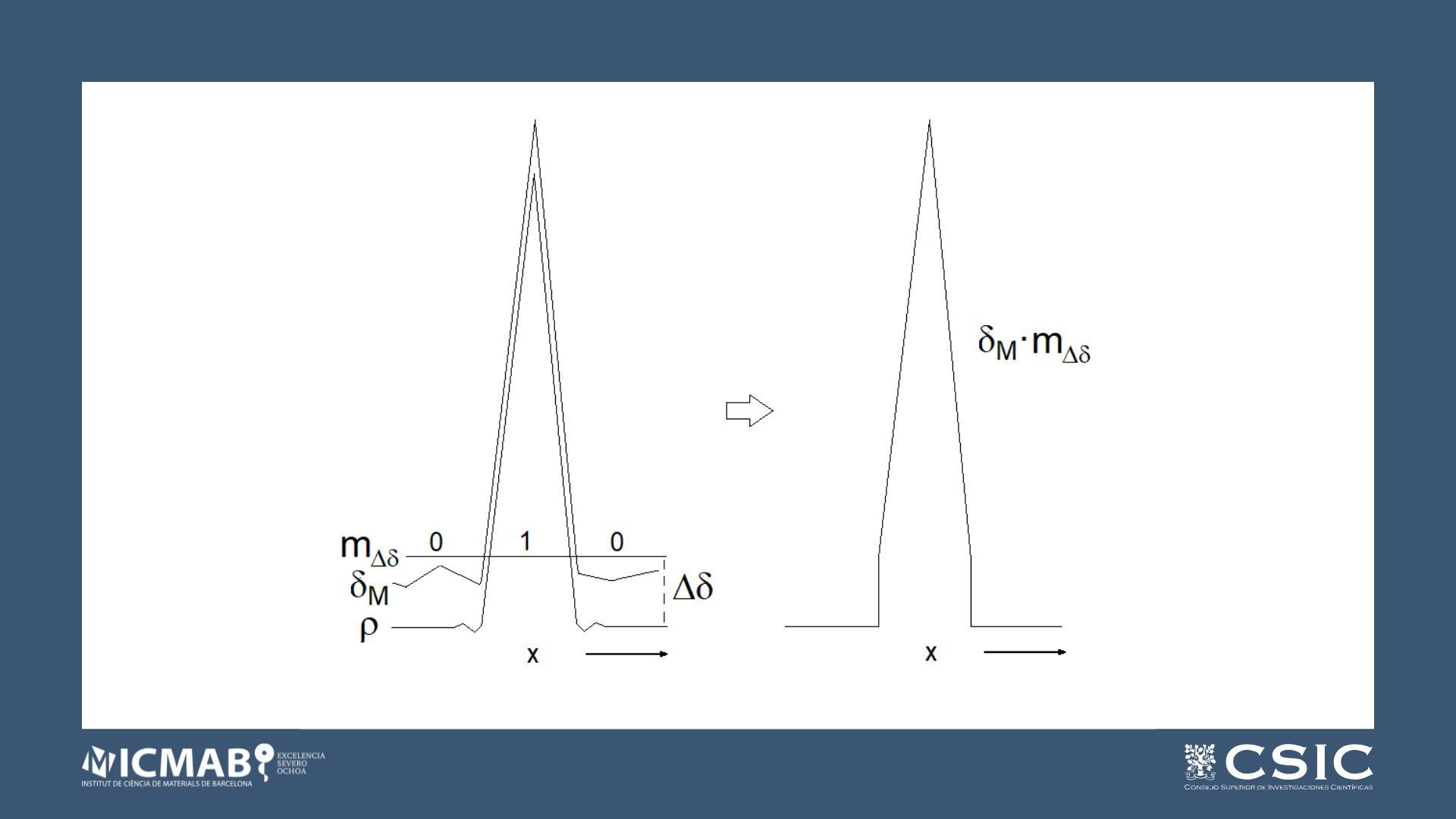
where ρ and δ_M are modified electron density functions and g is a small positive background. As the figure shows, by introducing the binary mask〖 m_∆δ, (1) can be expressed as ρ=K〖 δ〗_M 〖 m〗_∆δ, so that the new structure factor expression
E=K·FT{δ_M·〖 m〗_∆δ } (2)
is obtained by Fourier transform. DM for structure determination based on (2) are less prone to false uranium-atom solutions than traditional DM based on the Sayre equation (1952) and therefore more successful.
Figure Caption
(left) Atomic position of an 1D unit cell with schematic representation of the associated δ_M (x), ρ(x) and the binary mask〖 m〗_∆δ (x):
〖 m〗_∆δ (x) = 1 if 〖 δ〗_M (x)>∆δ
= 0 otherwise
(right) product function〖 δ〗_M (x) m_∆δ (x) which is proportional to ρ(x)
Abstract
The general equation δM(r) = ρ(r) + g(r) of the δ direct methods (δ-GEQ) is established which, when expressed in the form δM(r) − ρ(r) = g(r), is used in the SMAR phasing algorithm [Rius (2020). Acta Cryst A76, 489–493]. It is shown that SMAR is based on the alternating minimization of the two residuals Rρ(χ) = ∫V [ρ(χ) − ρ(Φ)sρ]2 dV and Rδ(Φ) = ∫V mρ[δM(χ) − ρ(Φ)sρ]2 dV in each iteration of the algorithm by maximizing the respective Sρ(Φ) and Sδ(Φ) sum functions. While Rρ(χ) converges to zero, Rδ(Φ) converges, as predicted by the theory, to a positive quantity. These two independent residuals combine δM and ρ each with |ρ| while keeping the same unknowns, leading to overdetermination for diffraction data extending to atomic resolution.
At the beginning of a SMAR phase refinement, the zero part of the mρ mask [resulting from the zero conversion of the slightly negative ρ(Φ) values] occupies ∼50% of the unit-cell volume and increases by ∼5% when convergence is reached. The effects on the residuals of the two SMAR phase refinement modes, i.e. only using density functions (slow mode) supplemented by atomic constraints (fast mode), are discussed in detail. Due to its architecture, the SMAR algorithm is particularly well suited for Deep Learning. Another way of using δ-GEQ is by solving it in the form ρ(r) = δM(r) − g(r), which provides a simple new derivation of the already known δM tangent formula, the core of the δ recycling phasing algorithm [Rius (2012). Acta Cryst. A68, 399–400].
The nomenclature used here is: (i) Φ is the set of φ structure factor phases of ρ to be refined; (ii) δM(χ) = FT−1{c(|E| − 〈|E|〉)×exp(iα)} with χ = {α}, the set of phases of |ρ| and c = scaling constant; (iii) mρ = mask, being either 0 or 1; sρ is 1 or −1 depending on whether ρ(Φ) is positive or negative.
M4ELC Sustainable Electronics
The general equation of δ direct methods and the novel SMAR algorithm residuals using the absolute value of ρ and the zero conversion of negative ripples
Jordi Rius
Volume 81, Part 1, January 2025

