


A new paper has been published in the journal ChemistryOpen:
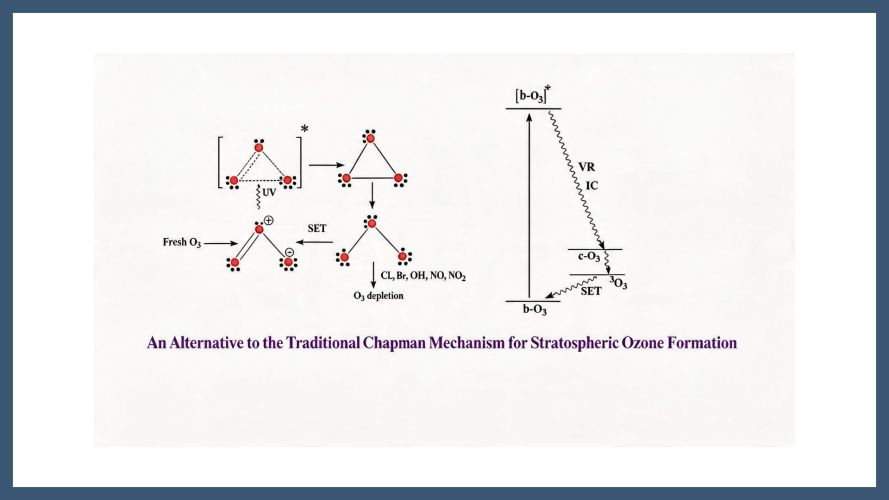
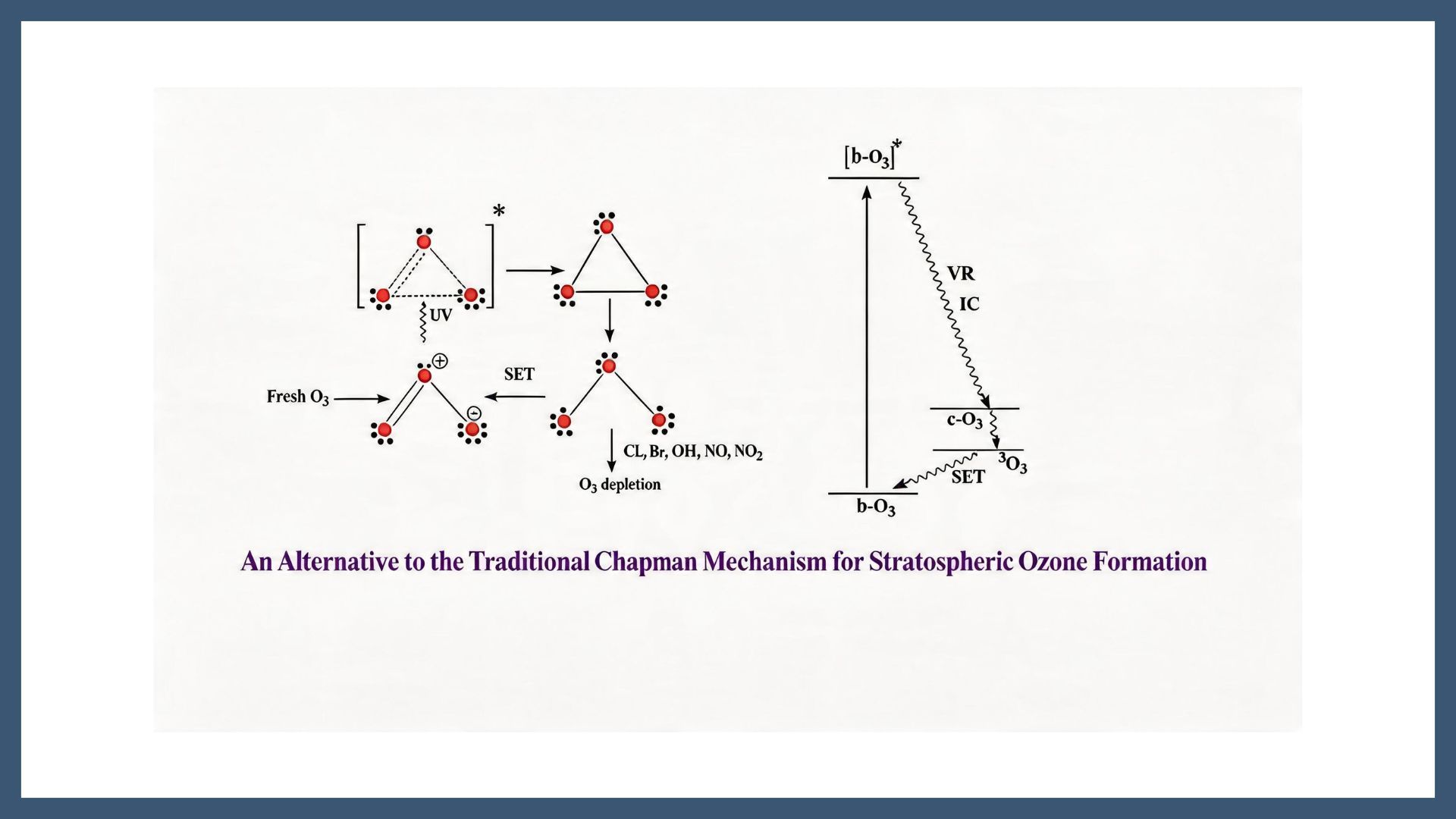
Our recently proposed Electronically Confined Space Analogy (ECSA) postulate offers a unified framework for interpreting the structure, stability, and photochemical behavior of 18-valence-electron (18-VE) molecules composed of second-row elements. We show that bent triatomic 18-VE isomers, such as ozone, exhibit strong ultraviolet absorption due to delocalized π systems and low-energy electronic transitions, whereas their cyclic counterparts are photochemically inert. Bent structures are consistently more stable than cyclic analogs, with stability governed by electronic polarization and symmetry rather than electronegativity. This thermodynamic preference ensures the dominance of UV-absorbing species under atmospheric conditions. Applying ECSA provides a molecular-level explanation for ozone's unique role as Earth's stratospheric UV filter, complementing and extending the traditional Chapman mechanism. We further propose a UV-driven ozone cycle that incorporates excited states and intermediates, offering an improved description of ozone photophysics and atmospheric resilience.
M4NRG Clean Energy
The Electronically Confined Space Analogy Elucidates How Second-Row Triatomic 18-Valence-Electron Molecules Shape Life and Light
Poater, Jordi; Vinas, Clara; Teixidor, Francesc
DOI: 10.1002/open.202500557

