


A new paper has been published in the journal Acta Biomaterialia.
This study introduces a series of water-soluble radical dendrimers (G0 to G5) as promising magnetic resonance imaging (MRI) contrast agents that could potentially address clinical safety concerns associated with current gadolinium-based contrast agents. By using a simplified synthetic approach based on a cyclotriphosphazene core and lysine-derived branching units, we successfully developed a G5 dendrimer containing up to 192 units of 2,2,6,6-Tetramethylpiperidinyloxy (TEMPO) radical. This synthesis offers advantages including ease of preparation, purification, and tunable water solubility through the incorporation of glutamic acid anion residues. Comprehensive characterization using 1H NMR, FT-IR, and SEC-HPLC confirmed the dendrimers' structures and purity.
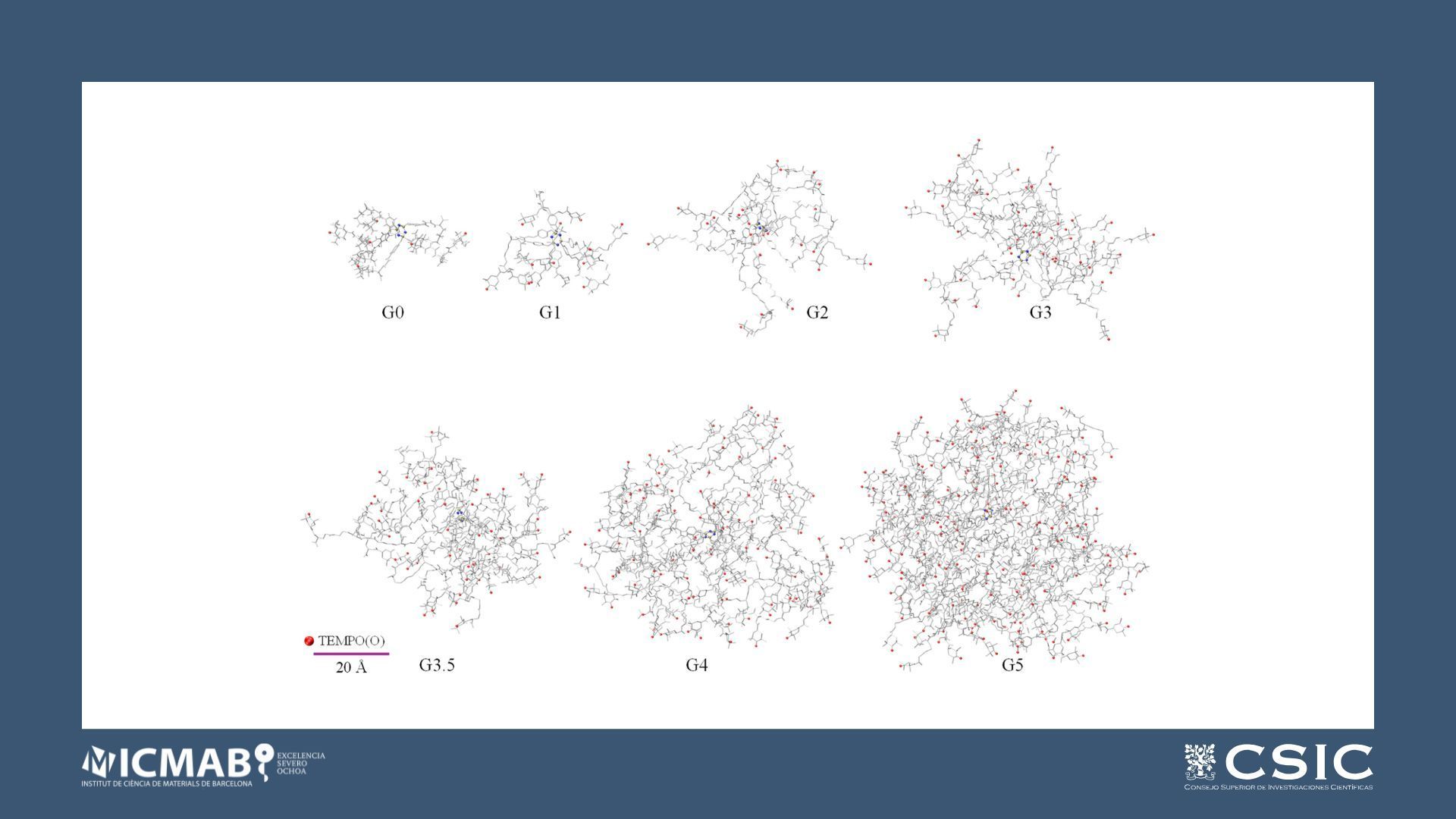
Electron paramagnetic resonance (EPR) spectroscopy revealed that TEMPO groups in higher generation dendrimers exhibited decreased mobility and stronger spin exchange in their local environments. In vitro MRI showed that relaxivity (r1) increased with higher dendrimer generations, with G5 exhibiting an exceptionally high r1 of over 24 mM-1s-1. Molecular dynamics simulations provided crucial insights into structure-property relationships, revealing the importance of water accessibility to TEMPO groups for enhancing relaxivity. Vero cell viability assay demonstrated G3 and G3.5 have good biocompatibility. In vivo MRI experiments in mice demonstrated that G3.5 was excreted through the kidneys and selectively accumulated in glioblastoma tumors.
M4HTH Smart Nanomedicine
Synthesis and Relaxivity study of amino acid-branched radical dendrimers as MRI contrast agents for potential brain tumor imaging
Yufei Wu, Vega Lloveras, Silvia Lope-Piedrafita, Marta Mulero-Acevedo, Ana Paula Candiota, José Vidal-Gancedo
Acta Biomateriala, Volume 192, 15 January 2025, Pages 461-472

