


A new paper has been published in Dyes and Pigments:
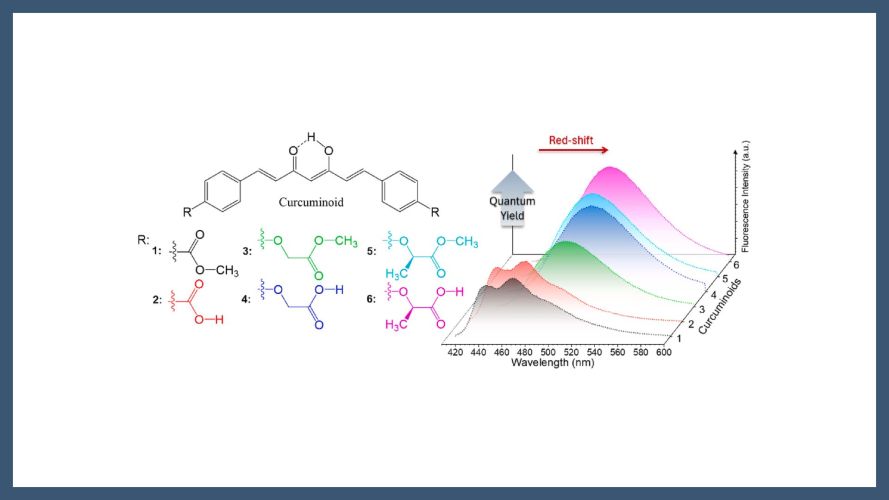
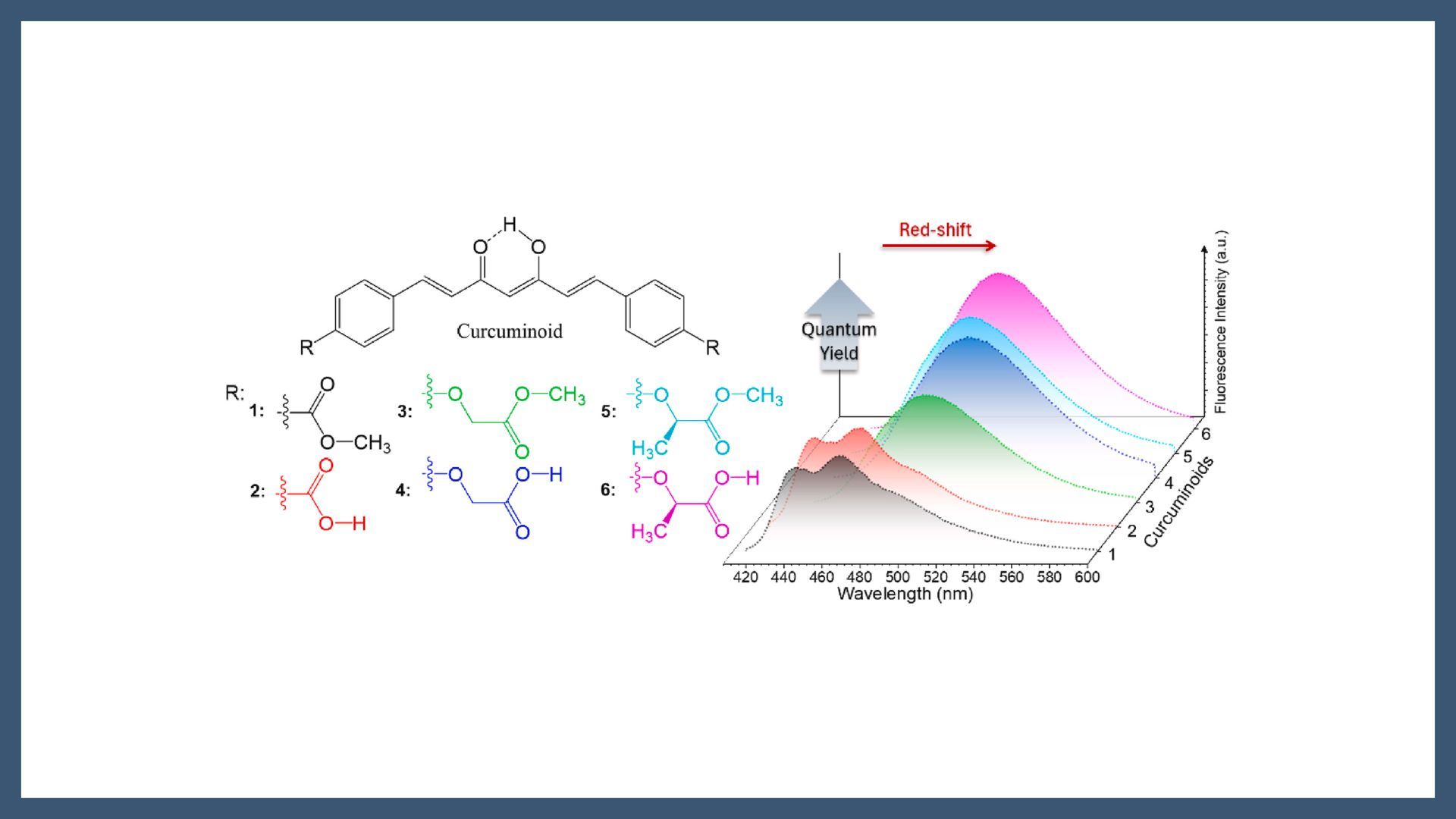
We report the synthesis and comprehensive photophysical-structural correlation of six curcuminoids (CCMoids) that feature ester or carboxylic acid groups at the para-position of the phenyl rings, either directly attached or separated by achiral or chiral spacer units. UV–Vis absorption and fluorescence measurements in toluene, dichloromethane (DCM), and ethanol (EtOH), together with TD-DFT calculations, were used to elucidate structure–property relationships governed by functional group identity, end-group connectivity, and chirality. Across the series, carboxylic-acid CCMoids show systematically red-shifted absorption/emission relative to their ester analogues, consistent with local electronic/steric effects and stronger solute–solvent interactions rather than increased π-delocalization. Fluorescence quantum yields and lifetimes generally increase with solvent polarity and upon transitioning from directly conjugated end groups (CCMoids 1–2) to spacer-containing derivatives (CCMoids 3–6), where emission is more sensitive to conformational constraints and solvent stabilization. In EtOH, chiral CCMoids display higher quantum yields than their achiral counterparts, whereas the opposite trend is observed in DCM. TD-DFT reproduces the experimental trends and provides predictive insight, enabling estimation of emission quantum yields when experimental values fall below instrumental detection limits.
M4ELC Sustainable Electronics
Structure–property correlations in ester- and carboxyl–functionalized curcuminoids: A combined experimental and theoretical study
Guerra, Nicole; Parra-Munoz, Nicole; Qian, Wenjie; Mella, Pablo; Campos, Aldo; Pizarro, Nancy; da Silva, Jesse Ferreira; Sanudo, E. Carolina; Sandoval, Tania E.; Aliaga-Alcalde, Nuria; Soler, Monica
DOI: 10.1016/j.dyepig.2026.113847

