


A new paper has been published in IEEE Transactions on Biomedical Engineering:
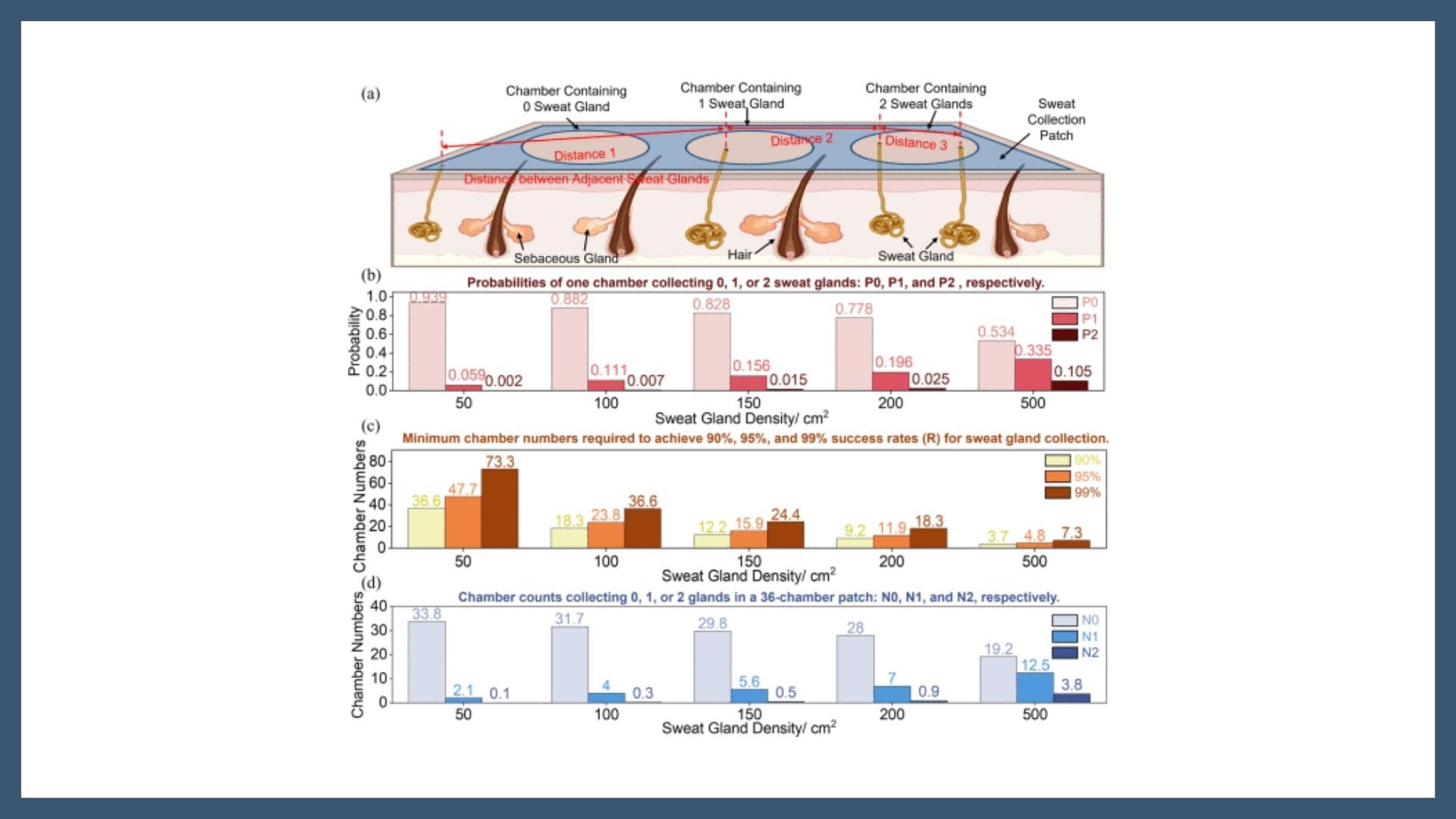
Wearable sweat sensors offer a promising route for non-invasive health monitoring; however, their accuracy and reliability remain limited. This limitation arises primarily because wearable sweat sensors typically collect and analyze sweat samples that are composed of mixed secretions from multiple sweat glands, resulting in averaged measurements that obscure the intrinsic concentrations and fluctuations of sweat biomarkers. Accurate sweat detection requires sampling sweat from a single sweat gland, yet no available method currently enables such high-resolution sampling. This study presents a novel single-sweat-gland sampling strategy, which is a class of patches containing dozens of openings to isolate individual sweat glands. By combining Poisson distribution theory with infrared thermography, a sweat patch incorporating 36 microchambers (400 µm in diameter) is designed to isolate sweat from individual glands. Computational modeling and Monte Carlo simulations involving 1000 random patch placements across diverse subjects demonstrate a 100% success rate in capturing sweat from single glands, without the need for vigorous physical exertion. The system functions effectively across different subjects under moderate sweating conditions and is adaptable to real-world applications. This high-resolution sampling strategy enables more accurate biomarker quantification and holds significant potential for improving sweat-blood biomarker correlation, advancing the development of reliable wearable diagnostics.
M4HTH Smart Nanomedicine
Single-Gland-Level Sweat Sampling: A Theoretical and Computational Approach Toward Improved Biomarker Accuracy in Wearable Sensors
Wang, Xiaohe; Ma, Yongquan; Zeng, Muling; Niu, Pengfei
DOI: 10.1109/TBME.2025.3600238

