


A new paper has been published in The Journal of Physical Chemistry Letters:
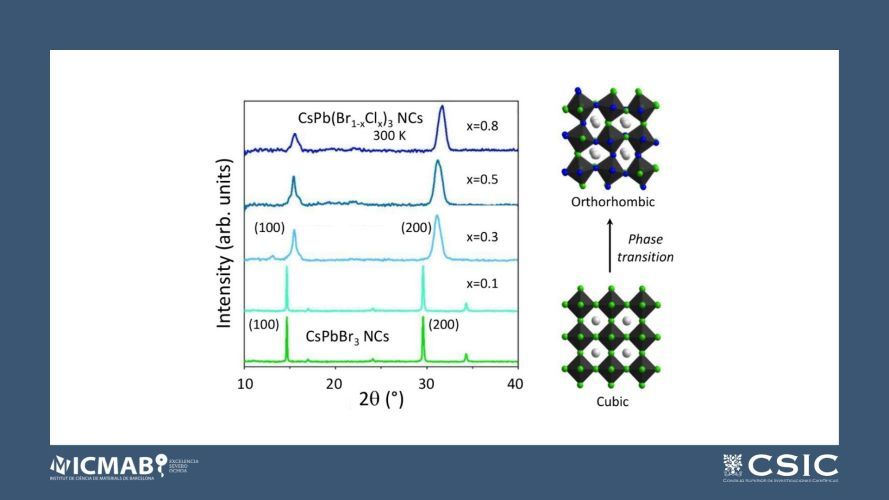
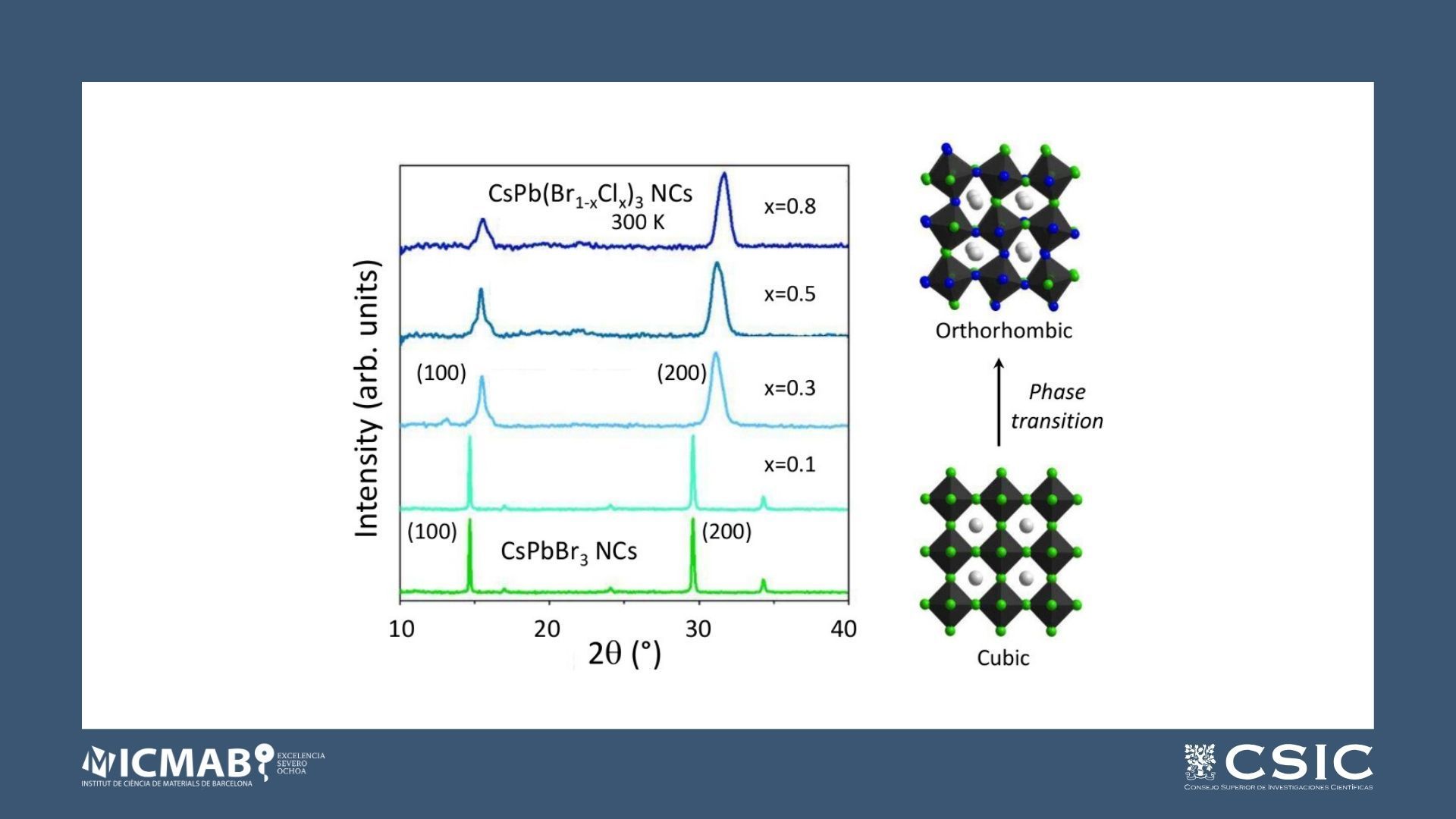
So far, the striking sign reversal in the near-ambient slope of the gap temperature dependence of colloidal CsPbCl3 perovskite nanocrystals (NCs) compared to its Br counterpart remains unresolved. Pure bromide NCs exhibit a linear gap increase with increasing temperature, to which thermal expansion and electron–phonon interaction equally contribute. In contrast, the temperature slope for the chlorine compound gap is clearly negative. By combining temperature- and pressure-dependent photoluminescence on a series of CsPb(Br1–xClx)3 NCs, we unravel the origin of such inversion.
The electron–phonon interaction is solely responsible, undergoing a sudden change in sign and magnitude due to activation of an anomalous electron–phonon coupling mechanism linked to vibrational modes characterized by synchronous octahedral tilting and Cs rattling. This takes place in the shrunken orthorhombic NC lattice for Cl concentrations exceeding ca. 40%. We have thus clarified a puzzling result directly impacting the optoelectronic properties of lead halide perovskite NCs.
M4NRG Clean Energy
Sign of the Gap Temperature Dependence in CsPb(Br,Cl)3 Nanocrystals Determined by Cs-Rattler-Mediated Electron–Phonon Coupling
Shima Fasahat, Nadesh Fiuza-Maneiro, Benedikt Schäfer, Kai Xu, Sergio Gómez-Graña, M. Isabel Alonso, Lakshminarayana Polavarapu & Alejandro R. Goñi
J. Phys. Chem. Lett. 2025, 16, 4, 1134–1141

