


The celebration looked back on three decades of scientific innovation, collaboration, and community-building. Founding members Pablo Ordejón (ICN2), Emilio Artacho (CIC nanoGUNE), José Soler (UAM), Javier Junquera (University of Cantabria), Alberto García (ICMAB-CSIC), and Daniel Sánchez-Portal (CFM-CSIC) were all present at the event, which honored the origins of SIESTA and the people who helped shape it.
Over the past 30 years, SIESTA has grown into a powerful and widely adopted platform, enabling simulations of complex materials and large-scale systems that would otherwise be out of reach. Its efficiency stems from the use of basis sets of strictly-localized atomic-like orbitals, in contrast with the plane-wave bases used in other major codes. SIESTA remains one of the most cited simulation packages in its field, with over 14,000 citations to its foundational 2002 paper (The SIESTA method for ab initio order-N materials simulation, Journal of Physics: Condensed Matter 14 (11), 2745).
García, ICMAB researcher involved in SIESTA’s development for many years and currently one of the project’s lead maintainers, reflected on his journey with the code:
“I joined the project to contribute a little expertise in pseudopotentials, coming from a background in plane-wave codes. One can really say that is history!”
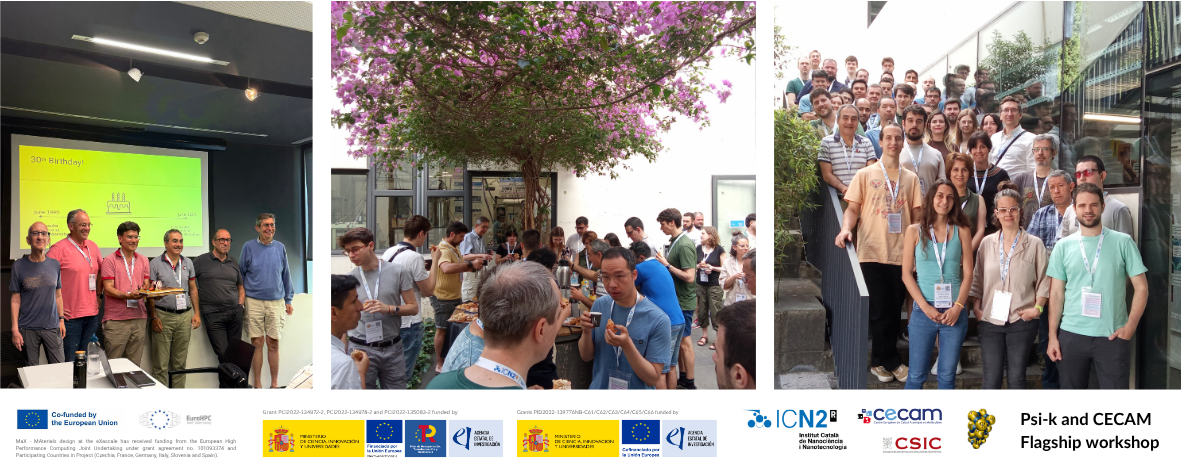
30 anys SIESTA celebration. The first photo with the founders | MaX project
The surprise tribute was organized by Roberta Farris, José Ángel Silva, and Federico Pedrón (ICN2), and included a heartfelt historical overview of the project. Attendees were moved by the stories of the early days—when the idea for SIESTA was first sparked at Espresso Royale in Urbana, Illinois—and the camaraderie that has sustained it ever since.
As Emilio Artacho, CIC nanoGUNE researcher, put it:
“The SIESTA adventure has always been a story of generosity and friendship, and I am extremely grateful for it.”
And in the words of Pablo Ordejón, ICN2 Director:
“To me, SIESTA means 30 years forging science, collaboration, and friendship.”
From its early beginnings to the cutting-edge research presented at this year’s workshop, SIESTA continues to represent the best of open science: collaborative and forward-looking. The workshop highlighted the contributions of new generations of developers that will bring the software to new frontiers.
Advanced SIESTA workshop: A key event in materials simulation
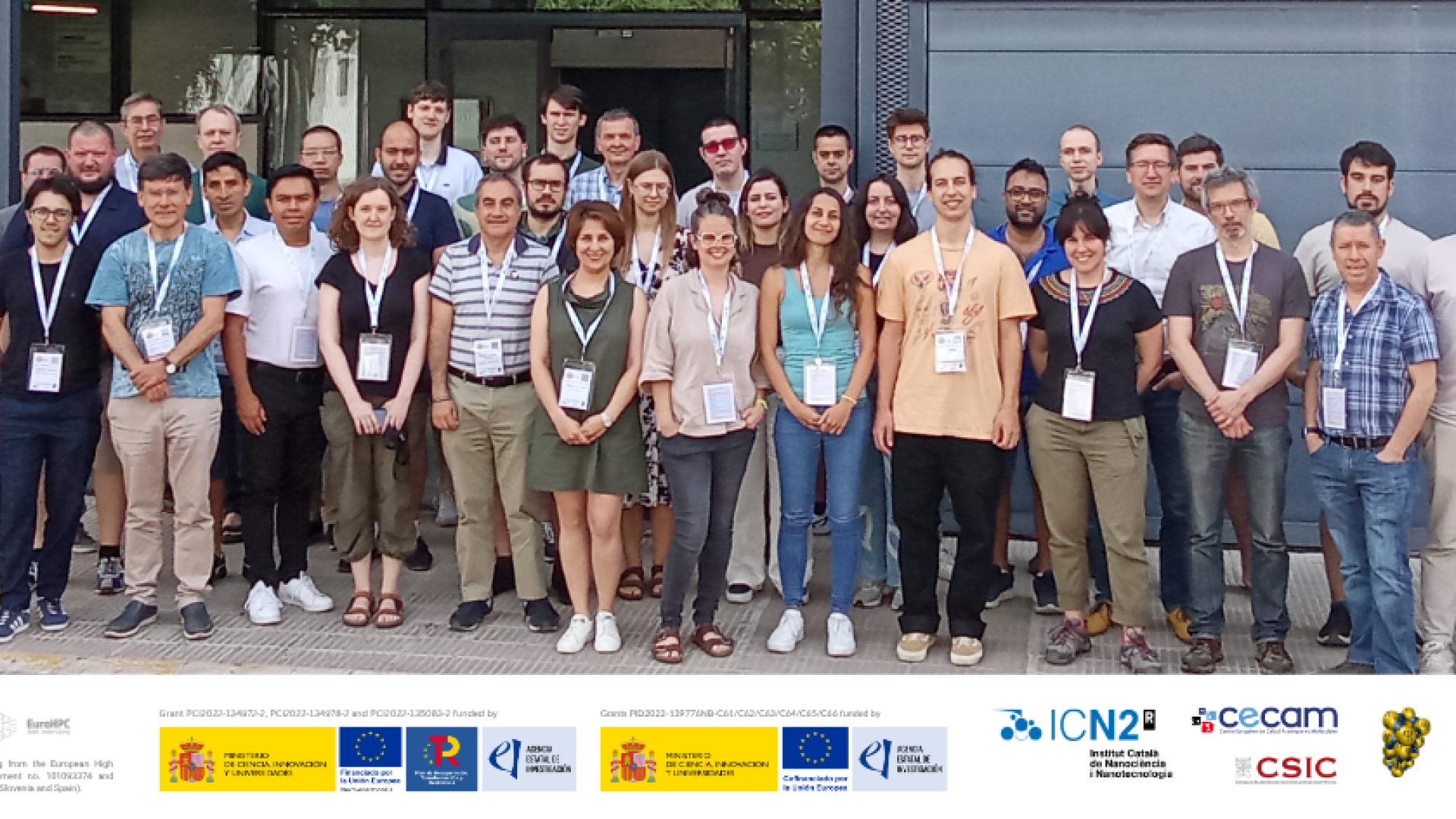
The 30-year SIESTA tribute was included in the Advanced SIESTA Workshop, held at the ICN2 from June 2-5, 2025. Co-organized by the MaX Centre of Excellence, the event gathered international researchers to explore the use of SIESTA, a prominent open-source code for materials simulation based on density functional theory (DFT).
The workshop provided hands-on training in advanced simulation methods and explored applications in electronic transport, magnetism, superconductivity, electrochemistry, and thermal properties. Special focus was given to machine learning integration and high-performance computing, aiming to prepare the community for exascale computing challenges.
Highlights included sessions on new tools like TranSIESTA, TDEP, and LUA scripting, and insights into the future of SIESTA 5.4. The workshop was supported by CASTIEL2, Psi-k, and CECAM, and emphasized the importance of accessible, open-source software in education and research worldwide.
Read more
SIESTA Project Celebrates 30th Anniversary with a Surprise Tribute | MaX
Advanced SIESTA Workshop: A Successful Showcase of Materials Simulation | MaX
ICN2 Hosts SIESTA Advanced Workshop as Part of the European “MaX” Project - ICN2
About SIESTA
New developments and applications for SIESTA program - ICMAB
The ICMAB most cited article of all time has more than 7400 citations - ICMAB