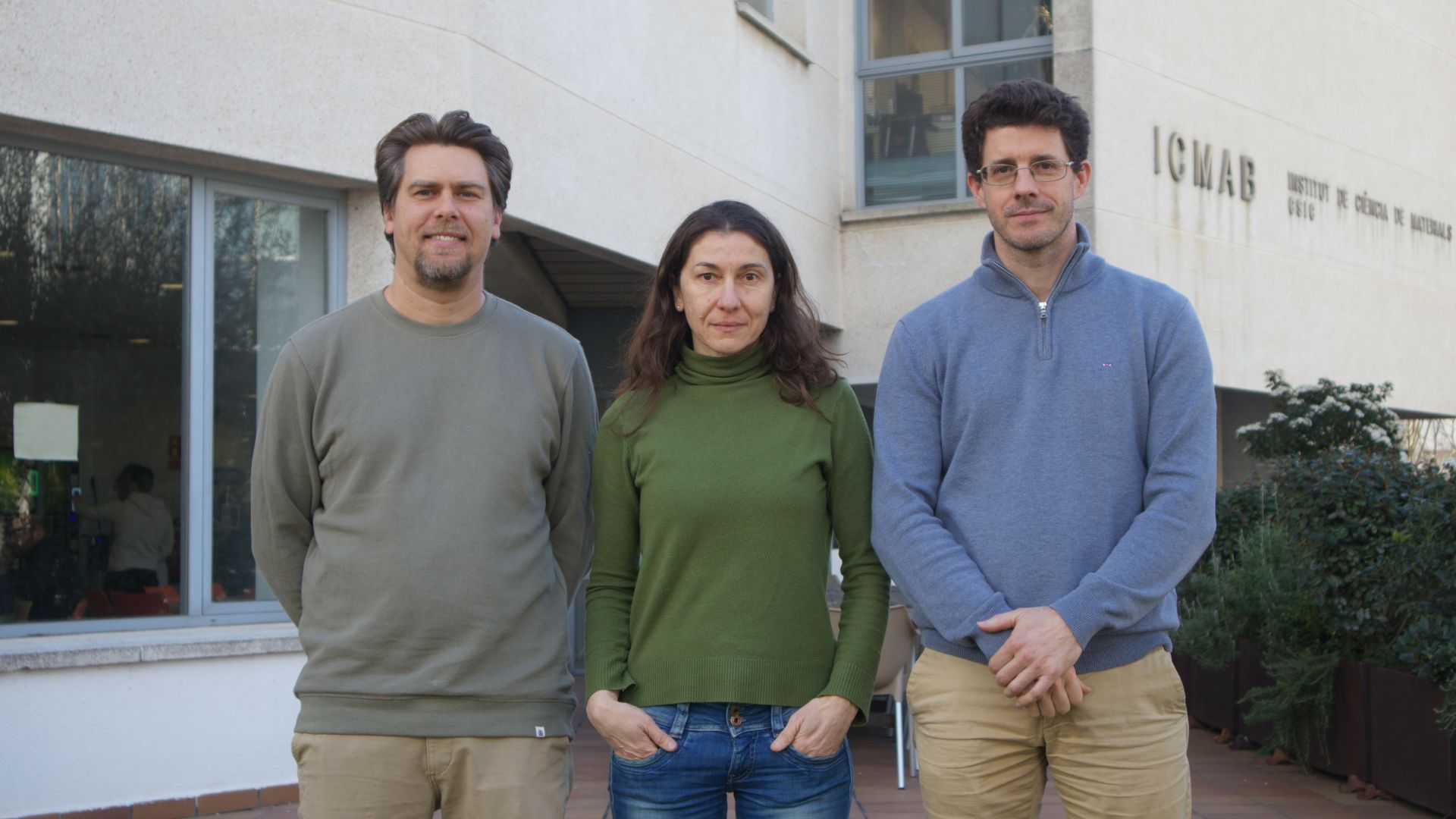
A study carried out through a close and productive collaboration between researchers at the Institut de Ciència de Materials de Barcelona (ICMAB-CSIC) and MIRAS beamline at ALBA Synchrotron has demonstrated that operando synchrotron-based infrared microspectroscopy can reveal how organic battery electrodes store charge in real time. Using the MIRAS beamline coupled to an adapted electrochemical cell, the team uncovered distinct reaction pathways for lithium and sodium in polyimide electrodes, providing unprecedented insight into their redox mechanisms.
Better Batteries for Sustainable Energy Systems
The transition towards sustainable energy systems requires safer, lower-cost and more environmentally friendly batteries. Organic electrode materials, made of lightweight and abundant elements, are promising candidates because they can operate with different charge carriers such as lithium, sodium, magnesium or calcium. However, understanding how these materials store and release charge - especially during battery operation - remains a major scientific challenge.
Scientists from ICMAB-CSIC and MIRAS beamline at ALBA Synchrotron, with contributions of researchers from IMDEA Energy and POLYMAT (University of the Basque Country), performed synchrotron-based operando Fourier Transform Infrared microspectroscopy (SR-μFTIR) at MIRAS. Thanks to the exceptional brilliance and spatial coherence of synchrotron light, they achieved micrometre-scale resolution and sub-second acquisition times while maintaining high signal-to-noise ratios.
By slightly modifying a commercially available electrochemical cell with a silicon window compatible with synchrotron radiation, the team enabled real-time monitoring of the chemical evolution of polyimide electrodes during battery cycling under realistic operating conditions.
Polyimide stores energy thanks to specific chemical groups called carbonyl groups, which can reversibly gain and lose electrons during battery operation.
When the battery was discharged, the signals associated with the original carbonyl groups decreased, and new signals appeared. These changes revealed that the carbonyl groups were being transformed (a process known as enolation) and were interacting with the metal ions coming from the electrolyte, leading to the formation of metal–enolate species.
By combining operando SR-μFTIR with density functional theory (DFT) calculations, the researchers discovered an important difference between lithium and sodium. In lithium cells, the insertion process was largely concerted and cooperative, with neighbouring carbonyl groups being reduced almost simultaneously. In sodium cells, the reaction proceeded in a stepwise manner, reflected in two distinct infrared bands and correlated voltage plateaus.
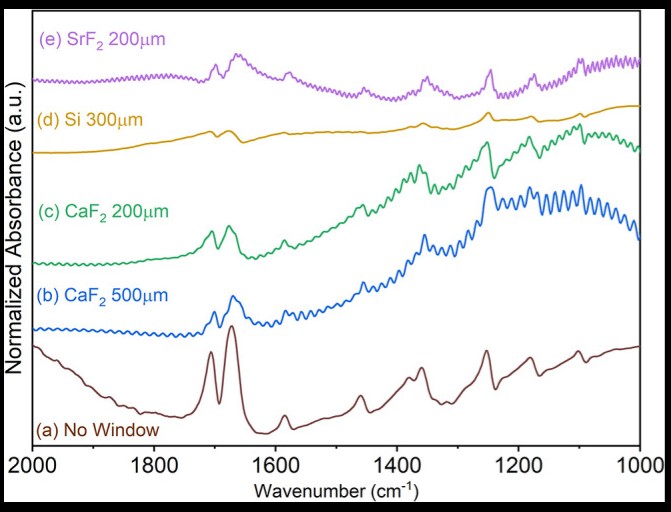 IR spectra in the region 2000–1000 cm–1 of a dry PI electrode directly under the IR microscope with no window (a) in the ECC-Opto-Std (ELCELL) with a 500 μm CaF2 (b), 200 μm CaF2 (c), 300 μm Si (d), or a 200 μm SrF2 (e) window | The authors
Improving batteries
This study provides the first direct spectroscopic evidence linking the sequential redox behaviour of sodium to its weaker binding cooperativity compared to lithium in polyimide electrodes, as supported by DFT calculations.
Understanding these subtle differences is crucial for improving sodium-ion batteries. Sodium is much more abundant and cheaper than lithium, making it highly attractive for large-scale energy storage. By knowing exactly how sodium behaves inside organic electrodes, researchers can design better materials and improve battery performance.
Synchrotron-based operando infrared microspectroscopy emerges as a powerful, non-invasive tool to accelerate the development of safer, more sustainable energy storage technologies, highlighting the capabilities of MIRAS beamline and expertise at ICMAB-CSIC, and reinforcing ALBA’s role as a key infrastructure for cutting-edge battery research
Reference
Ashley P. Black, Deyana S. Tchitchekova, Nagaraj Patil, Nicolas Goujon, David Mecerreyes, Rebeca Marcilla, Ibraheem Yousef, and Alexandre Ponrouch
Operando Synchrotron-Based Fourier Transform Infrared Microspectroscopy of Metal-Ion Organic Battery Materials
Chemistry of Materials 2026 38 (2), 645-656
DOI: 10.1021/acs.chemmater.5c01795