Article abstract:
Surfactants are inexpensive chemicals with promising applications in virus inactivation, particularly for enveloped viruses. Yet, the detailed mechanisms by which surfactants deactivate coronaviruses remain underexplored. This study delves into the virucidal mechanisms of various surfactants on Feline Coronavirus (FCoV) and their potential applications against more pathogenic coronaviruses. By integrating virucidal activity assays with fluorescence spectroscopy, dynamic light scattering and laser Doppler electrophoresis, alongside liposome permeability experiments, we have analyzed the effects of non-ionic and ionic surfactants on viral activity. The non-ionic surfactant octaethylene glycol monodecyl ether (C10EO8) inactivates the virus by disrupting the lipid envelope, whereas ionic surfactants like Sodium Dodecyl Sulfate and Cetylpyridinium Chloride predominantly affect the spike proteins, with their impact on the viral membrane being hampered by kinetic and thermodynamic constraints. FCoV served as a safe model for studying virucidal activity, offering a faster alternative to traditional virucidal assays. The study demonstrates that physicochemical techniques can expedite the screening of virucidal compounds, contributing to the design of effective disinfectant formulations. Our results not only highlight the critical role of surfactant-virus interactions but also contribute to strategic advancements in public health measures for future pandemic containment and the ongoing challenge of antimicrobial resistance.
MST Department work:
Surfactants are commonly used as disinfection agents in personal care products against bacteria and viruses, including SARS-CoV-2. However, there is a lack of understanding of the molecular mechanisms of the inactivation of viruses like SARS-CoV-2 by surfactants. One popular hypothesis is that they are able to dissolve the virus envelope (the SARS-CoV-2 virus, like other viruses such as flu viruses are protected by lipid enveloped). This hypothesis is based on the fact that surfactants are used to dissolve and encapsulate insoluble solutes. However, enveloped viruses are self-assembled organic nanoparticles and disrupting a self-assembled structure is difficult.
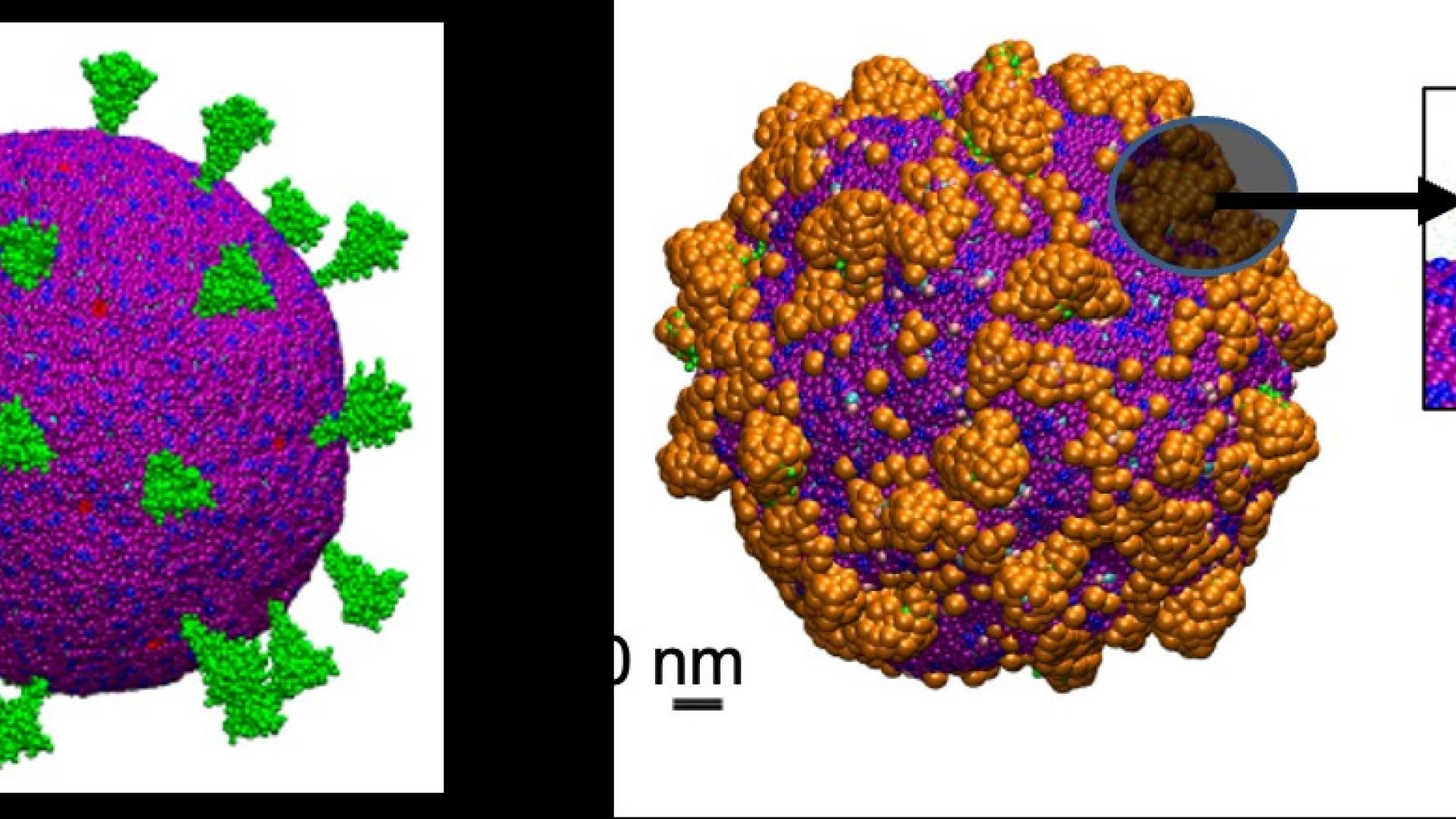
We have tackled this problem considering molecular dynamics simulations of the SARS-CoV-2 virus in presence of different types of surfactants (anionic and cationic) [1]. In these simulations, the equations of motion of the surfactant molecules and the virus components are solved over time taking into account the different physical forces between them. We have considered first coarse grain (CG) simulations of a full virus and a simplified model of surfactants. Subsequently, we refined the simulations by considering simulations with full atomistic details of patches of the envelope in situations of interest identified in the CG simulations.
Our simulations predict that both anionic and cationic surfactants have only a small impact over the virus envelope, being inserted into the envelope without dissolving it or generating pores. However, we found that surfactants may induce a deep impact on the spike protein of the virus (responsible for its infectivity), easily covering it and inducing its collapse over the envelope surface of the virus. In addition, we found that anionic surfactants easily block the receptor binding domain of the Spike protein (the fragment of the Spike protein responsible for attaching to cell receptors), so they are particularly effective.
These theoretical predictions have been verified experimentally recently using a combination of highly sensitive experimental techniques [2]. The experiments also show that contrary to anionic and cationic surfactants, neutral surfactants disrupt the virus envelope (instead of blocking the Spike protein) although higher concentrations are needed.
Our results suggest that the best strategy for the design of surfactants as virucidal agents will be to focus on those strongly interacting with the spike protein and suggest that computational methods can be employed for a rational design of an appropriate disinfecting agent.
[1] M Domingo and J Faraudo, J. Chem. Phys. 158, 114107 (2023)
[2] H. Mateos et al., J. Colloid Interface Sci 662, 535-544 (2024)
Video: https://www.youtube.com/watch?v=SxBEQLxNnys