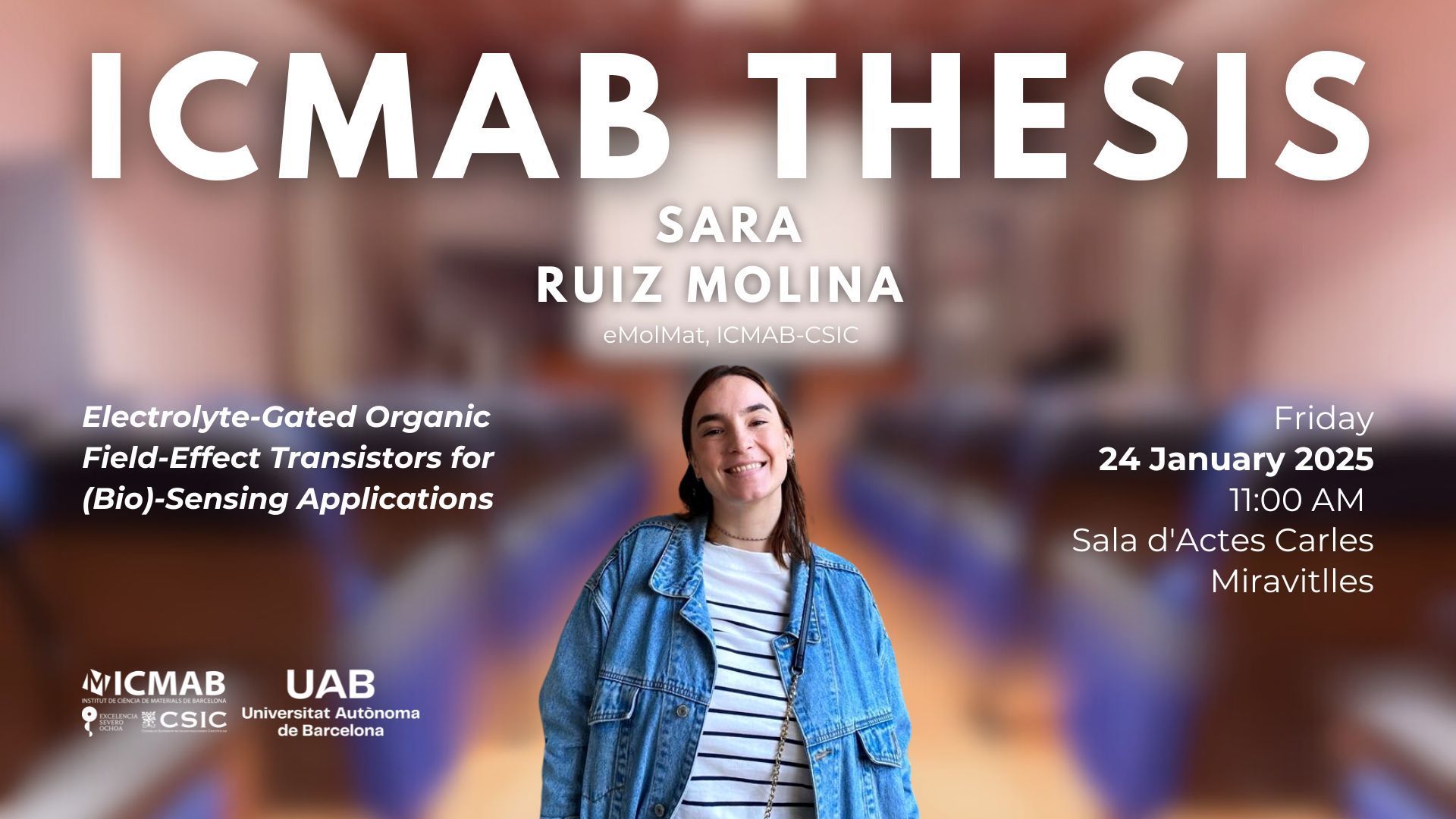
Electrolyte-Gated Organic Field-Effect Transistors for (Bio)-Sensing Applications
Date: Friday, 24 January 2025
Time: 11 AM
Venue: Institut de Ciència de Materials de Barcelona (ICMAB, CSIC) - Sala d'Actes Carles Miravitlles
Abstract
This doctoral thesis focused on the development and application of Electrolyte-Gated Organic Field-Effect Transistors (EGOFETs) and Hydrogel-Gated Organic Field-Effect Transistors (HYGOFETs) for bioelectronic purposes. Devices were fabricated by depositing small molecules of organic semiconductors (OSC) blended with an insulating polymer from solution, employing the Bar-Assisted Meniscus-Shearing technique (BAMS). The work involved designing flexible, low-power biosensors for detecting biomolecule aggregation and cellular activity, particularly amyloid peptides, which are relevant for neurodegenerative diseases like Alzheimer’s and Parkinson’s. The ability of EGOFETs to detect proteins without the need for makers highlighted their potential in systematic studies of protein aggregation and drug testing. In addition, HYGOFETs, utilizing agarose hydrogel, demonstrated improved stability in biosensing environments. The thesis also explored the potential of EGOFETs as strain sensors and their application in flexible electronics, identifying key electrical changes under mechanical stress. The research introduced innovative solutions for addressing voltage drift in EGOFETs and showed their capacity to record and stimulate cellular activity, specifically single-cell membrane potentials. Overall, the findings emphasized the promising future of EGOFETs and HYGOFETs in bioelectronic applications, enhancing the understanding of these devices while paving the way for advanced flexible biosensors.
Supervisors
- Marta Mas, ICMAB-CSIC, Spain
PhD Comitte
- President: Imma Ratera, ICMAB-CSIC, Spain
- Secretary: Francesca Leonardi, OnePlanet research Center, Netherlands
- Vocal: Javier Ramón Azcón, IBEC, Spain
University: Universitat Autònoma de Barcelona (UAB)
PhD Programme: Material Science