


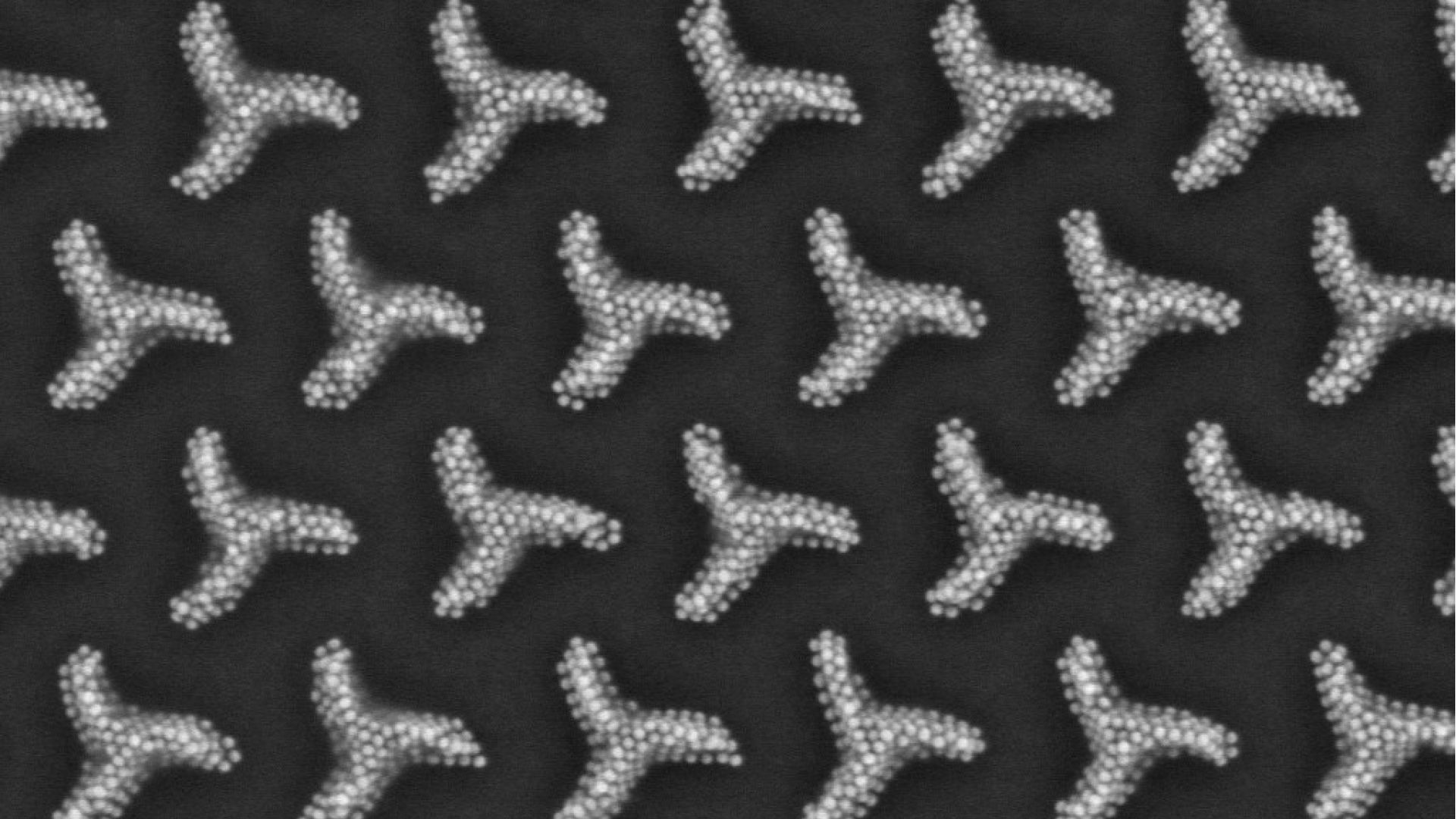
A first study, published in Nature Communications, showcases self-assembled chiral plasmonic architectures (triskelion patterns) made from gold and silver nanoparticles. These structures demonstrate exceptional optical responses, selectively interacting with circularly polarized light, opening up exciting possibilities for advanced optoelectronic devices.
In a second study published in ACS Applied Materials & Interfaces, the team introduced novel plasmonic metasurfaces using inverted pyramid arrays. These metasurfaces provide unprecedented polarization control and can be fabricated using soft lithography and anisotropic etching, resulting in a cost-effective and scalable method.
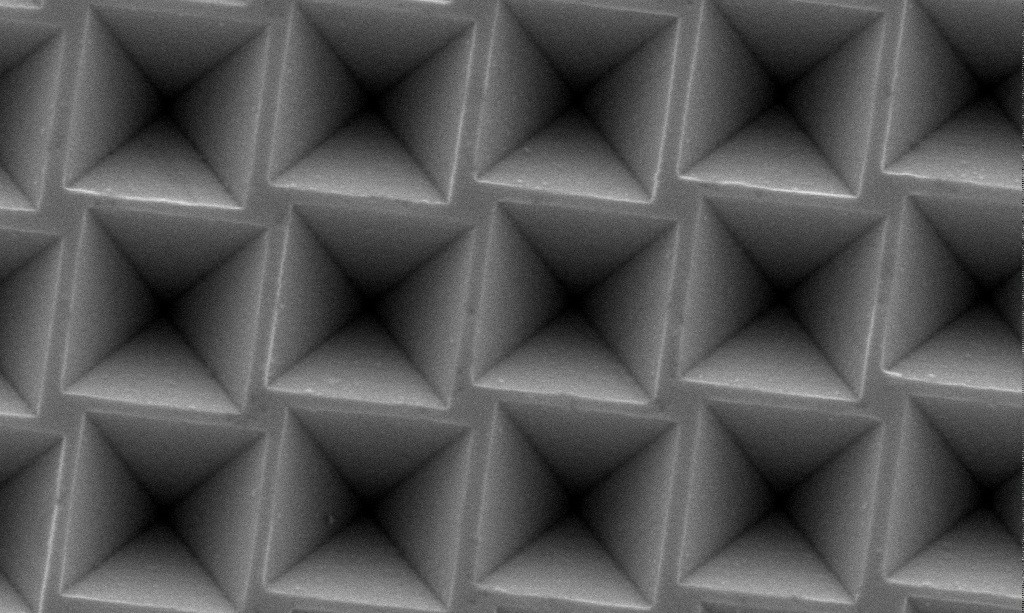
Scanning electron microscopy (SEM) image of a silicon substrate that has been nanostructured using soft lithography and anisotropic etching to obtain an array of inverted pyramids. Due to a mismatch between the array directions and the crystalline directions of the silicon, a chiral motif is observed. | Acapted from ACS Appl. Mater. Interfaces 17, 10, 15824–15835, 2025
Luis Pérez, co-author of both studies, commented on the potential of these advancements:
“Our research lays the foundation for a new generation of light-manipulating devices that could significantly improve technologies in fields like displays and environmental monitoring.”
Researcher Agustín Mihi, coauthor of the study and expert in nanophotonics, emphasized the importance of scalability in these innovations:
"Not only do we push the limits of optical properties at the nanoscale, but we ensure that these technologies can be scaled up for industrial applications. This combination of performance and scalability is essential for transforming these discoveries into real-world products."
These two studies together offer revolutionary insights into the manipulation of light at the nanoscale and pave the way for more efficient and accessible optoelectronic devices, with broad applications in industries ranging from healthcare to energy and communications.
Articles
Chiral plasmonic superlattices from template-assisted assembly of achiral nanoparticles
Xiaoyu Qi, Luis Alberto Pérez, Jose Mendoza-Carreño, Miquel Garriga, Maria Isabel Alonso & Agustín Mihi
Nature Communications 16, 1687, 2025
doi.org/10.1038/s41467-025-56999-0
Strong Chiro-Optical Activity of Plasmonic Metasurfaces with Inverted Pyramid Arrays
Luis Alberto Pérez*, Jinhui Hu, Jose Mendoza-Carreño, Miquel Garriga, Maria Isabel Alonso, Oriol Arteaga, Alejandro R. Goñi*, Agustín Mihi*
ACS Appl. Mater. Interfaces 17, 10, 15824–15835, 2025
doi.org/10.1021/acsami.4c19803