These publications have been recently highlighted in the “Superconductivity News Forum” web site.
Review: Perspectives in power applications of low- and mainly high-temperature superconductors: energy, transport and industry
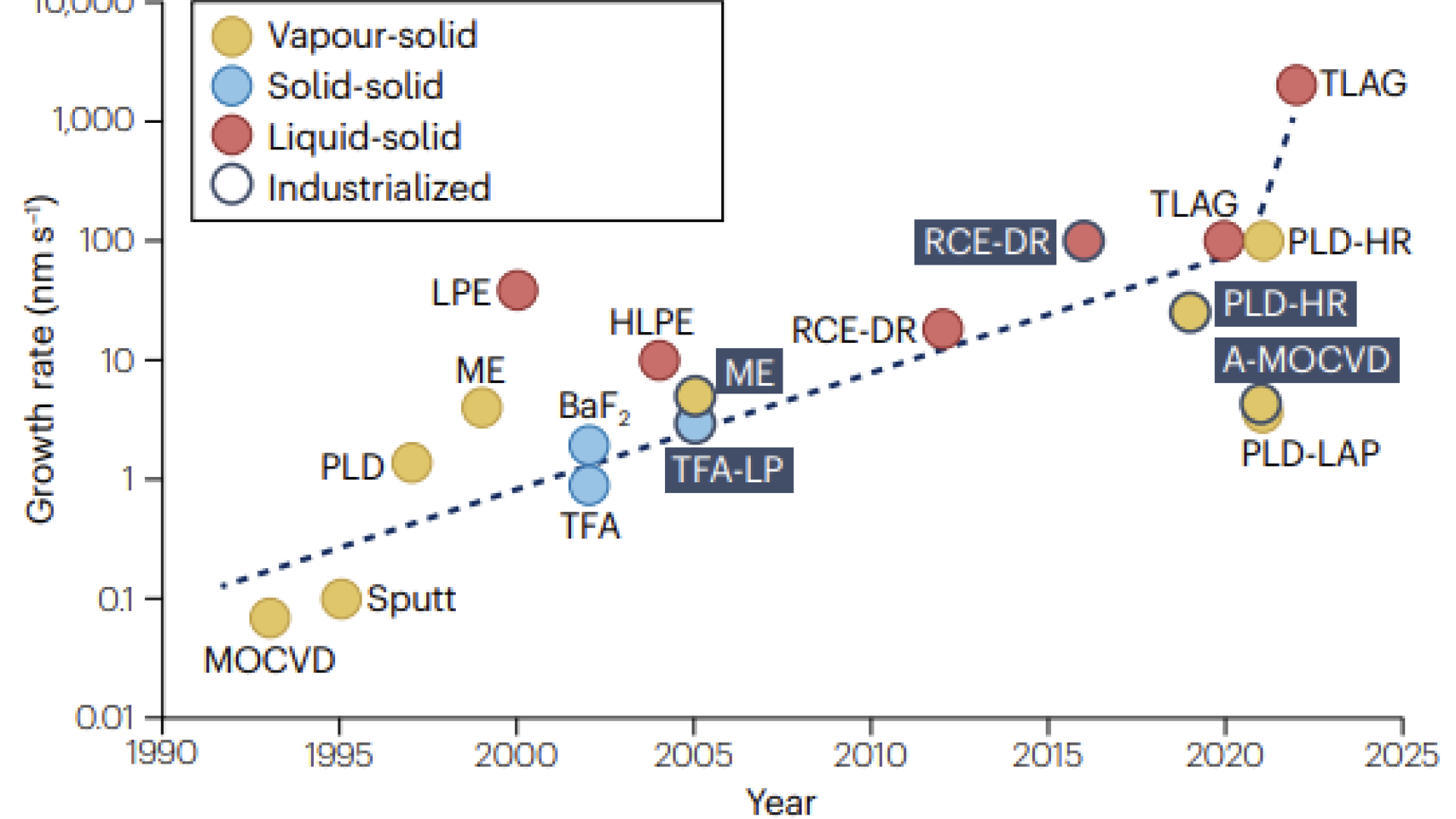
The review was written by researchers from CIEMAT and ICMAB-CSIC (X. Obradors and T. Puig) and it has been published in La Rivista del Nuovo Cimento. This article provides an up-to-date and comprehensive overview (~100 pages) of the development of high-critical-current superconducting materials and power devices related to electrical energy systems (generation, transport, storage and transmission), electrified transport (airborne, waterborne and terrestrial), industrial applications, and high-energy physics. Overall, the potential benefits in terms of advanced sustainability, associated with improved efficiency and reduced power consumption, are extensively discussed.
Roadmap: Superconducting high-power cables and lines – Development status and technology roadmap
This roadmap has been published in Superconducting Science and Technology. The article is authored by scientists from 30 scientific institutions worldwide (10 countries), including researchers from ICMAB (T. Puig and X. Obradors). The roadmap comprises 19 sections (~80 pages) describing the current state of the art of the materials used to build HTS cables as well as recent advances in the development of AC and DC power cables for a wide range of applications. The contribution from ICMAB is entitled “Status of HTS material R&D for superconducting cable“. The roadmap covers different types of superconducting power cables intended for efficient low-loss electricity distribution and long-distance transmission, in some cases combined with liquid hydrogen, as well as applications such as powering data centers and integration into electric aviation or railway systems. The advantages of superconducting cables compared with conventional technologies are discussed in detail, and numerous examples of existing deployments worldwide are presented.
2025 Roadmap on nanoscale superconductivity for quantum technologies
Finally, a second roadmap titled “2025 Roadmap on nanoscale superconductivity for quantum technologies” has also been published in Superconducting Science and Technology. This roadmap arises from the COST action “Superconducting Nanodevices and Quantum Materials for Coherent Manipulation” (SuperQuMap) and it includes contributions from 51 scientific institutions in 12 countries, including one from ICMAB (A. Palau). The manuscript provides a global overview of recent progress and future perspectives on a wide range of nanostructured superconductors (9 contributions and ~100 pages), the physical principles governing these materials (7 contributions), and quantum-based electronic devices (7 contributions) investigated using superconductors. The contribution from ICMAB is entitled “Electrical tuning of superconducting devices”. Other aspects being discussed in the article are related to quantum computing, SQUIDs, terahertz communications or photon detectors.
Altogether, these publications reflect the exciting future of superconductivity and the strong involvement of ICMAB in some of the most significant international research initiatives currently underway.
References
Perspectives in power applications of low- and mainly high-temperature superconductors: energy, transport and industry
L. García-Tabarés, F. Toral, J. Munilla, L. González, T. Puig & X. Obradors
Volume 48, pages 435–536, (2025)
DOI: 10.1007/s40766-025-00071-6
Superconducting high-power cables and lines – Development status and technology roadmap
Mathias Noe, Teresa Puig, Danko C van der Laan, Robert Bach, Sasha Ishmael, Emelie Nilsson, Carsten Räch, Noriko Chikumoto, Arnaud Allais, Bai Song, Kai Allweins, Friedhelm Herzog, Francesco Dioguardi, Tabea Arndt, Adela Marian, Liye Xiao and Jeonwook Cho
DOI: 10.1088/1361-6668/ae15c2
2025 Roadmap on nanoscale superconductivity for quantum technologies
Oleksandr Dobrovolskiy, Hermann Suderow, Francesco Tafuri, Annica Black-Schaffer, Jose Lado, Asle Sudbo, Daniela Stornaiuolo, Chuan Li, Anna E. Böhmer, Lan Maria Tran, Andrzej J Zaleski, Adrian Crisan, Massimiliano Polichetti, Armando Galluzzi, Ali Gencer, Bernd Aichner, Neven Barisic, Wolfgang Lang, Tomas Samuely, Martin Gmitra, Tristan Cren, Matteo Calandra, Peter Samuely, Jeroen Custers, Rosa Cordoba, Vladimir M Fomin, Nicola Poccia, Pavol Szabó, Fabrizio Porrati, Gleb N Kakazei, Jan Aarts, J W A Robinson, Javier Villegas, Matthias Althammer, Hans Huebl, Akashdeep Kamra, Mathias Weiler, Hugo Jan Dil, Daniil Yevtushynsky, Beena Kalisky, Yonathan Anahory, Simon J Bending, Peter Liljeroth, Abdou Hassanien, Isabel Guillamón, Edwin Herrera, Alejandro Silhanek, Joris Van de Vondel, Anna Palau, Ilya Charaev, Mariia Sidorova, Floriana Lombardi, Thilo Bauch, Cheryl Feuillet-Palma, Vasily Stolyarov, Dimitri Roditchev, Vladimir M Krasnov, Benedikt Hampel, Maria Jose Martinez Perez, Javier Sese, Dieter Koelle, Stefano Poletto, Alessandro Bruno and Davide Massarotti
DOI: 10.1088/1361-6668/ae303010.1088/1361-6668/ae3030