


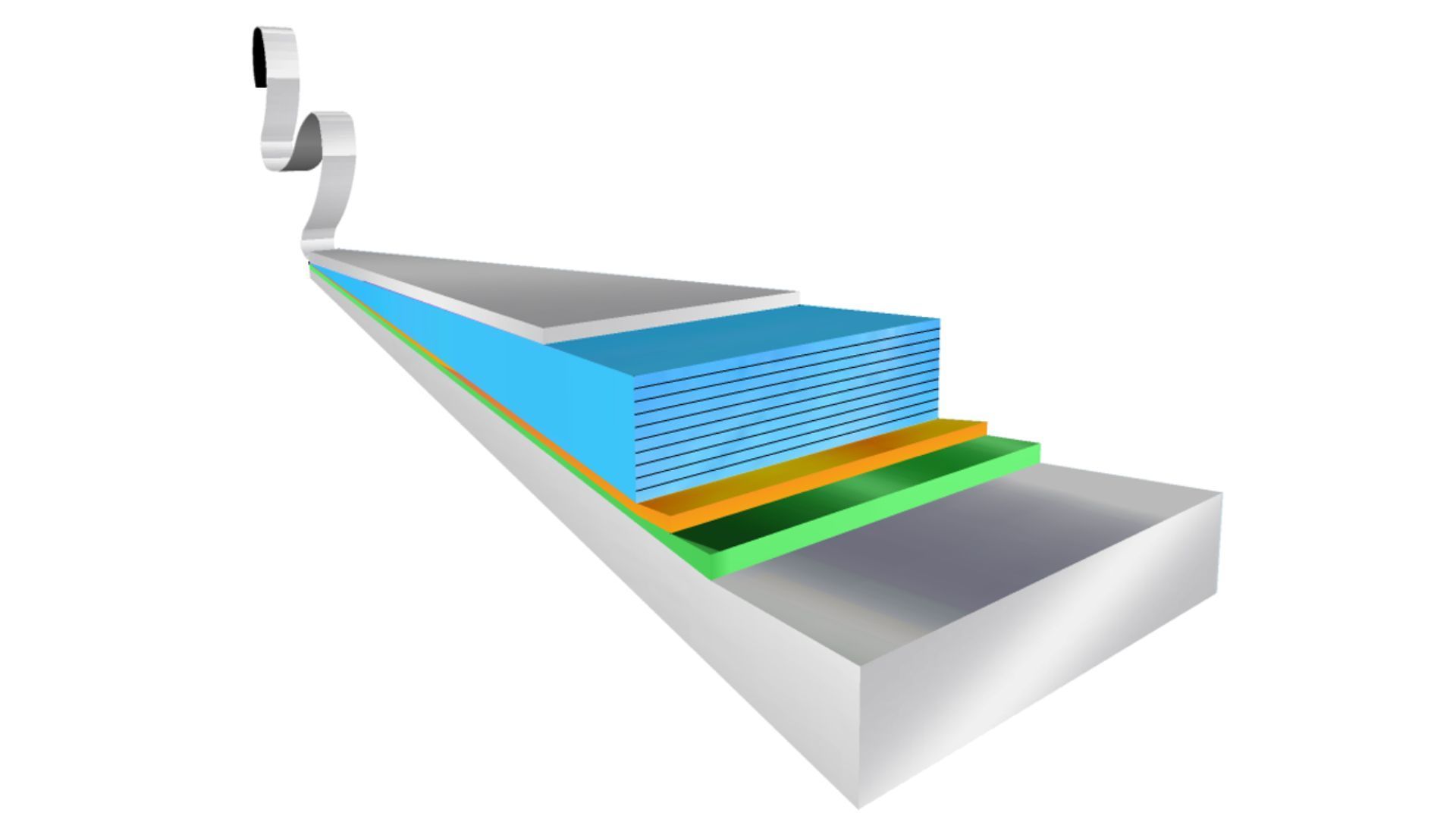
The first one is coauthored by Teresa Puig* (ICMAB-CSIC), Joffre Gutierrez (ICMAB-CSIC) and Xavier Obradors (ICMAB-CSIC). The second one, just from last month, by coauthors Xavier Obradors* (ICMAB-CSIC), Teresa Puig* (ICMAB-CSIC), Susana Ricart (ICMAB-CSIC), Anna Palau (ICMAB-CSIC), Mariona Coll (ICMAB-CSIC), Joffre Gutierrez (ICMAB-CSIC), Jordi Farjas (Universitat de Girona) and Elena Bartolomé (ICMAB-CSIC).
About the reviews
Impact of high growth rates on the microstructure and vortex pinning of high-temperature superconducting coated conductors
High-temperature superconducting REBa2Cu3O7 (RE = rare earth or yttrium) coated conductors have emerged as a new class of materials with exceptional physical properties, such as very high critical currents and irreversibility field. Understanding the physics of vortices in these complex materials and controlling of the atomic structure of defects have made it possible to design their performance and achieve exceptional values of superconducting properties which enable their integration into devices. In order to improve performance and reduce costs, faster growth methods are now being explored, which raise new vortex physics scenarios. In this Technical Review, we distinguish the rich vortex pinning microstructure for vapour–solid, solid–solid and liquid–solid growth methods and how it is modified in the fast-growth process. The interplay between vortex physics and defect structure generated at high growth rates is addressed, as well as the implications of the electronic structure on vortex physics.
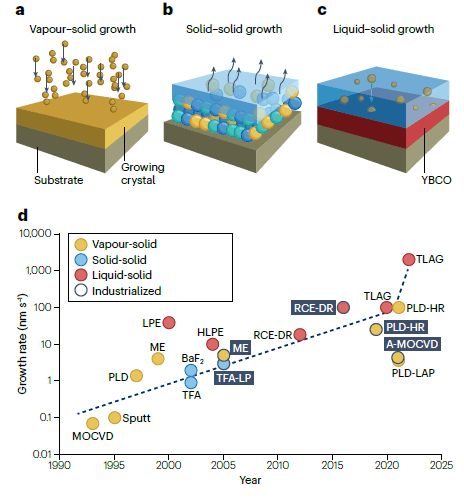
Figure 1. Different REBCO epitaxial growth techniques. a, Epitaxial growth controlled by vapour phases, which includes techniques like PLD, MOCVD, ME, MBE and sputtering. b, Growth through a solid–solid reaction mediated by gas diffusion with nanocrystalline precursors like CuO, Y2O3 and BaF2; includes most of the CSD methods, TFA in particular. c, Nucleation and growth from a Ba–Cu–O liquid phase in which RE2O3 nanoparticles are dissolved; techniques include TLAG, RCE-DR and HLPE. d, Time evolution of the growth rate is represented for the past 35 years. The industrialized methods are highlighted in grey. The dashed line indicates a steady annual increase of the growth rate up of 3 nm s−1 until year 2020, when an abrupt increase with TLAG was observed up to 2,000 nm s−1. A-MOCVD, advanced metal organic chemical vapour deposition; HLPE, hybrid LPE; LPE, liquid phase epitaxy; MBE, molecular beam epitaxy; ME, metal evaporation; MOCVD, metalorganic chemical vapour deposition; PLD, pulsed laser deposition; PLD-HR, high-rate PLD; PLD-LAP, liquid-assisted processing PLD; RCE-DR, reactive coevaporation and direct reaction; REBCO, REBa2Cu3O7 (RE = rare earth or yttrium); Sputt, sputtering; TFA, trifluoroacetate; TFA-LP, low-pressure TFA; TLAG, transient liquid-assisted growth; YBCO, YBa2Cu3O7.
Reference:
Puig, T.*, Gutierrez, J. and Obradors, X. (2024). Impact of high growth rates on the microstructure and vortex pinning of high-temperature superconducting coated conductors. Nature Reviews Physics, 6(2), 132-148.
DOI: 10.1038/s42254-023-00663-3.
You can read the article here.
Progress in superconducting REBa2Cu3O7 (RE= rare earth) coated conductors derived from fluorinated solutions
High temperature superconductors (HTS) are being grown in thin film form and as coated conductors by means of several different approaches, among them Chemical Solution Deposition (CSD). The main advantages of using CSD to grow REBa2Cu3O7 (RE = rare earth) films is the low cost of producing them while high performance is maintained. Therefore, CSD is a promising approach to prepare competitive high-performance HTS conductors.
In this review the progress in the CSD approach is described when fluorinated chemical solution precursors are used. The advances in solution preparation, deposition and pyrolysis are first described. It is then shown that multifunctional colloidal solutions including preformed nanoparticles can be used to introduce artificial vortex pinning centers. It is shown that a deep understanding of the nucleation and growth process allows to achieve a fine tuning of the final micro and nanostructure.
A wide discussion of the genealogy of crystalline defects determining the epitaxial films nanostructure and its relationship with vortex pinning properties is reported which finally leads to devise a general scheme of the vortex pinning landscape in the whole magnetic field – temperature phase diagram. It is also described how modifying the carrier concentration allows to reach record critical current density values.
Finally, a short summary of the progress in scaling the CSD coated conductor manufacturing industrial process is presented.
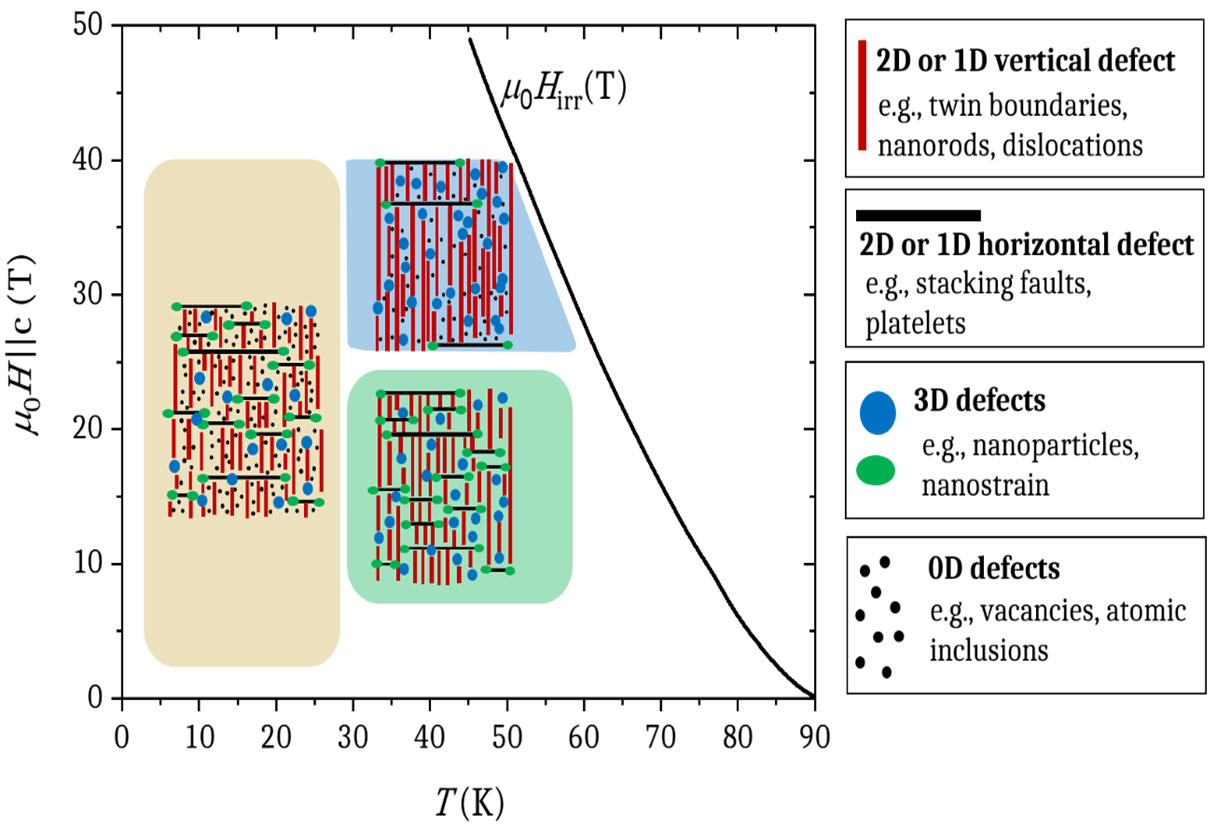
Figure 2. H–T diagram with three optimized pinning landscapes in the regions of: low temperatures from low magnetic fields to ∼35 T, intermediate temperatures and intermediate magnetic fields (∼15 T) and intermediate temperatures and very high magnetic fields (∼35 T). Reproduced from DOI: 10.1038/s43246-022-00266-y. CC BY 4.0.
Reference:
Obradors, X.*, Puig, T.*, Ricart, S., Palau, A., Coll, M., Gutiérrez, J., Farjas, J. & Bartolomé, E. (2024). Progress in superconducting REBa2Cu3O7 (RE= rare earth) coated conductors derived from fluorinated solutions. Superconductor Science and Technology, 37(5), 053001.
DOI: 10.1088/1361-6668/ad36eb
You can access the article here.
