


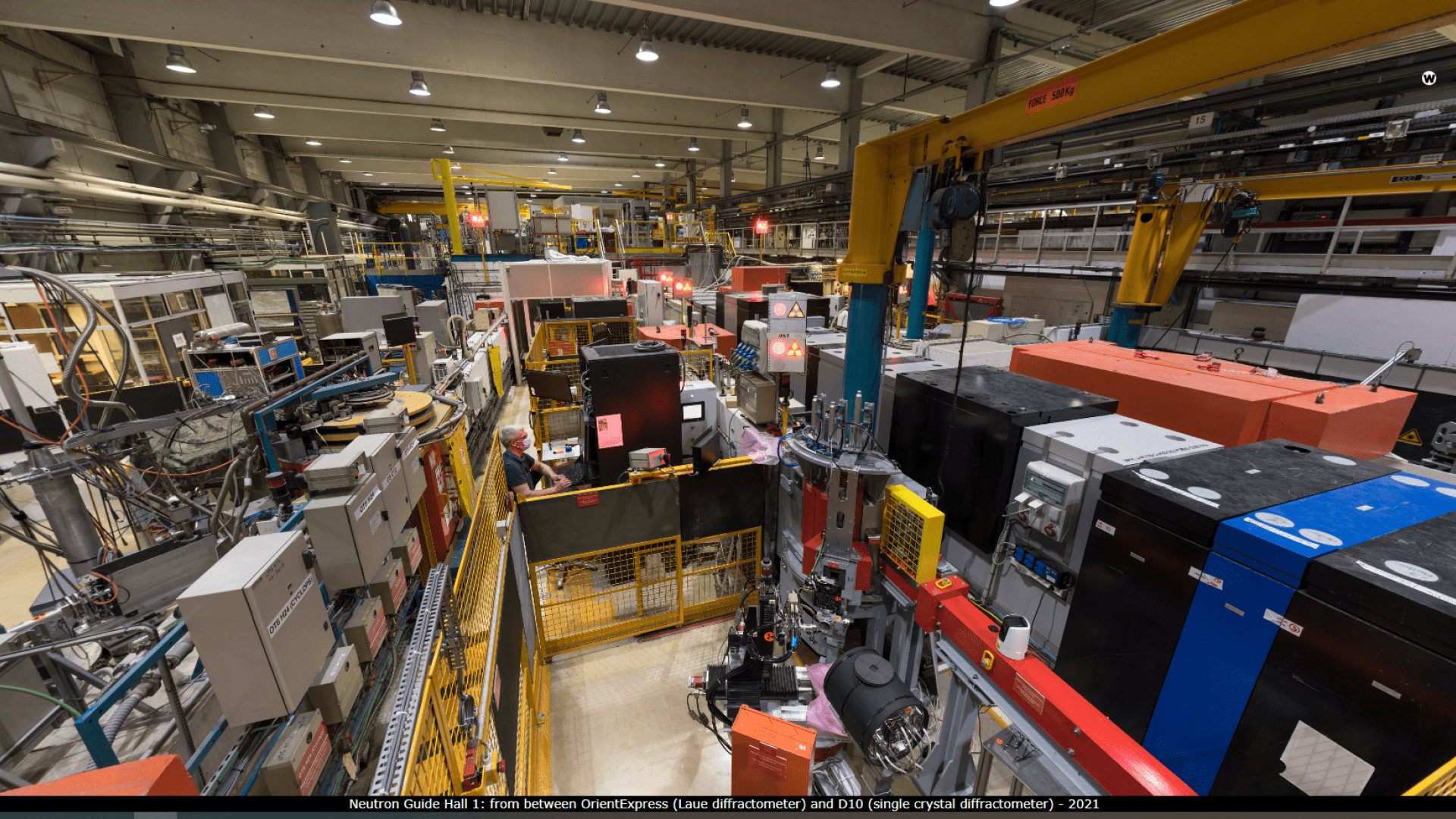
Multiferroic materials, in which electric and magnetic properties are combined in promising ways, will be the heart of new solutions for data storage, data transmission, and quantum computers. Meanwhile, understanding the origin of such properties at fundamental level is key for developing applications, and neutron are the ideal probe. Neutrons possess a magnetic dipole moment which makes them sensitive to magnetic fields generated by unpaired electrons in materials. This makes neutron scattering techniques a powerful tool to probe the magnetic behaviour of materials at atomic level.
The story of the so-called Cu/Fe layered perovskites (RBaCuFeO5) and the breakthrough results now published by the CMEOS group (Crystallography of Magnetic and Electronic OxideS) at ICMAB-CSIC in collaboration with ILL researches are a paradigmatic example highlighting both the role of fundamental studies in the development of applications and of the power of neutrons. Being a promising class of materials exhibiting coupled magnetic and electric ordering properties at ambient temperatures, the magnetic structure of the layered perovskites YBaCuFeO5 – and thus the origin of their interesting magneto-electric behaviour – was still to be unambiguously determined. The results now published pinpoint the spiral magnetic structure of these materials, finally establishing the common origin of its promising magnetic and electric properties up to room temperatures.
The first important step was to go from polycrystalline powder samples to high-quality single crystals. The crystals were grown and characterised at ICMAB-CSIC. José-Luís Garcia-Muñoz and his team performed neutron experiments at the ILL using five instruments and taking advantage of advanced sample environment technologies (Orient Express, Cyclops, D10, D9, D3). Most of data analysis was performed by the ICMAB PhD candidate (now young doctor) Arnau Romaguera.
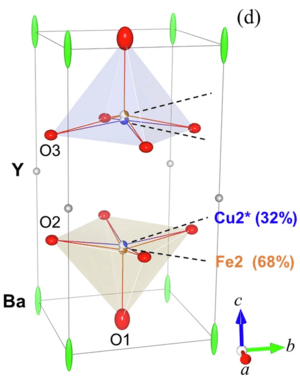
Structure of the YBCFO crystal determined at 10 K | J.L. García-Muñoz
Tiny spiralling magnets
Multiferroics are materials where two ferroic orders coexist. From a technological perspective, the combination of ferroelectricity (characterized by a net electrical polarization) and long-range magnetic order (such as ferromagnetic, ferrimagnetic, or antiferromagnetic order, depending on the alignment of magnetic moments arising from the non-coupled electron spins) is highly sought after.
In some multiferroics, electric and magnetic properties are strongly coupled: the alignment of the magnetic moments induces the charge separation. A well-established case of strongly coupled electric and magnetic order is spiral magnetic order –neighbouring spins arrange themselves in a spiral pattern, which in turn is able to create electric dipoles.
Coupled magnetic and electric orders make it possible to act on the magnetic properties using an electric field, and to act on the electric properties using a magnetic field. Coupled multiferroics are thus promising materials to design new devices. In particular, using an electric (rather than magnetic) field to act on the magnetic order – for example, to change the state of a bit in a storage device, or to manipulate spin states – is much less energy consuming. Moreover, such materials are usually less volatile (less perturbed by external magnetic fields), which increases stability in devices and allows for further miniaturisation.
Spiral multiferroics are scarce. In fact, rather severe constrains on the symmetry and geometry of the material’s microscopic structure are imposed for such peculiar properties to arise. In most multiferroic materials, the characteristic ordering only subsists at very low temperatures. In practice, this strongly limits the possibility of implementation in devices.
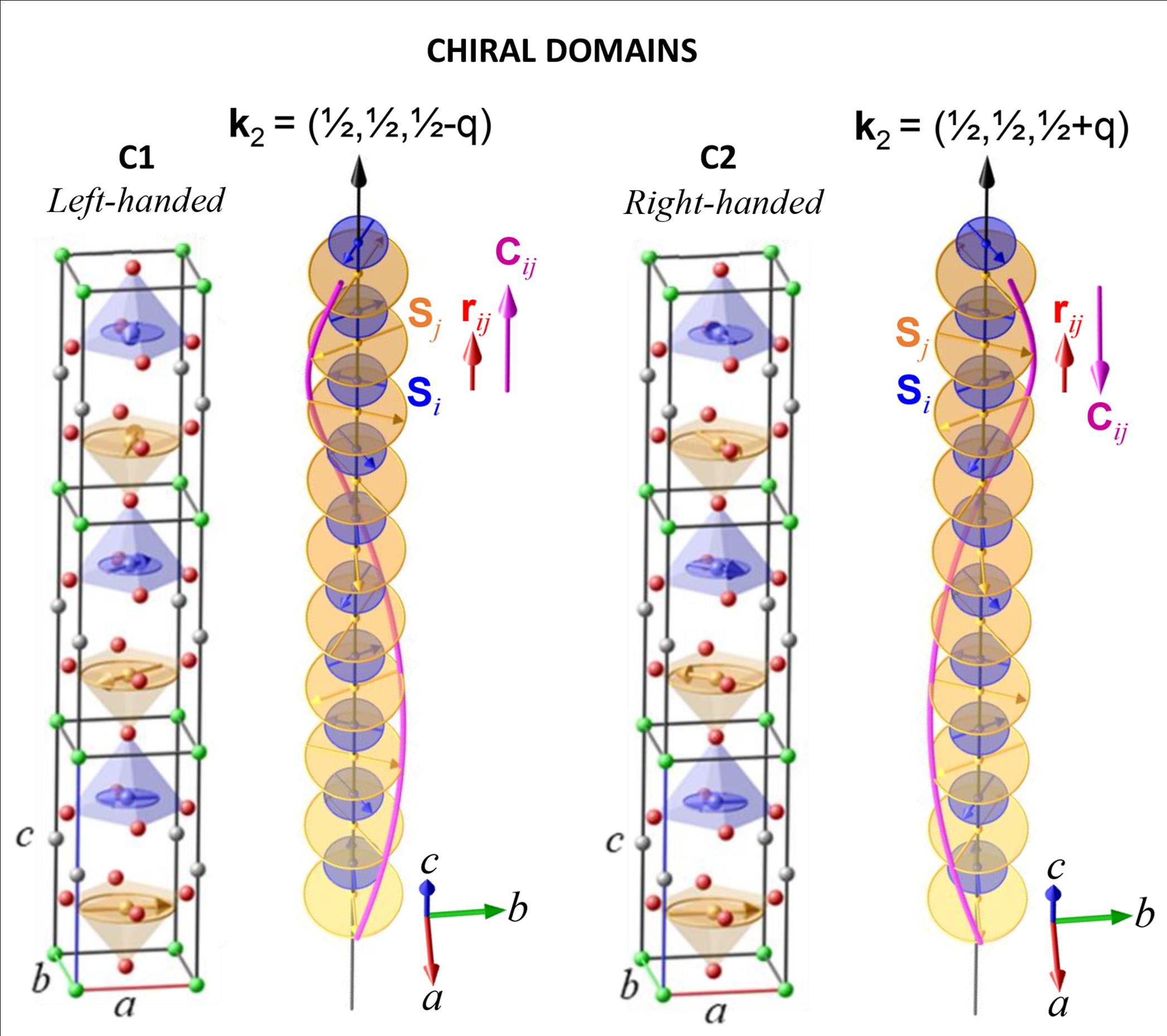 Chiral magnetic domains at ambient temperature on layered perovskites | J.L. García-Muñoz
Unveiling perovskite mysteries with neutrons
Layered perovskites (RBaCuFeO5) are a rare case exhibiting coupled magnetic and electric ordering properties at high temperatures, and thus a promising class of materials for different applications. However, their underlying magnetic structure – and thus the origin of their interesting magneto-electric behaviour – was still to be unambiguously determined. In fact, a non-conventional mechanism (named ‘spiral order by disorder’) was devised that could account for the extraordinary thermal stability of their presumed spiral magnetic order. Nevertheless, there was no conclusive data supporting the existence of spiral order in these materials. Indeed, the available results, obtained with polycrystalline samples using powder neutron diffraction measurements, were compatible with spiral order but also with sinusoidal spin modulation – an arrangement that would not give rise to ferroelectricity. A study able to disentangle the two possibilities was still lacking.
The study now published in Communications Materials filled in this gap, essentially by taking two very important steps forward. First, the availability of single crystals. Second, their complex magnetic structure and magnetoelectric response were then extensively analysed with polarised and unpolarised neutrons at the ILL. The use of polarised neutrons by the Spherical Neutron Polarimetry (SNP) technique at D3 neutron instrument was decisive to prove that these singular layered perovskites are spiral magnets well beyond ambient temperature thanks to a new mechanism of ‘spiral order by disorder’.
These findings highlight the power of fundamental research and neutron techniques in advancing next-generation multifunctional materials.
Reference Article
A. Romaguera, O. Fabelo, N. Qureshi, J.A. Rodríguez-Velamazán & J.L. García-Muñoz
Evidence of high-temperature magnetic spiral in YBaCuFeO5 single-crystal by spherical neutron polarimetry
Communications Materials, Volume 5, 273 (2024), 19 December 2024.
DOI: 10.1038/s43246-024-00710-1