


A new paper has been published in Physical Review Letters:
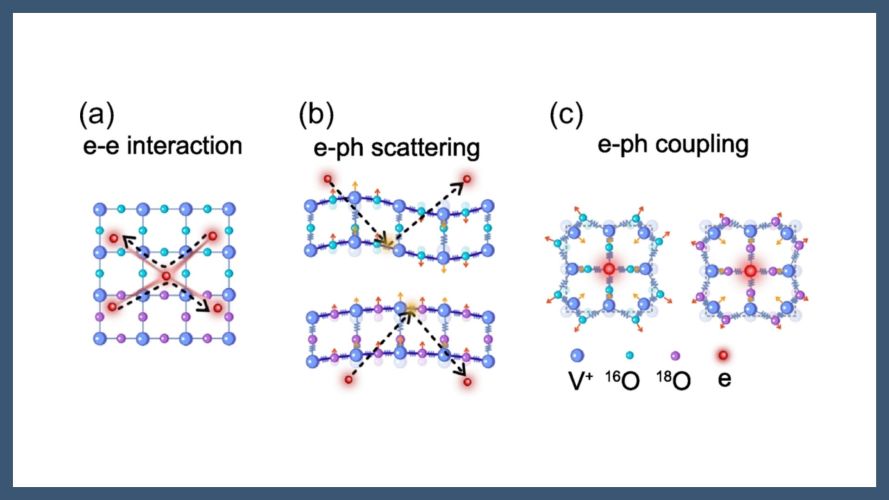
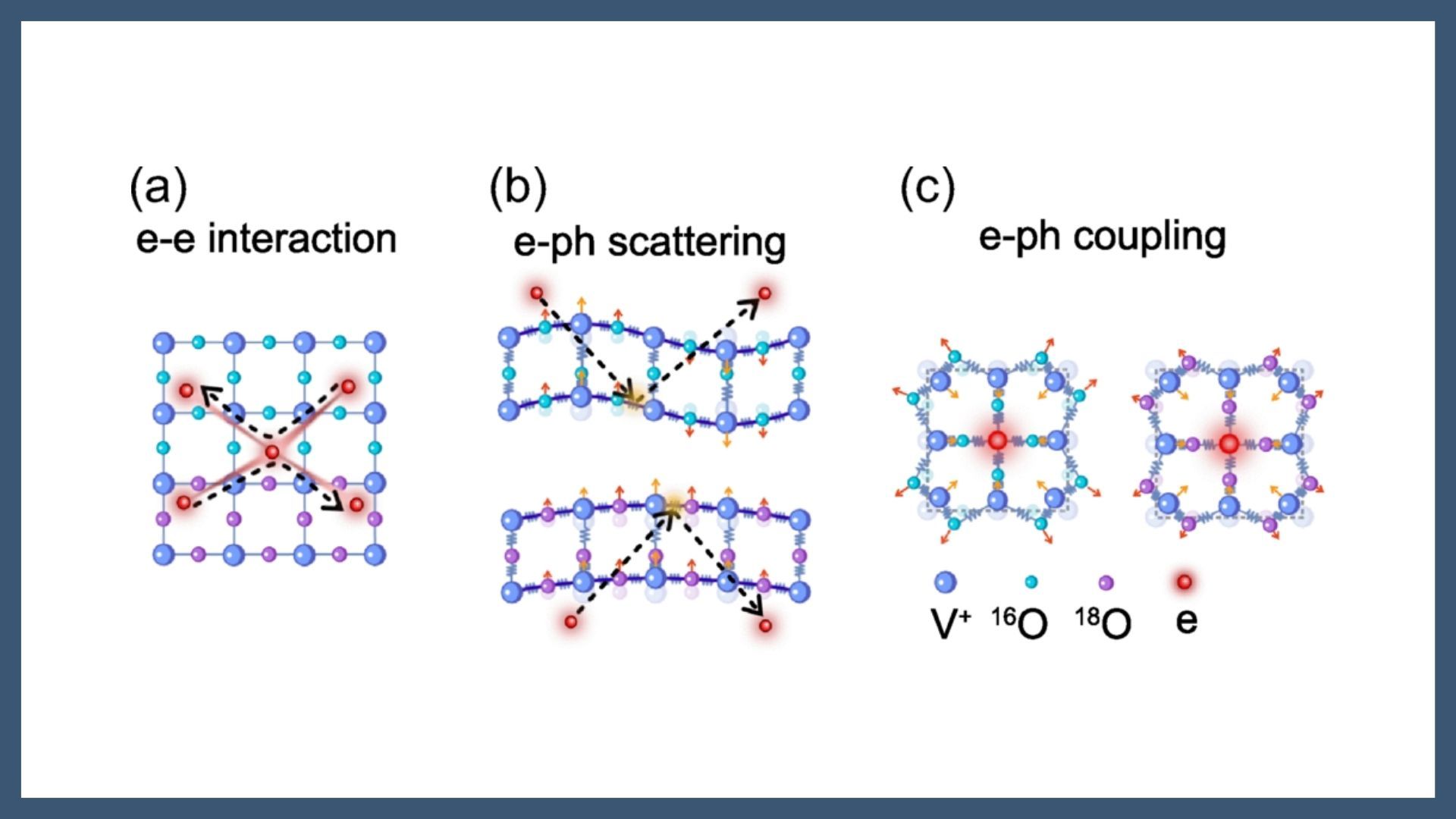
Transition metals exemplify correlated electronic systems, where electron-electron (e−e) scattering often results in a quadratic temperature dependence of the electrical resistivity, p(𝑇) ∝T2. In SrVO3 (SVO), a material with a V−3d1 electronic configuration that ensures metallicity through narrow 3d-t2g bands, a p(𝑇) ∝T2 dependence has been reported. While traditionally attributed to e−e scattering, recent studies suggest that electron-phonon (e-ph) interactions may play a significant role. To unravel the influence of phonon interactions on carrier transport in SVO, we present a comparative study of the transport and optical properties of SVO films with partial substitution of 16O ions by their heavier isotope, 18O. Our findings reveal that 18O substitution induces a change in the slope of dp(T)/dT at nominal fixed carrier density, highlighting the dominant contribution of e-ph coupling over e−e scattering in determining p(T). Furthermore, it is found that the 18O substitution softens the phonon lattice and promotes a reduction in plasma frequency and an increase in the carrier effective mass. These results indicate that the e-ph coupling strength increases upon 18O substitution. Our findings suggest that e-ph interactions may surpass e−e scattering in governing the resistivity of metallic ionic lattices.
M4ELC Sustainable Electronics
Oxygen Isotope Fingerprints of Electron-Phonon Coupling in SrVO3 Films
Singh, Gyanendra; Huang, Xiaochun; Mirjolet, Mathieu; Pane, Salvador; Lippert, Thomas; Schneider, Christof W.; Fontcuberta, Josep
DOI: 10.1103/mtzb-b5ww

