


An article has been published in Advanced Energy Materials, about the thermal conductivity of polymers:
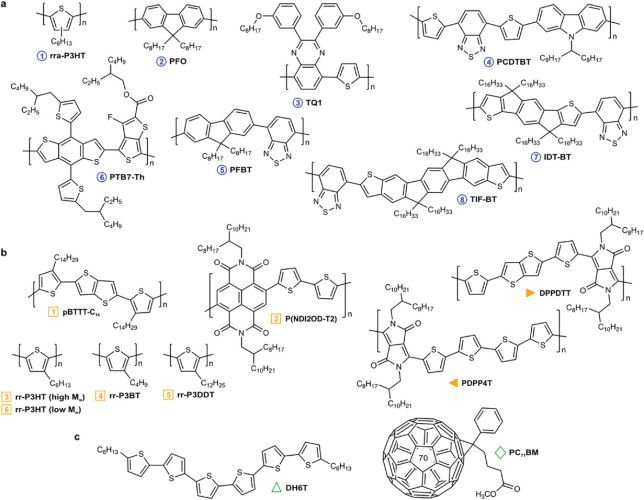
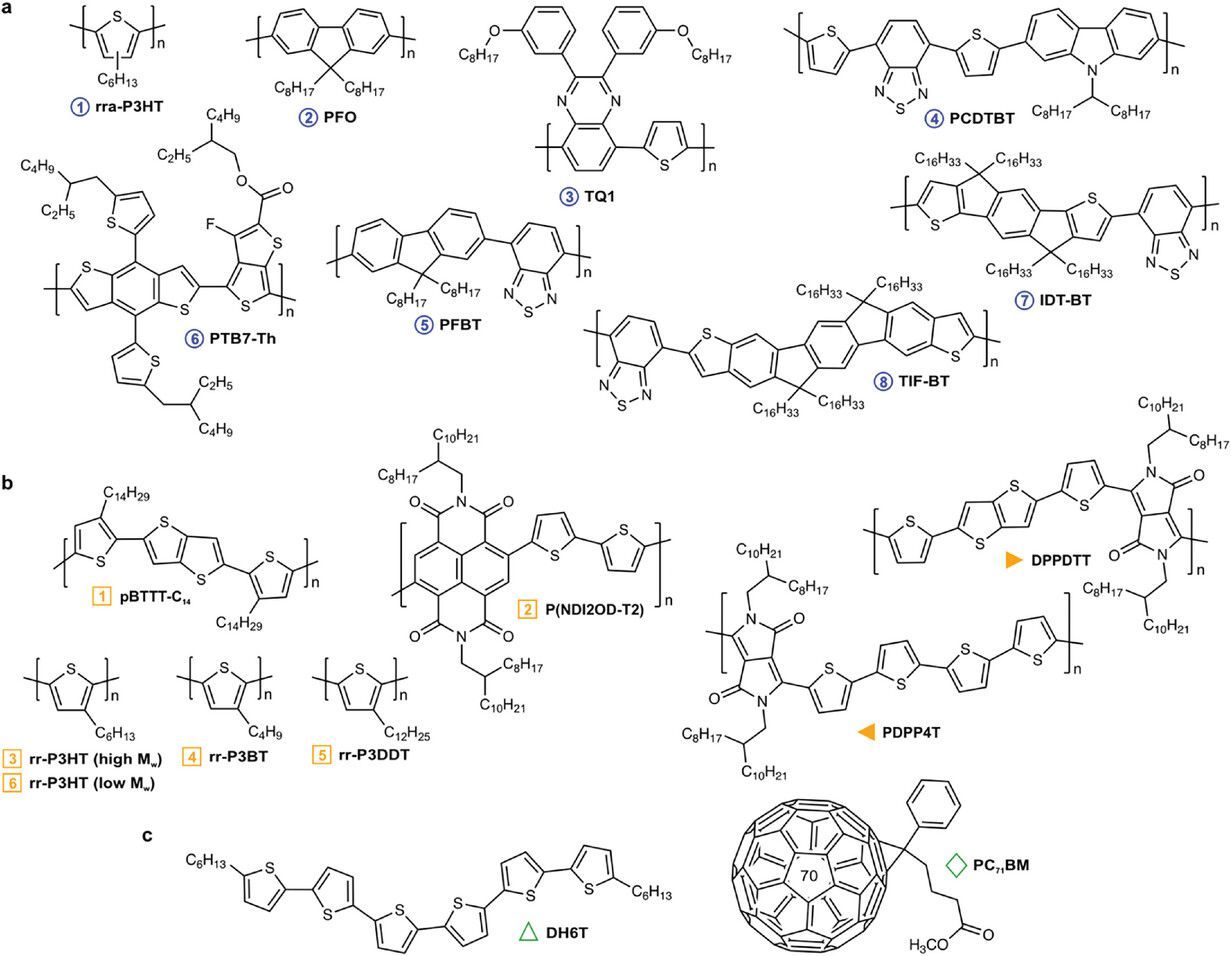
The thermal conductivity (κ) governs how heat propagates in a material, and thus is a key parameter that constrains the lifetime of optoelectronic devices and the performance of thermoelectrics (TEs). In organic electronics, understanding what determines κ has been elusive and experimentally challenging. Here, by measuring κ in 17 π-conjugated materials over different spatial directions, it is statistically shown how microstructure unlocks two markedly different thermal transport regimes. κ in long-range ordered polymers follows standard thermal transport theories: improved ordering implies higher κ and increased anisotropy. κ increases with stiffer backbones, higher molecular weights and heavier repeat units. Therein, charge and thermal transport go hand-in-hand and can be decoupled solely via the film texture, as supported by molecular dynamics simulations. In largely amorphous polymers, however, κ correlates negatively with the persistence length and the mass of the repeat unit, and thus an anomalous, albeit useful, behavior is found. Importantly, it is shown that for quasi-amorphous co-polymers (e.g., IDT-BT) κ decreases with increasing charge mobility, yielding a 10-fold enhancement of the TE figure-of-merit ZT compared to semi-crystalline counterparts (under comparable electrical conductivities). Finally, specific material design rules for high and low κ in organic semiconductors are provided.
M4ELC Sustainable Electronics
On The Thermal Conductivity of Conjugated Polymers for Thermoelectrics
Xabier Rodríguez-Martínez, Fernan Saiz, Bernhard Dörling, Sara Marina, Jiali Guo, Kai Xu, Hu Chen, Jaime Martin, Iain McCulloch, Riccardo Rurali, Juan Sebastian Reparaz, Mariano Campoy-Quiles
Advanced Energy Materials, 2401705, July 2024

