


Press
New study reveals how synchrotron light impacts battery materials during real-time analysis
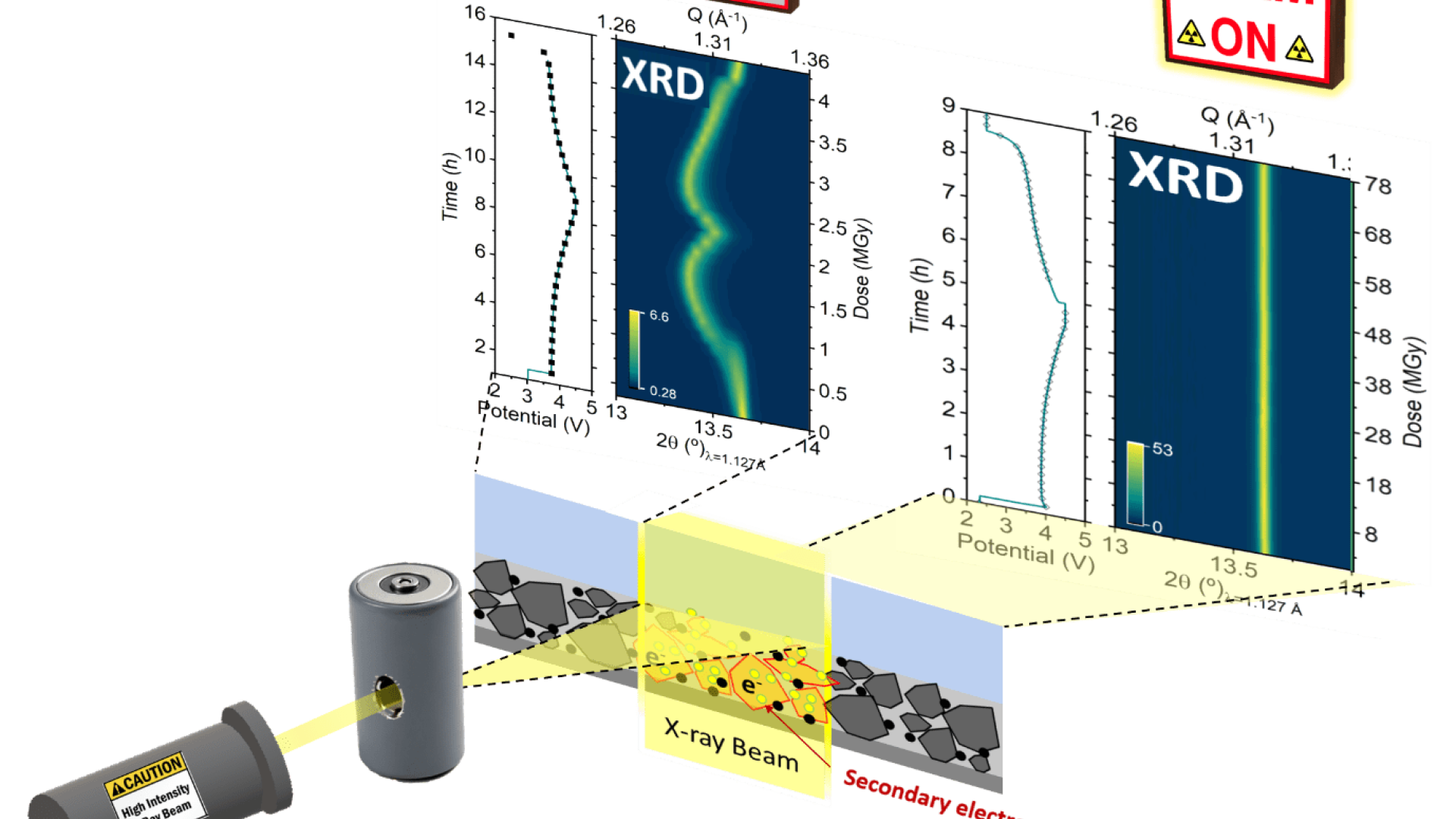
A multi-centre study carried out by ALBA Synchrotron, ICMAB-CSIC, CIC energiGUNE and BRTA researchers has uncovered critical beam-induced effects in battery materials studied using synchrotron light. The team demonstrated that X-ray radiation can inhibit electrochemical activity in common lithium-ion battery electrodes during characterization studies. The study identifies radiation dose thresholds and proposes new strategies to mitigate beam-induced effects to ensure more accurate operando battery characterization.
Efficient energy storage is critical to achieving a clean energy future, since large-scale batteries will enable the storage and distribution of renewable energy sources like solar and wind power. Global efforts to optimize battery performance include the development of new materials, which are often characterized using synchrotron-based operando techniques. These real-time measurements examine the performance of the battery as it charges and discharges. However, the potential impact of high-intensity X-ray beams on the materials under study had not been fully understood until now, raising concerns about the accuracy of results from these powerful techniques.
A new study, published in Chemistry of Materials, sheds light on this issue by systematically investigating how synchrotron radiation affects two widely used battery electrode materials based on lithium: LiNi0.33Mn0.33Co0.33O2 (NMC111) and LiFePO₄ (LFP). The research reveals that the X-ray beams produced at synchrotron facilities and used in these experiments can alter the electrochemical activity of these materials, and in extreme cases, this may lead to incorrect conclusions about the performance of the materials.
Researchers from the Institute of Materials Science of Barcelona (ICMAB-CSIC), the Centre for Cooperative Research on Alternative Energies (CIC energiGUNE), the Basque Research and Technology Alliance (BRTA) and the ALBA Synchrotron collaborated to investigate the electrochemical behavior of NMC111 and LFP—two key components of commercial lithium-ion batteries—under X-ray radiation. Using X-ray Diffraction (XRD) and X-ray Absorption Spectroscopy (XAS) at the Materials Science and Powder Diffraction Beamline (MSPD) and NOTOS beamlines of ALBA, they observed how the materials reacted to different radiation intensities while undergoing charge and discharge cycles.
The results showed that at high doses, the synchrotron radiation caused a localized inhibition of the electrochemical reactivity at the irradiated areas. In other words, the X-ray beam interfered with the normal functioning of the battery material, slowing down or halting the expected chemical reactions. The effects were found to be dose-dependent, with higher radiation doses leading to more significant inhibition. Importantly, the study demonstrated that these effects were reversible. Once the beam was moved to a different area or when the radiation intensity was reduced, the materials returned to their normal activity. This suggests that the materials were not permanently damaged by the beam, but rather their activity was temporarily “paused” due to X-ray exposure.
These findings corroborate already known beam-induced effects in operando measurements with synchrotron light. Nevertheless, thanks to the systematic investigation they also enable researchers to propose several strategies to mitigate them. For example, reducing the intensity of the synchrotron beam by using attenuators, such as aluminum foils to lower the photon flux reaching the sample. The researchers also found that thinner battery electrodes were less affected by the beam, suggesting that the thickness of the materials being studied influences their radiation tolerance. Additionally, they observed that controlling the exposure time and introducing rest periods between measurements could help prevent the build-up of beam effects.
This study, the first to use the NOTOS beamline for advancing battery research, not only provided a first systematic analysis of the beam-induced effects when using synchrotron light to study materials under actual working conditions, but also has broader implications for improving the accuracy of synchrotron-based characterization techniques across many fields of materials science.
As scientists work to develop new and more efficient battery materials—especially for applications like electric vehicles and renewable energy storage—synchrotron specialists around the world will continue refining high-brilliance X-ray techniques to provide accurate, real-time data for understanding the complex chemical processes that take place during battery operation. One of the coauthors of this scientific contribution, Dr. Carlos Escudero, beamline scientist at NOTOS beamline, stated: “The use of synchrotron radiation provides the researchers with the ability to observe complex and dynamic processes making it an essential tool for advancing battery research. The potential of operando XAS and XRD synchrotron techniques to characterize battery materials during cycling, helping to get a better understanding of the ongoing electrochemical processes, is attracting more and more researchers. However, when performing experiments with synchrotron light, one should consider possible beam-induced effects that can lead to misleading results. Their detection and the development of mitigation strategies to minimize these undesired effects is a key”.
Reference article:
Beam Effects in Synchrotron Radiation Operando Characterization of Battery Materials: X‐Ray Diffraction and Absorption Study of LiNi0.33Mn0.33Co0.33O2 and LiFePO4 Electrodes.
Ashley P. Black*, Carlos Escudero, François Fauth, Marcus Fehse, Giovanni Agostini, Marine Reynaud, Raphaelle G. Houdeville, Dimitrios Chatzogiannakis, Joseba Orive, Alejandro Ramo-Irurre, Montse Casas-Cabanas*, M. Rosa Palacin*
Chem. Mater. 2024, 36, 5596−5610
doi/full/10.1021/acs.chemmater.4c00597