


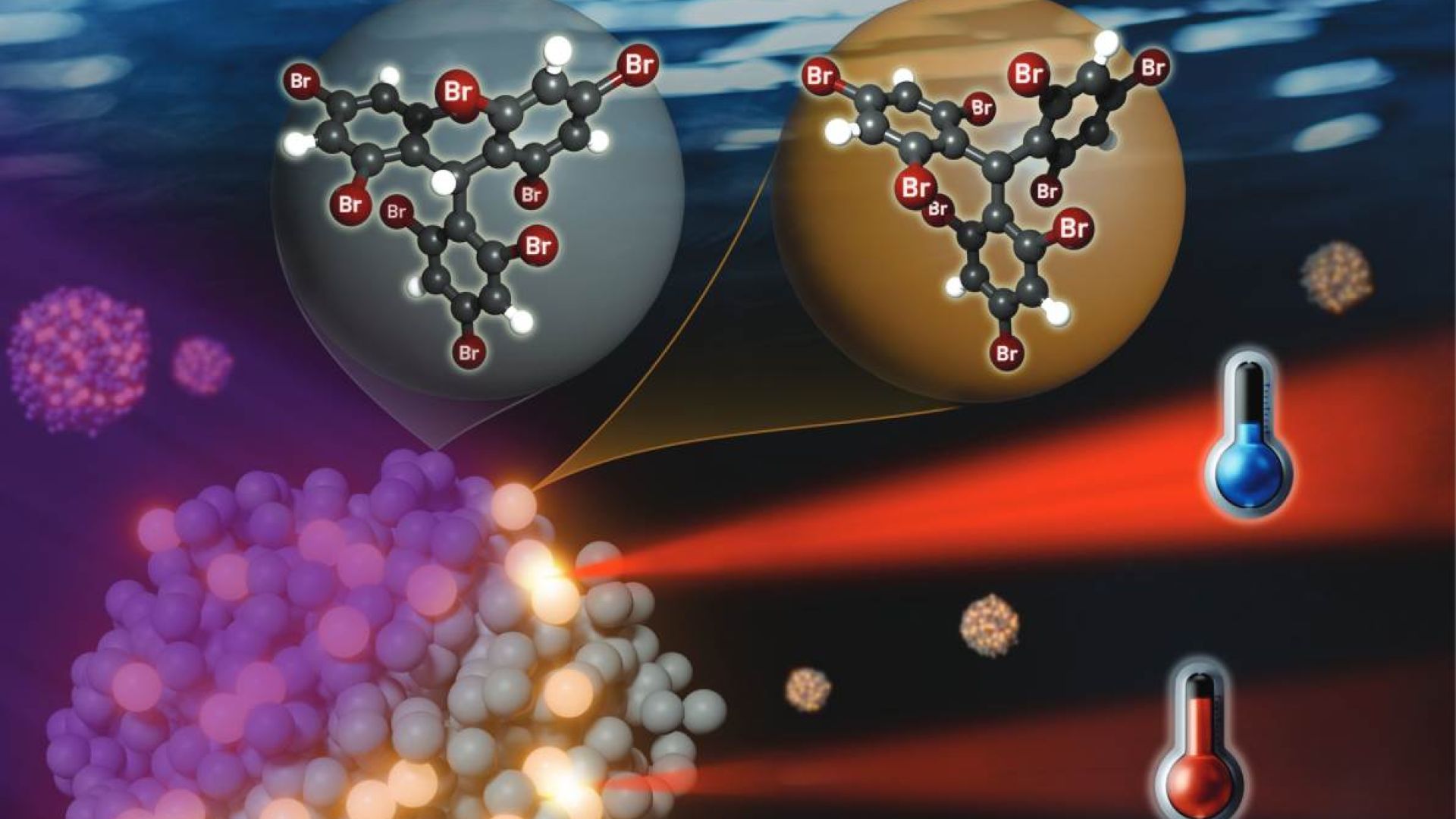
A team of researchers at ICMAB, in collaboration with researchers from theNetworking Research Center on Bioengineering, Biomaterials and Nanomedicine (CIBER-BBN), theInstituto de Ciencia Molecular (ICMol) and the Laboratory for Chemistry of Novel Materials, has made a significant breakthrough related to brominated trityl radical nanoparticles. Their study, recently published in the Journal of Materials Chemistry C and featured on the cover, sheds light on an both the emissive and thermal properties of these nanoparticles.
"For us, developing brominated organic radical nanoparticles has made possible to push their emission deeper into the NIR while preserving thermometric sensitivity, bringing us closer to non-invasive nanoscale temperature measurements for high-resolution, real-time sensing in biomedical applications.”, explained Imma Ratera and Paula Mayorga, authors of this research.
Cover featuring the article by Ratera et al. in the Journal of Materials Chemistry C
Synthesis and characterization of organic nanoparticles (ONP)
Researchers prepared tris(2,4,6-tribromophenyl)methane (TTBrM-αH) and tris(2,4,6-tribromophenyl)methyl radical (TTBrM). The obtained TTBrM was crystallized, and two different polymorphs were identified. One corresponds to platelet-like crystals with a minimal Cmeta–Cmeta intermolecular distance of 4.092 Å between two neighbouring radical molecules. This structure was previously reported. But, researchers also discovered a new polymorph in the form of needle-shaped crystals and exhibiting a shorter Cmeta–Cmeta distance of 3.802 Å. This value is comparable to that observed for TTM crystals (i.e., 3.854 Å) that is known to form excimers when used to generate radical doped organic nanoparticles.
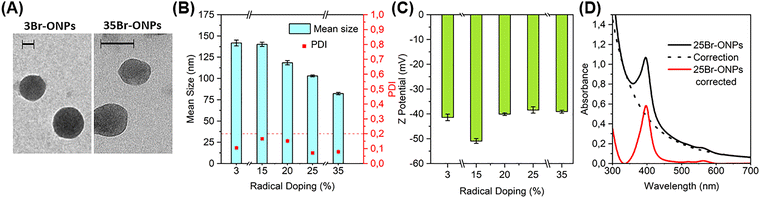
Br-ONPs characterization. (A) Representative TEM image of 3Br-ONPs (left) and 35Br-ONPs (right). Scale = 50 nm in both cases; (B) hydrodynamic diameter evolution, polydispersity (PDI) index and (C) Z-Potential distribution with increasing TTBrM doping ratio of the Br-ONPs; (D) UV-Vis electronic absorption spectra of 25Br-ONPs water dispersion before (black) and after (red) the mathematical treatment for scattering correction.
Emissive and thermal properties of Br-ONPs
With the successful nanostructuration of TTBrM radicals into Br-ONPs, their fluorescence behaviours were examined in the laboratory to complete the characterization of the nanoparticles. To this end, emission spectra for each aqueous dispersion were recorded under a fixed wavelength excitation at room temperature. The spectra of Br-ONPs with low radical doping ratios only showed a main emission band at 597 nm, in line with the fluorescence spectrum of the isolated TTBrM in solution. At such low concentration of TTBrM radical, the molecules inside the Br-ONPs are expected to be completely isolated, avoiding the aggregation-caused quenching (ACQ) and also too far apart to electronically interact effectively, preventing the formation of optically active excimers.
Researchers also investigated the thermometric performance of Br-ONPs with different TTBrM radical doping through temperature-dependent emission measurements under 390 nm excitation. All samples display dual emission bands corresponding to the monomer (597 nm) and excimer (710 nm) transitions. As the temperature increases from 5 °C to 55 °C, a gradual decrease in excimer emission is observed across all samples, accompanied by a relatively stable or slightly increasing monomer signal (Fig. S9E–H), confirming a ratiometric thermometric response.
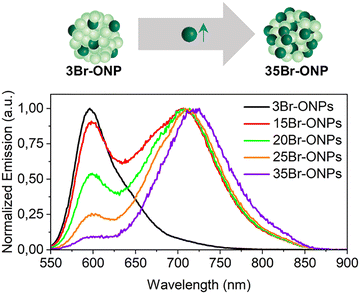
Fluorescence behaviour of Br-ONPs. Normalized emission spectra of Br-ONPs suspensions at different % of TTBrM content. Experimental details: all the water suspensions were measured at 20 °C and at a single excitation wavelength (λexc) at 390 nm.
Reference article
Brominated trityl radical nanoparticles: metal-free ratiometric nanothermometer with near-infrared excimeric emission in water
Nerea Gonzalez-Pato, Giovanni Schievano, Pau Armada, Jesús Cerdá, Davide Blasi, Juan Aragó, Jaume Veciana, Paula Mayorga-Burrezo and Imma Ratera
J. Mater. Chem. C, 2025,13, 23392-23399
DOI: 10.1039/D5TC02784E
