


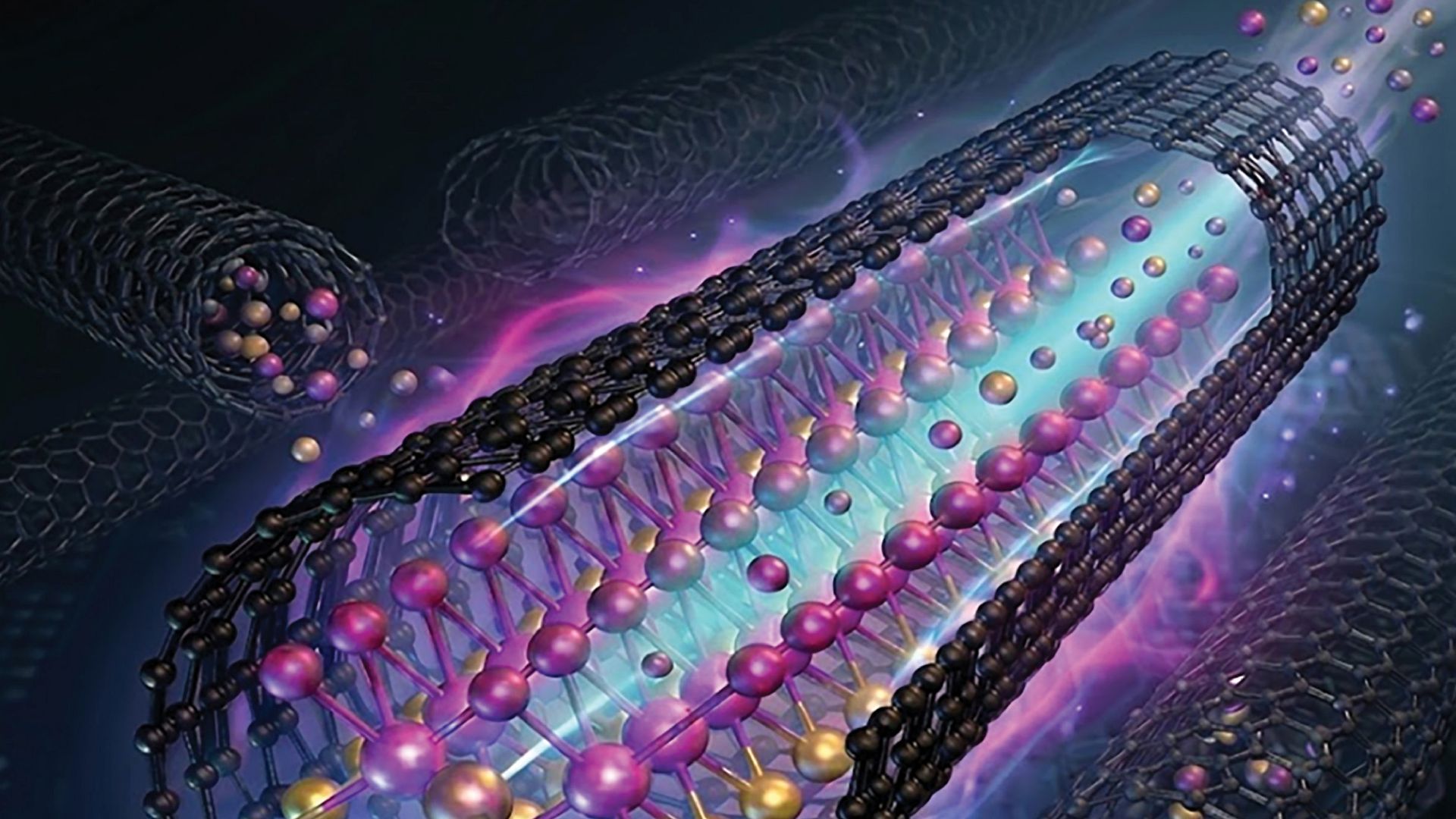
What are strain-engineered one-dimencional van der Waals heterostructures?
Strain-engineered one-dimensional (1D) van der Waals heterostructures are nanoscale structures made by combining different materials in a wire-like geometry. Their components interact through weak van der Waals forces, allowing them to be combined without necessarily forming conventional chemical bonds at the interface.
Strain engineering involves stretching, compressing, bending, or confining these materials to modify their atomic structure and physical properties. These changes can affect their electronic band structure, electrical conductivity, optical response, and charge transport.
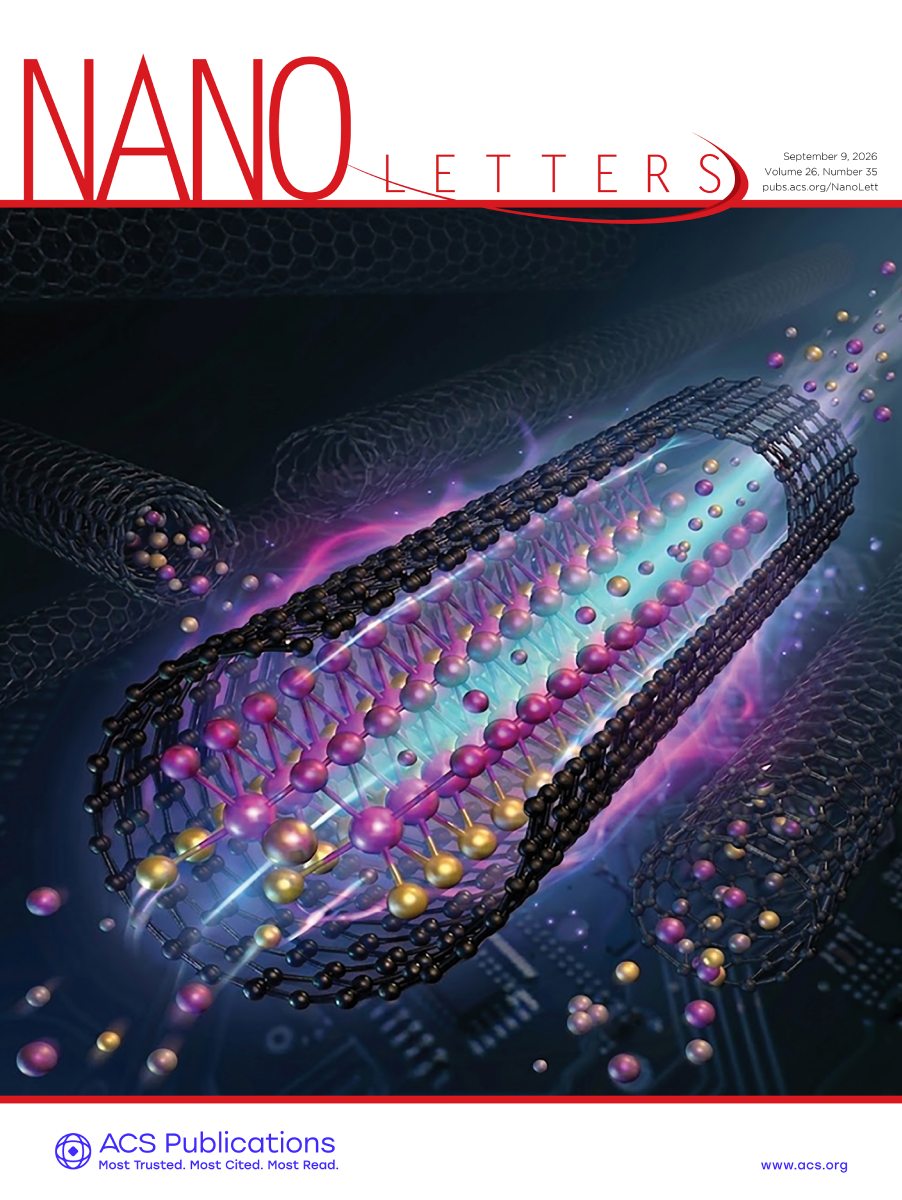
Cover of the article featured in Nano Letters by Tobías et al.
What is the importance of this research?
This research demonstrates that BiTeI, a polar semiconductor with strong spin-orbit coupling, can be confined inside carbon nanotubes to create a new type of one-dimensional van der Waals heterostructure. The nanotubes act not only as containers but also as templates that mechanically compress the material, generating strain at the atomic scale. The study shows that this confinement significantly alters the electronic structure of BiTeI, increasing its band gap and modifying its Rashba spin splitting, a property that is central to the development of spintronic devices that use electron spin rather than charge to process information.
More broadly, the work establishes nanoconfinement as a powerful strategy for engineering quantum materials. The authors found that BiTeI-filled nanotubes exhibit enhanced and stable electrical conductivity, while theoretical calculations predict that strain could even drive the material toward semimetallic or metallic behavior. These findings suggest new opportunities for designing tunable materials for infrared photodetectors, optical sensors, telecommunications technologies, and future spin-based electronics. Beyond BiTeI itself, the study provides a general framework for controlling the properties of low-dimensional materials through confinement and strain, opening new directions in nanotechnology and materials science.
Abstract
Controlling the nanostructure and electronic properties of polar semiconductors could enable new applications in nanoelectronics. Here, we report the synthesis of one-dimensional BiTeI nanowires confined within single- and multiwalled carbon nanotubes using a sublimation-driven transport reaction. Aberration-corrected scanning transmission electron microscopy reveals highly ordered BiTeI nanowires ranging from one to six atomic layers. Density gradient ultracentrifugation enables the separation of filled and empty nanotubes, while Raman spectroscopy evidences host–guest interactions. Furthermore, the encapsulation of BiTeI leads to an increase in the optical band gap and a stable enhancement in electrical conductivity in macroscopic films. First-principles calculations show that compressive strain significantly modifies the BiTeI electronic structure, including reduced Rashba splitting and strain-induced band reordering. Overall, nanoconfinement is shown to be a powerful route to probe and engineer strain-tunable electronic states in polar semiconductors at the one-dimensional scale.
Reference article
Strain-Engineered One-Dimensional van der Waals Heterostructures: BiTeI Confined in Carbon Nanotubes.
Nano Lett. 9 September 2026; 26 (35): 11738–11747
https://doi.org/10.1021/acs.nanolett.6c02509
