The article is by authors Gail A. Vinnacombe-Willson, Ylli Conti, Steven J. Jonas, Paul S. Weiss, Agustín Mihi, and Leonardo Scarabelli (Advanced Materials, Volume 34, Issue 37, September 15, 2022, 2205330, 10.1002/adma.202205330).
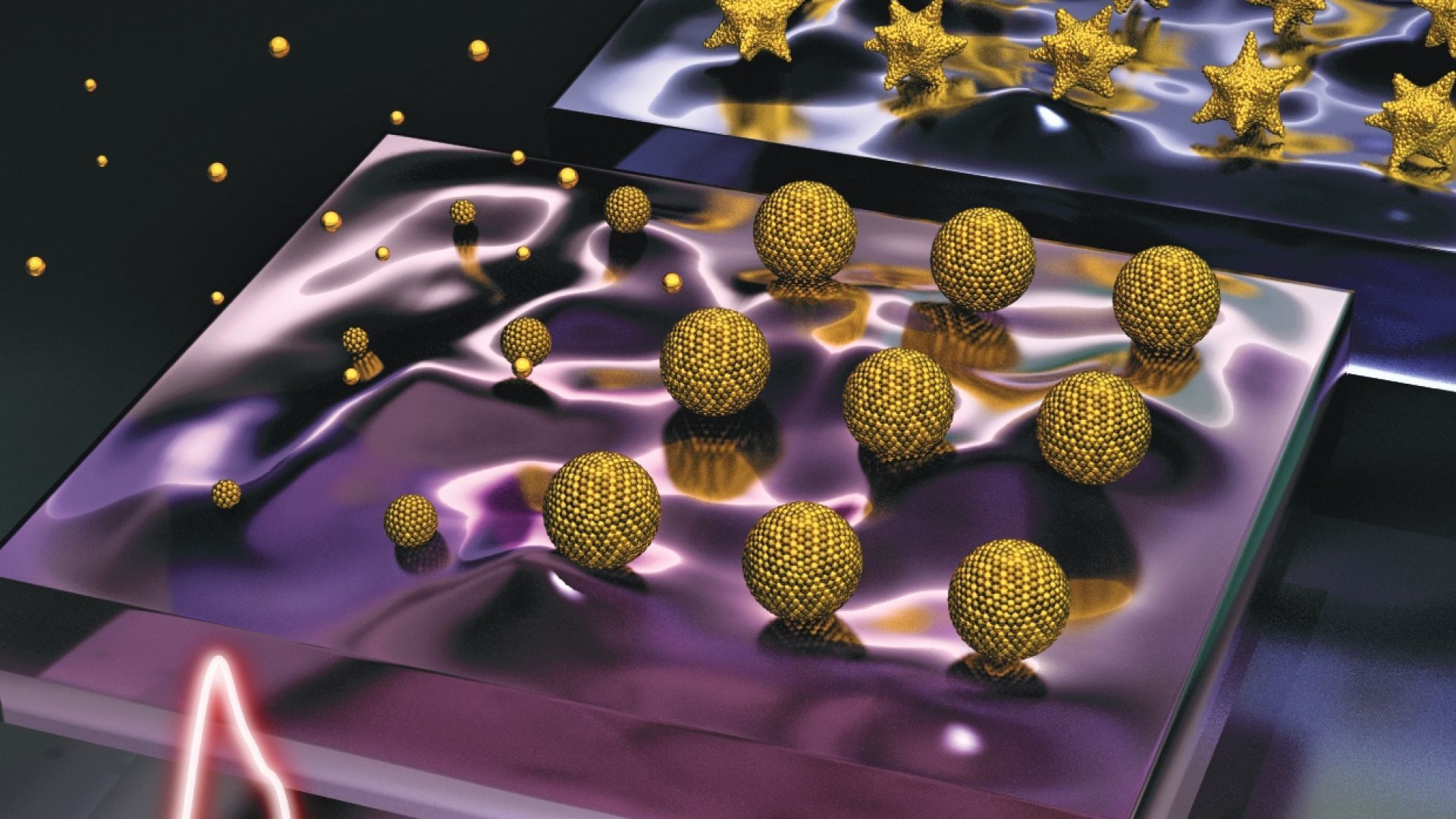
In article number 2205330, Leonardo Scarabelli and co-workers report on the in situ growth of gold nanoparticle plasmonic ordered arrays. In situ growth is an unconventional fabrication approach where gold precursors are reduced directly at specific chemically patterned areas on the substrate. Taking advantage of bottom-up wet-chemistry synthesis principles, nanoparticle morphology and array periodicity can be easily tuned using this method. The plasmonic arrays display narrow lattice plasmon resonances, constituting a major step forward for this class of techniques.
The cover represents these plasmonic ordered arrays formed by gold nanospheres of different sizes and gold nanostars. These plasmonic nanoparticles on substrates are important for designing optoelectronics, sensors and metamaterials with rational electronic, optical and magnetic properties.
Bottom-up synthesis offers unmatched control over morphology and optical response of individual plasmonic building blocks. Usually, the incorporation of nanoparticles made by bottom-up wet chemistry starts from batch synthesis of colloids, which requires time-consuming and hard-to-scale steps like ligand exchange and self-assembly.
Herein, an unconventional bottom-up wet-chemical synthetic approach for producing gold nanoparticle ordered arrays is developed. Water-processable hydroxypropyl cellulose stencils facilitate the patterning of a reductant chemical ink on which nanoparticle growth selectively occurs.
Arrays exhibiting lattice plasmon resonances in the visible region and near infrared (quality factors of >20) are produced following a rapid synthetic step (<10 min), all without cleanroom fabrication, specialized equipment, or self-assembly, constituting a major step forward in establishing in situ growth approaches. Further, the technical capabilities of this method through modulation of the particle size, shape, and array spacings directly on the substrate are demonstrated. Ultimately, establishing a fundamental understanding of in situ growth has the potential to inform the fabrication of plasmonic materials; opening the door for in situ growth fabrication of waveguides, lasing platforms, and plasmonic sensors.
See the cover here