


A new article has been published in Advanced Materials:
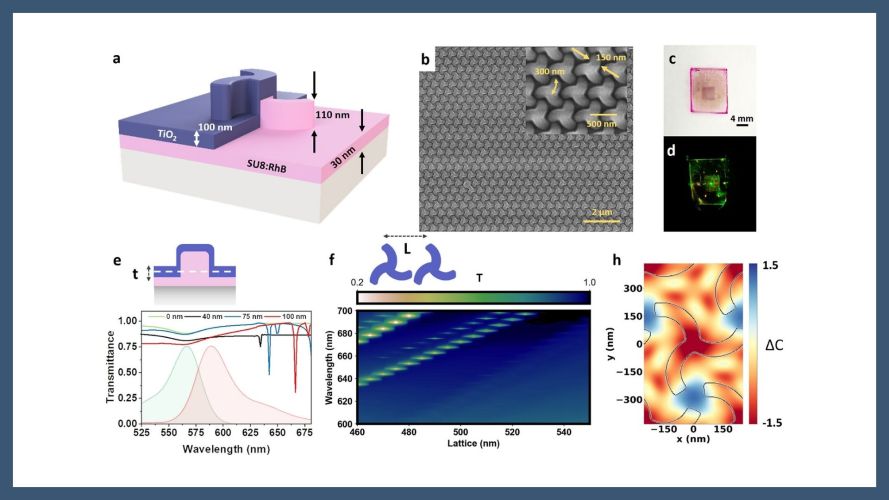
Circularly polarized light is essential for applications in optical communication, quantum computing, display systems, and chiral material characterization, among others. Yet, the inherently weak chiroptical response of most materials remains a fundamental limitation. Chiral nanophotonics overcomes this challenge by strongly enhancing light–matter interactions through resonant subwavelength nanostructures. Among these, emitters coupled to chiral bound states in the continuum (BICs) have shown excellent performance. However, the majority of chiral BIC architectures depend on costly nanofabrication processes, which significantly limit their scalability. Here, soft nanoimprinting lithography is used to produce chiral nanostructures that enable chiral lasing from an organic dye embedded in the patterned resist. Nearly fully circularly polarized lasing emission (97%) arises from coupling the dye photoluminescence to supported BIC resonances, as revealed by angular dispersion measurements and corroborated by Fourier microscopy and FDTD simulations. These results confirm coupling between orthogonally polarized TE and TM modes causing the BIC. Our work establishes a scalable route toward highly chiral light sources, advancing practical nanophotonic platforms for quantum and optical technologies.
M4NRG Clean Energy
Near-Unity Chiral Lasing Enabled by Quasi-Bound States in the Continuum
Mendoza-Carreno, Jose; Perez, Luis A.; De Galarreta, Carlota Ruiz; Rouanet, Theo; Alonso, M. Isabel; Mihi, Agustin
DOI: 10.1002/adma.73740

