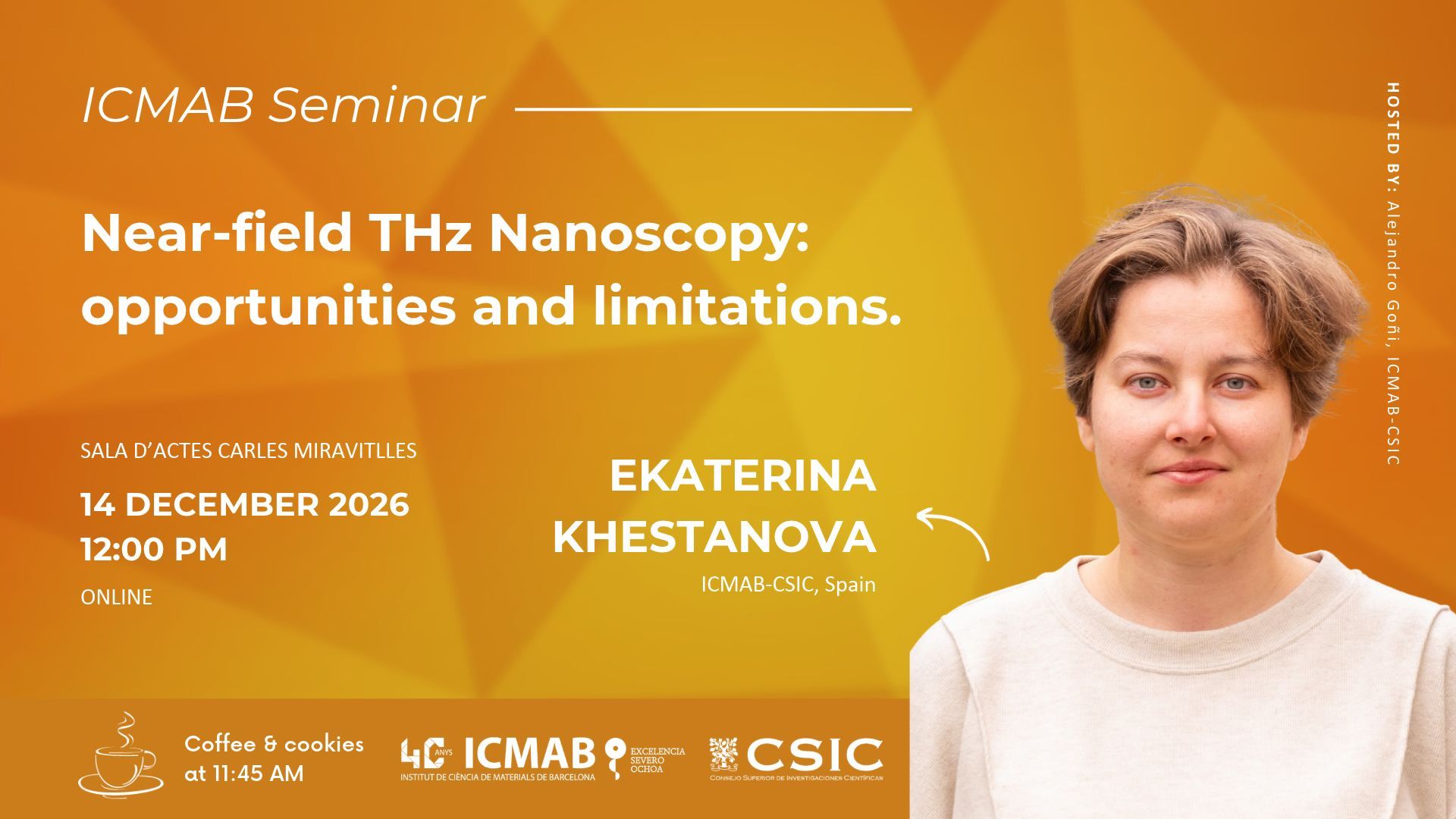
Near-field THz Nanoscopy: opportunities and limitations
Ekaterina Khestanova, ICMAB-CSIC
Monday, 14 December 2026, 12.00 PM
ICMAB - Sala d'Actes Carles Miravitlles and ONLINE (Register here)
Abstract
Terahertz radiation (0.1–10 THz) probes the low-energy electrodynamics of quantum materials: Drude transport, superconducting gaps, resonances related to the phonon, magnon and other collective modes. In the far field, however, diffraction limits THz spectroscopy to spots comparable to the wavelength (30 µm–3 mm). That is usually much larger than sizes of 2D materials flakes, crystalline domains or nanofabricated devices. Scattering-type scanning near-field optical microscopy (s-SNOM), established over two decades ago, removes this limit by concentrating the incident field at an apex of a metallic AFM tip. Since then, THz nanoscopy has detected contrast from fewer than 100 mobile electrons in a transistor, imaged the insulator-metal transition, and visualized confined polaritons in graphene, hBN and other 2D materials. For superconductors, theory predicts that the near-field probes can access the superconducting gap, the c-axis superfluid density and collective modes that do not couple linearly to far-field radiation. However, the experimental observations with sSNOM have been scarse.
This talk focuses on s-SNOM constraints behind the obtained results and failed theoretical predicitons.
Short bio
Ekaterina Khestanova earned her PhD from the University of Manchester in 2017, where she investigated the mechanical and electronic properties of two-dimensional materials, including the elasticity of graphene and the suppression of superconductivity in NbSe₂. Toward the end of her PhD, she successfully isolated monolayer NbSe₂ and demonstrated superconductivity in the two-dimensional limit, providing insight into the applicability of the Mermin-Wagner theorem. In 2018, she joined ITMO University in St. Petersburg, Russia, as a postdoctoral researcher, where she studied the optical properties of exciton-polaritons in monolayer transition-metal dichalcogenides.
In 2021, she began a second postdoctoral appointment at ICFO in Barcelona, Spain, focusing on vortex-assisted dissipation in superconductors using terahertz near-field photovoltage measurements as the primary experimental probe. In 2026 she joined ICMAB in Barcelona, as the Ramón y Cajal Fellow, where she is establishing a cryogenic terahertz spectroscopy laboratory.
Find out more here.
Hosted by Alejandro Goñi, from the NANOPTO research group (Materials for Energy Research Line)
>>If you want to meet the speaker, please contact the host at This email address is being protected from spambots. You need JavaScript enabled to view it.