


This review is coauthored by Carlos L. Bassani, Greg van Anders, Uri Banin, Dmitry Baranov, Qian Chen, Marjolein Dijkstra, Michael S. Dimitriyev, Efi Efrati, Jordi Faraudo, Oleg Gang, Nicola Gaston, Ramin Golestanian, G. Ivan Guerrero-Garcia, Michael Gruenwald, Amir Haji-Akbari, Maria Ibáñez, Matthias Karg, Tobias Kraus, Byeongdu Lee, Reid C. Van Lehn, Robert J. Macfarlane, Bortolo M. Mognetti, Arash Nikoubashman, Saeed Osat, Oleg V. Prezhdo, Grant M. Rotskoff, Leonor Saiz, An-Chang Shi, Sara Skrabalak, Ivan I. Smalyukh, Mario Tagliazucchi, Dmitri V. Talapin, Alexei V. Tkachenko, Sergei Tretiak, David Vaknin, Asaph Widmer-Cooper, Gerard C. L. Wong, Xingchen Ye, Shan Zhou, Eran Rabani, Michael Engel, and Alex Travesset.
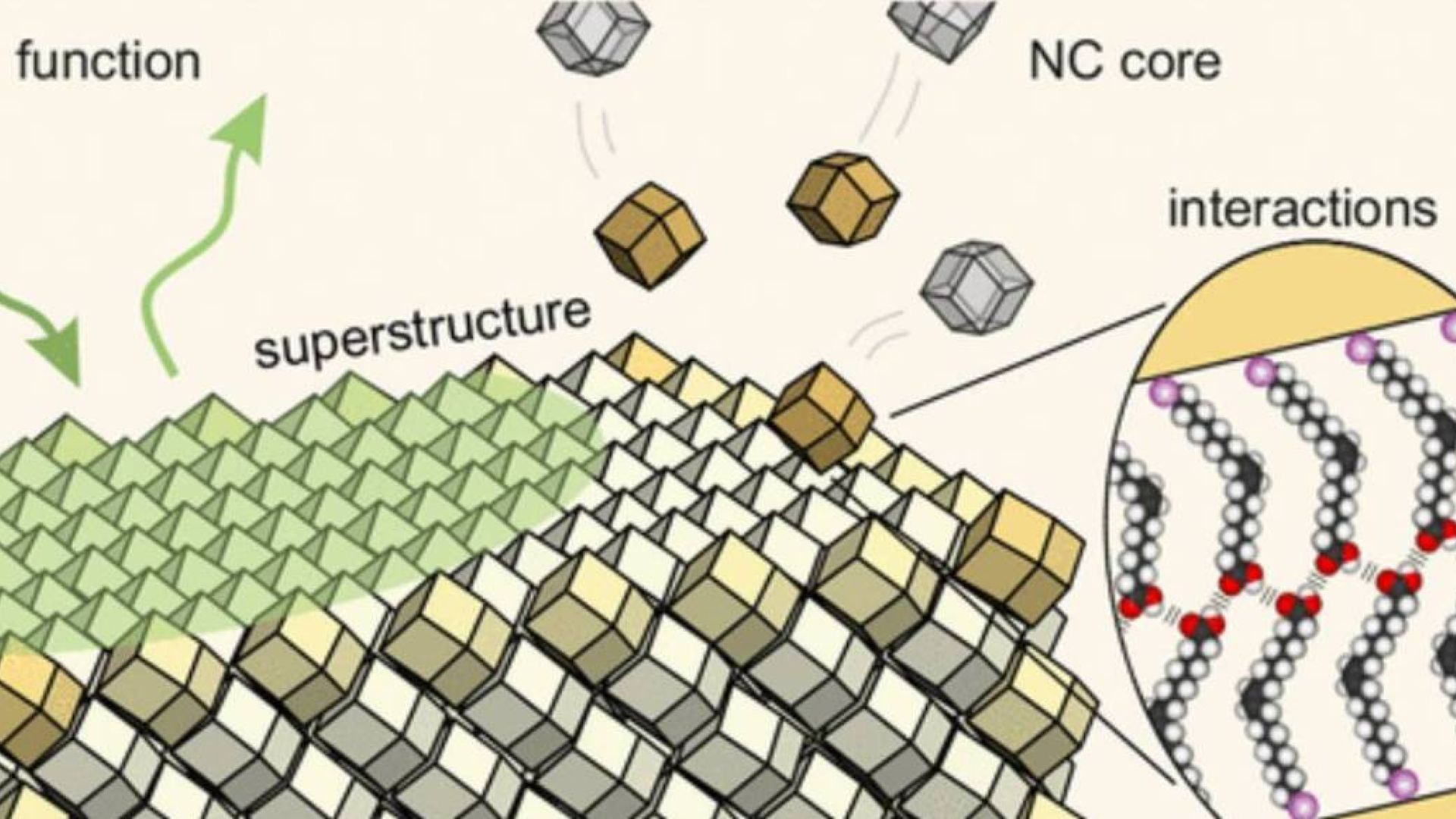
In the paper, it is explored the potential of nanocrystals (a term used equivalently to nanoparticles) as building blocks for nanomaterials, and the current advances and open challenges for fundamental science developments and applications. Nanocrystal assemblies are inherently multiscale, and the generation of revolutionary material properties requires a precise understanding of the relationship between structure and function, the former being determined by classical effects and the latter often by quantum effects. With an emphasis on theory and computation, they discuss challenges that hamper current assembly strategies and to what extent nanocrystal assemblies represent thermodynamic equilibrium or kinetically trapped metastable states. They also examine dynamic effects and optimization of assembly protocols. Finally, they discuss promising material functions and examples of their realization with nanocrystal assemblies.
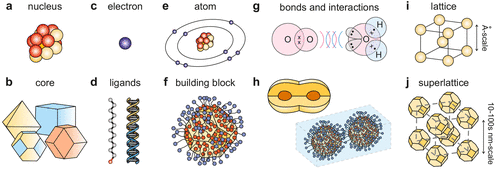
Figure. Analogy between NCs and atoms. (a, b) NC cores play the role of atomic nuclei. (c, d) Ligands such as polymers and DNA are equifunctional to the electron shell. (e, f) Their combination gives rise to NC building blocks analogous to atoms. (g, h) Similarly to atoms, NCs can interact and bond. NCs interact via ligands through steric forces, van der Waals forces, or specific sites for hydrogen bonding. Solvent conditions modulate NC interactions. NCs can also bond by hybridization of quantum states, forming NC molecules. (i) Quantum chemistry explains the formation of crystalline lattices at the Å-scale. (j) NCs self-assemble into superlattices. The degrees of freedom of NC core habits and ligand chemistry, length, and coverage, tune superlattice parameters in the range of tens to hundreds of nanometers.
REFERENCE
Bassani, C. L., et al., Nanocrystal Assemblies: Current Advances and Open Problems, ACS Nano (2024)
You can access the article here!
