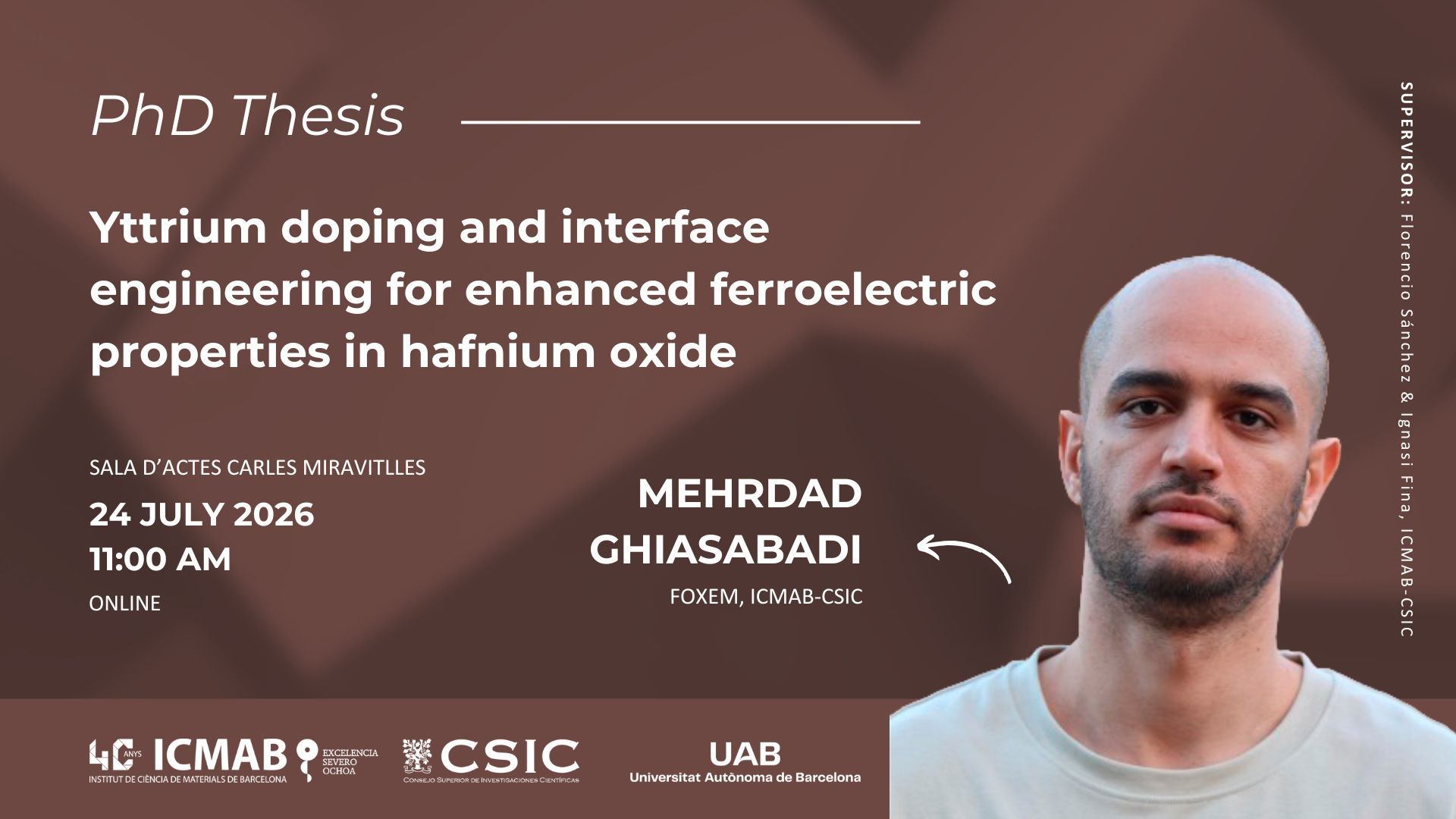
Yttrium doping and interface engineering for enhanced ferroelectric properties in hafnium oxide
PhD Candidate: Mehrdad Ghiasabadi
Date: Friday, 24 July 2026
Time: 11.00 AM
Venue: Sala d'Actes Carles Miravitlles
Abstract
Stabilizing the metastable orthorhombic ferroelectric phase of HfO2 is critically dependent on both chemical doping and material’s architecture. This thesis explores three complementary strategies to achieve robust and reliable ferroelectricity in epitaxial HfO2 based films, namely, doping, interface engineering, and hybrid nanolamination. First, yttrium is investigated as a dopant alternative to Zr to enhance phase stability and polarization retention, in particular for in thick films. Epitaxial Hf0.93Y0.07O2-x films grown on SrTiO3(001) and SrTiO3(110) substrates exhibit strong remanent polarization across the entire explored thickness range (5.3−108 nm), in contrast to films doped with alternative dopants, which show decreased polarization for increasing thickness. Transmission electron microscopy reveals a columnar structure and coexistence of ferroelectric orthorhombic and non-ferroelectric monoclinic phases. These results demonstrate that yttrium is intrinsically an effective dopant for stabilizing the orthorhombic ferroelectric phase and achieving robust polarization, independently of film thickness. Second, interface engineering is employed as a complementary to doping strategy to control the ferroelectric response of La-doped HfO2 (LHO) films. ZrO2 bottom layers and top layers are introduced. In particular, it is observed that ZrO2 top capping effectively suppresses leakage current, indicating a reduced density of interface-related defects. ZrO2-capped LHO samples show lower coercive fields, faster switching down to 90 ns, and markedly improved endurance compared to uncapped films. These results demonstrate the positive role of ZrO2 capping layer in improving the reliability of HfO2 based ferroelectric films. Third, nanolamination is explored. Wake-up-free Hf0.5Zr0.5O2 (HZO)/HfO2 nanolaminates with 1 nm HfO2 interlayers exhibit enhanced remanent polarization and higher dielectric permittivity compared to single-layer HZO films, although they show slightly slower switching and more severe fatigue. Further performance improvements are achieved by incorporating subnanometer La-doped HfO2 layers as interlayers in LHO/HZO nanolaminates. These samples retain a continuous columnar structure, show high endurance and retention, and maintain rapid switching dynamics compared to single layer and HZO/HfO2 nanolaminates. Moreover, they exhibit reduced leakage and large iii non-ferroelectric resistive switching up to 108%, making them attractive candidates for multifunctional memory architectures. Together, these three approaches—doping, interface engineering, and nanolamination— offer a comprehensive framework for tuning the functional and reliability properties of epitaxial HfO2-based ferroelectrics. The findings, achieved with epitaxial films, provide crucial insights into the fundamental mechanisms governing phase stability and domain dynamics and can guide new strategies for the development of advanced complementary metal-oxide semiconductor (CMOS)-compatible memory and neuromorphic computing devices.
Supervisors
- Florencio Sánchez, ICMAB-CSIC
- Ignasi Fina, ICMAB-CSIC
PhD committee
- President: José P. B. Silva, University of Minho, Portugal
- Secretary: Carlos Frontera, ICMAB-CSIC, Spain
- Vocal: Suzzane Lancaster, CICnanoGUNE, Spain
University: Universitat Autònoma de Barcelona (UAB)
PhD Programme: Materials Science