


A new paper has been published in Advanced Science:
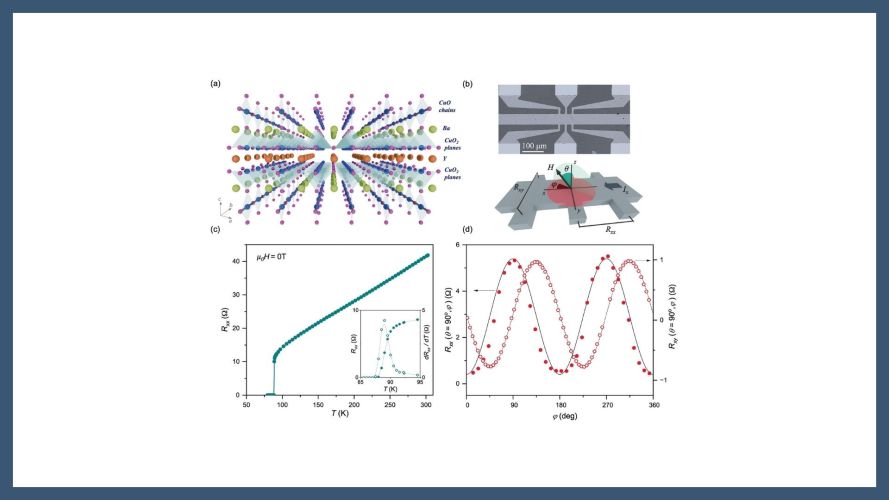
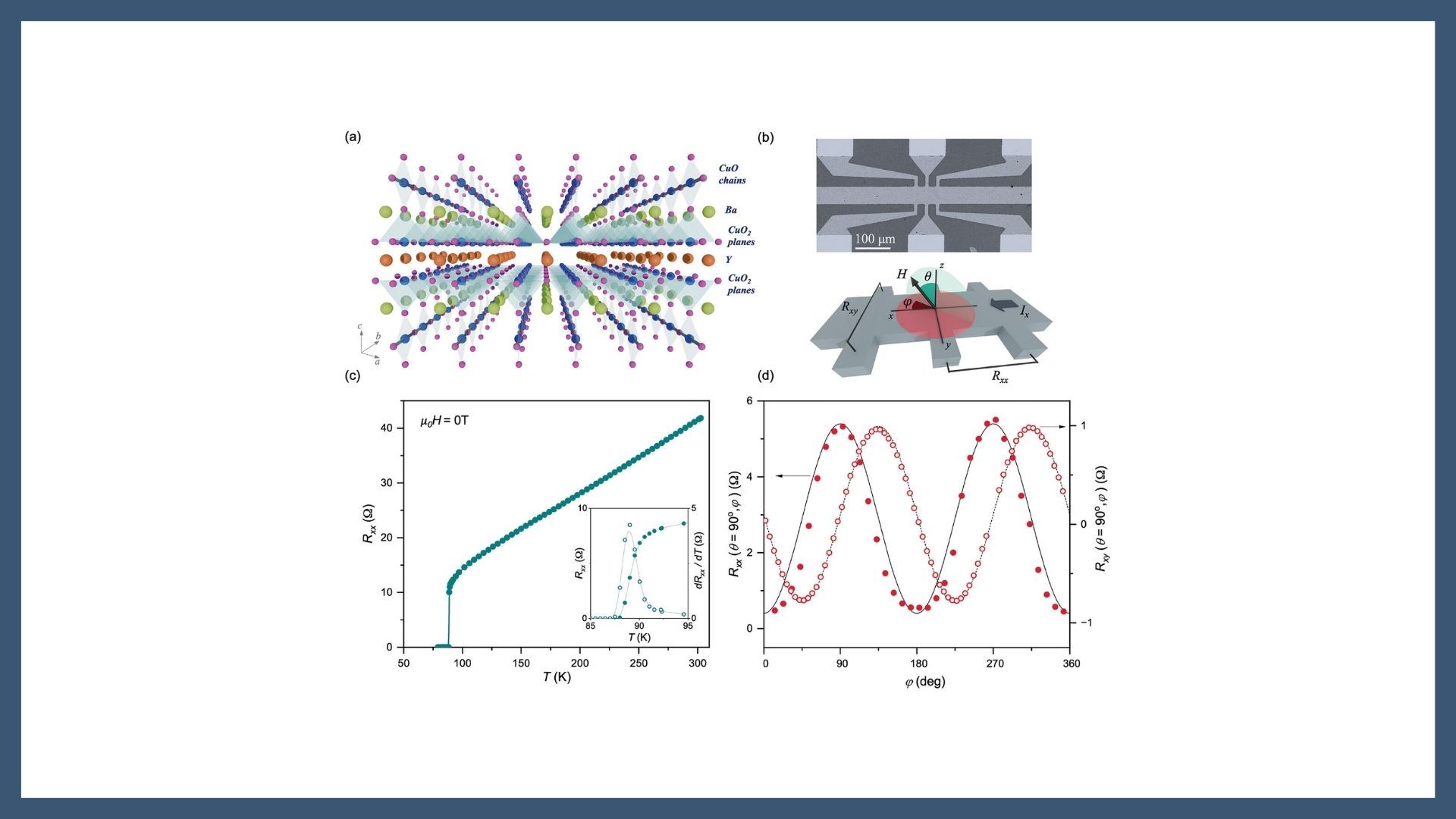
Spin transport in superconductors offers a compelling platform to merge the dissipationless nature of superconductivity with the functional promise of spin-based electronics. A significant challenge in achieving spin polarization in conventional superconductors stems from the singlet state of Cooper pairs, which exhibit no net spin. The generation of spin-polarized carriers, quasiparticles, or triplet pairs in superconductors has predominantly been realized in hybrid superconductor/ferromagnet systems through proximity-induced spin polarization. Historically, cuprate superconductors have been characterized by strong electronic correlations but negligible spin–orbit coupling. In this study, we observe a large in-plane angle-dependent magnetoresistance and a pronounced planar Hall effect arising near the superconducting phase transition in the prototypical high-temperature cuprate superconductor YBa2Cu3O7-x without using a proximity ferromagnet. These effects - unusual in centrosymmetric cuprates - may arise from spin-polarized quasiparticle transport potentially mediated by strong spin–orbit coupling. By systematically tuning magnetic field strength, orientation, temperature, and doping, we identify transport signatures that are consistent with spin–orbit-driven phenomena. Our findings suggest the presence of a previously underappreciated spin–orbit landscape in cuprates, which may provide the basis for exploring spintronic functionalities in high-temperature superconductors.
M4ELC Sustainable Electronics
Magnetotransport Signatures of Spin–Orbit Coupling in High-Temperature Cuprate Superconductors
Barrera, Aleix; Li, Huidong; Gunkel, Thomas; Alcala, Jordi; Damerio, Silvia; Avci, Can Onur; Palau, Anna
DOI: 10.1002/advs.76166

