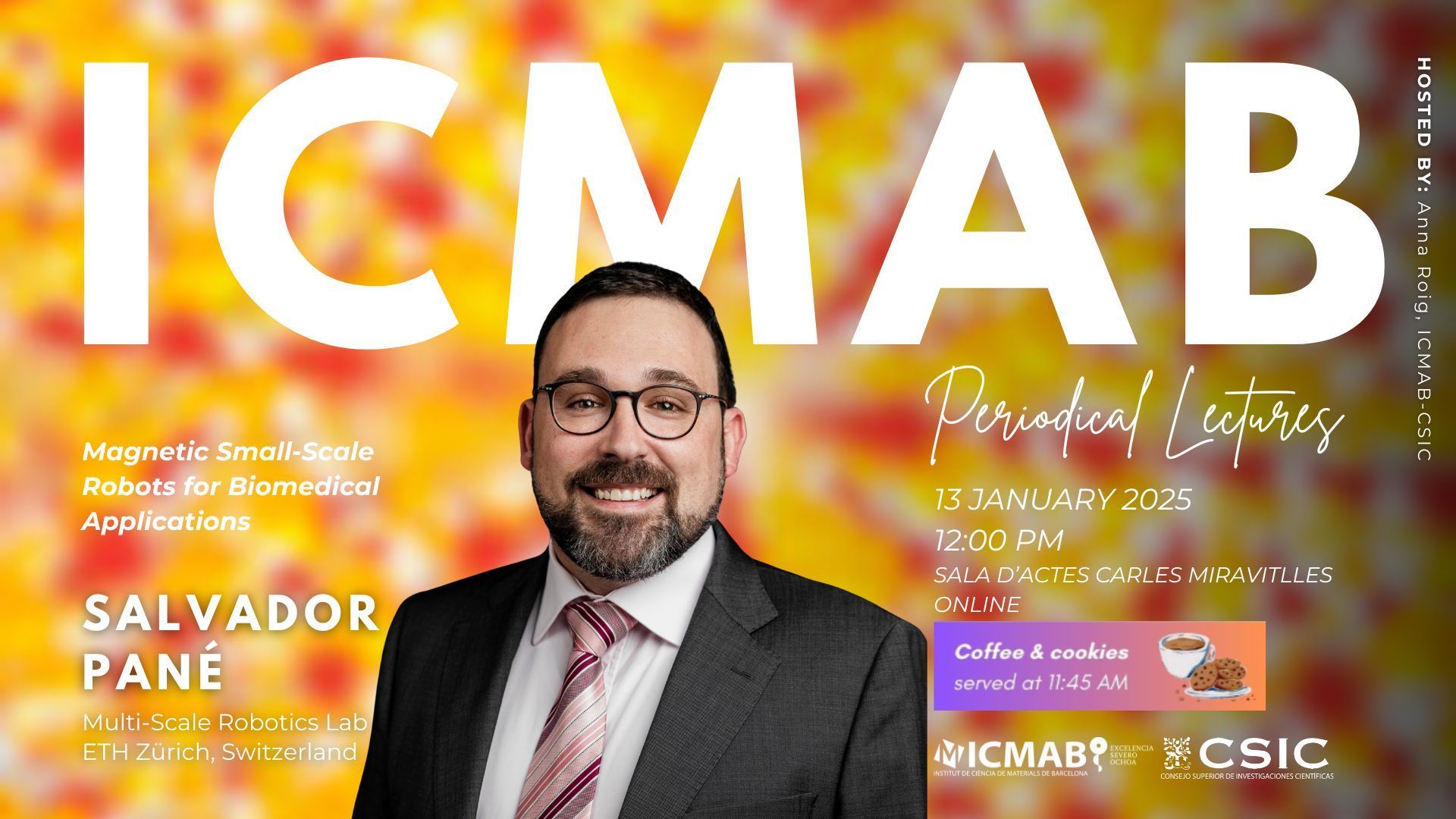
Magnetic Small-Scale Robots for Biomedical Applications
Salvador Pané, Multi-Scale Robotics Lab, ETH Zürich, Switzerland
Monday 13th January 2025, 12.00 PM
ICMAB - Sala d'Actes Carles Miravitlles and ONLINE (Register here)
Abstract
Magnetic micro- and nanorobots are small-scale devices that have the ability to move through fluids using external magnetic fields, and have the potential to deliver drugs and perform other medical tasks within confined spaces of the human body. The recent advancements in magnetic small-scale robotics can be largely attributed to progress in material science and manufacturing. While numerous applications have been demonstrated, there are still several areas that require further research, including complex locomotion, multifunctionality, biocompatibility, and biodegradability. As a result, new material-based concepts, innovative fabrication techniques are urgently needed to address these challenges and improve the field of small-scale robotics. This discussion will explore various material-based concepts and innovative fabrication techniques aimed at overcoming translational hurdles and further enhancing the capabilities of small-scale robotics. In the first part of the talk, we will show how 3D printed microtemplates can be exploited to produce complex robotic microstructures made of electrodeposited rigid metals, soft polymers and combinations of these. As a result, topologically complex metal-organic structures can be realized with sub-micrometric resolution. I will also demonstrate that metal-organic interlocked micromachines can solve several practical challenges in small-scale robotics. We will show that high magnetic responsiveness, drug loading capabilities, biocompatibility, on-demand shape transformation, and multi-locomotion modes can be embedded in a single microrobotic machine. In the second part of my talk, we will show how to achieve multifunctional microrobots using magnetoelectric multiferroic composites. These materials have the ability to generate an electric field under the application of an external magnetic field. The magnetoelectric small-scale swimmers comprise a magnetostrictive component that allows for both the magnetic locomotion of the device, and also for the activation of the piezoelectric component. This wireless polarization can then be used for cell electrostimulation and differentiation.
Short bio
Prof. Salvador Pané i Vidal (Barcelona 1980) is a Professor of Materials for Robotics at the Institute of Robotics and Intelligent Systems (IRIS) and co-director of the Multi-Scale Robotics Lab at ETH Zürich. He earned his B.S. (2003), M.S. (2004), and a Ph.D. in Chemistry (2008) from the University of Barcelona (UB). Prof. Pané has authored over 200 articles in international peer-reviewed journals and books on science education. His current focus is on integrating chemistry and materials with small-scale robotics. He has served as coordinator for the FET Open project (MANAQA) and FET Proactive (ANGIE). In 2013, he received the Starting Grant from the European Research Council (ERC). From 2015 to 2019, he chaired the COST Action "e-MINDS" and represents Switzerland in the European Academy of Surface Technology. Prof. Pané is a co-founder of Magnes AG and Oxyle AG. In 2017, he was honored with the Big-on-Small Award at the International Conference on Manipulation, Automation, and Robotics at Small Scales (MARSS) and received a Consolidator Grant (ERC) in 2019, along with the ERC Proof-of-Concept grant in the same year.
Hosted by Anna Roig