


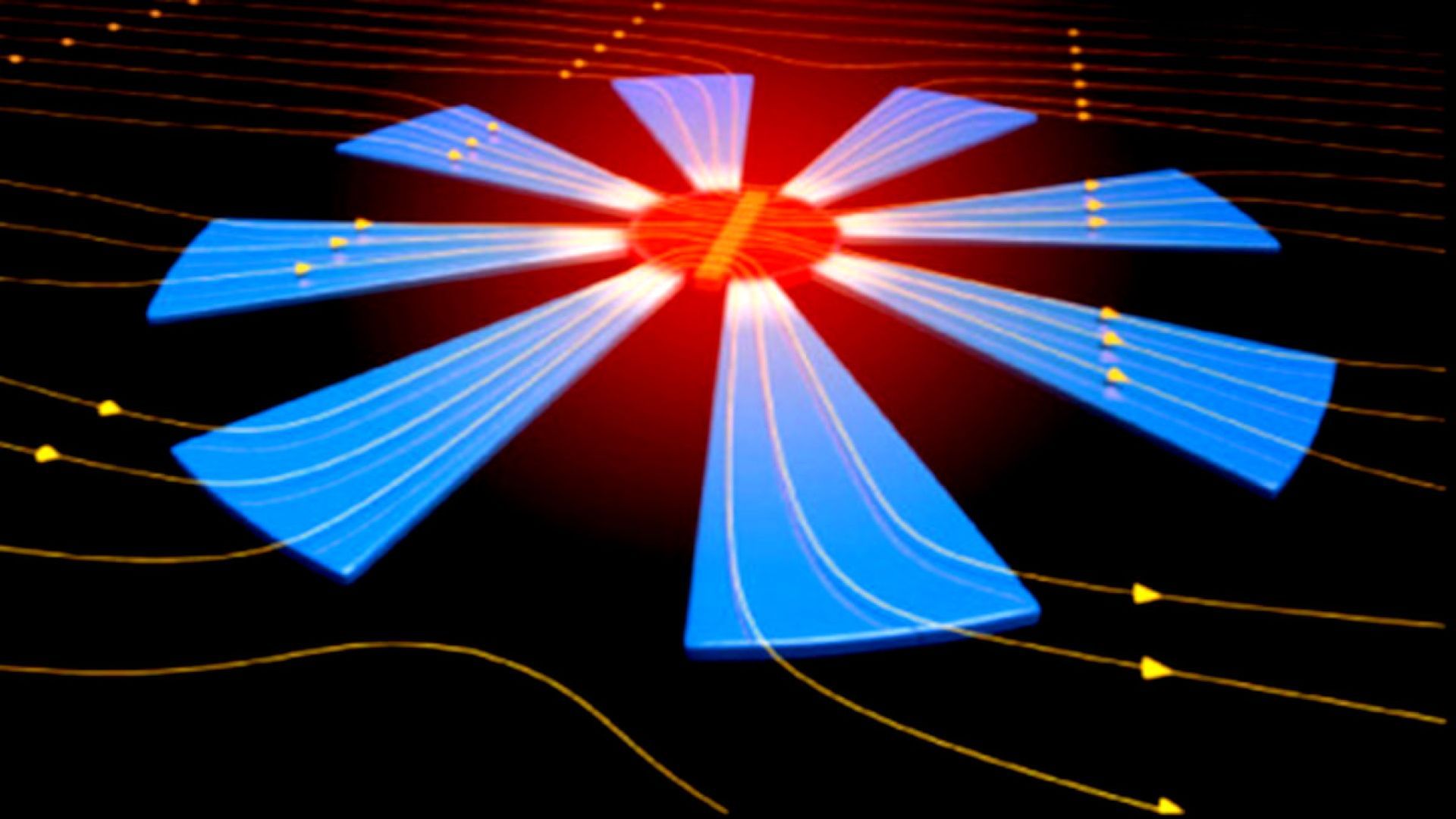
A flower-shaped structure only a few micrometres in size made of a nickel-iron alloy can concentrate and locally enhance magnetic fields. The size of the effect can be controlled by varying the geometry and number of 'petals'. This magnetic metamaterial developed by Anna Palau's group at ICMAB in collaboration with her partners of the CHIST-ERA MetaMagIC project, has now been studied at BESSY II. Such a device can be used to increase the sensitivity of magnetic sensors, to reduce the energy required for creating local magnetic fields, but also, at the PEEM experimental station, to study samples under much higher magnetic fields than currently possible.
The team has developed a special metamaterial that looks like tiny flowers under the scanning electron microscope. The 'petals' consist of strips of a ferromagnetic nickel-iron alloy. The microflowers can be produced in various geometries, not only with different inner and outer radii, but also with variable numbers and widths of petals. This flower-shaped geometry causes the field lines of an external magnetic field to concentrate in the centre of the device, resulting on a greatly intensified magnetic field.
Magnetic metamaterials
'Metamaterials are artificially produced materials with microstructures whose dimensions are smaller than the electromagnetic or thermal waves they are designed to manipulate,' explains Palau. The physicist is working on magnetic microstructures that can be used in data storage, information processing, biomedicine, catalysis and magnetic sensor technology. By using these metamaterials, the sensitivity of magnetic sensors could be highly increased, as the magnetic field to be detected would be amplified at the center of these systems.
Mapping magnetic domains at BESSY II
Anna Palau, the team's PhD candidate Aleix Barrera, and BESSY II scientist Sergio Valencia have now investigated this at the XPEEM experimental station at BESSY II. They placed a cobalt rod in the centre of various microflowers as a sensor for the magnetic field and mapped the magnetic domains inside the cobalt rod. 'By adjusting the geometric parameters such as shape, size and number of petals, the magnetic behaviour can be switched and controlled,' says Valencia. As a result, the sensitivity of a magnetoresistive sensor could be increased by more than two orders of magnitude.
New options, also for experiments at XPEEM
This innovation opens up new technological options for improving the performance of small magnetic sensors and for developing multifunctional magnetic components. In the future, such microstructures could be used to generate much higher magnetic fields locally, which is also of interest for the experimental XPEEM station at BESSY II.
'Our experimental system is a photoemission electron microscope, so magnetic fields deflect the electrons and make the experiments difficult,' says Valencia. 'The maximum magnetic field we can normally apply for imaging is about 25 millitesla (mT). With the magnetic field concentrator, where the field is only locally enhanced, we can easily achieve fields five times higher.' This is very exciting because it opens up the possibility of studying a range of magnetic systems under conditions that have not been possible before.
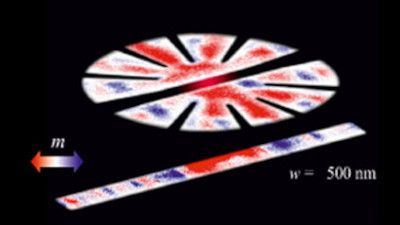
Two magnetic contrast maps. The cobalt rod is located in the centre of the microflower. © S. Valencia /HZB
New applications
The work showcases the potential of metasurface-assisted magnetic sensors in applications such as biomedical imaging, industrial monitoring, and fundamental research in magnetism. The ICMAB researchers played a key role in the theoretical modeling, fabrication, and experimental validation of these sensors, highlighting their expertise in materials science and device engineering. Their findings open new pathways for next-generation, high-sensitivity magnetic sensing technologies.
Reference Article
On-Chip Planar Metasurfaces for Magnetic Sensors with Greatly Enhanced Sensitivity
Aleix Barrera, Emile Fourneau*, Natanael Bort-Soldevila, Jaume Cunill-Subiranas, Nuria Del-Valle, Nicolas Lejeune, Michal Staňo, Alevtina Smekhova, Narcis Mestres, Lluis Balcells, Carles Navau, Vojtěch Uhlíř, Simon J. Bending, Sergio Valencia, Alejandro V. Silhanek*, Anna Palau*
ACS Nano, 2025
DOI: 10.1021/acsnano.5c00422
News post adapted from Helmholtz-Zentrum Berlin - BESSY II (25 March 2025)