


A new paper has been published in the Journal of Materials Chemistry A:
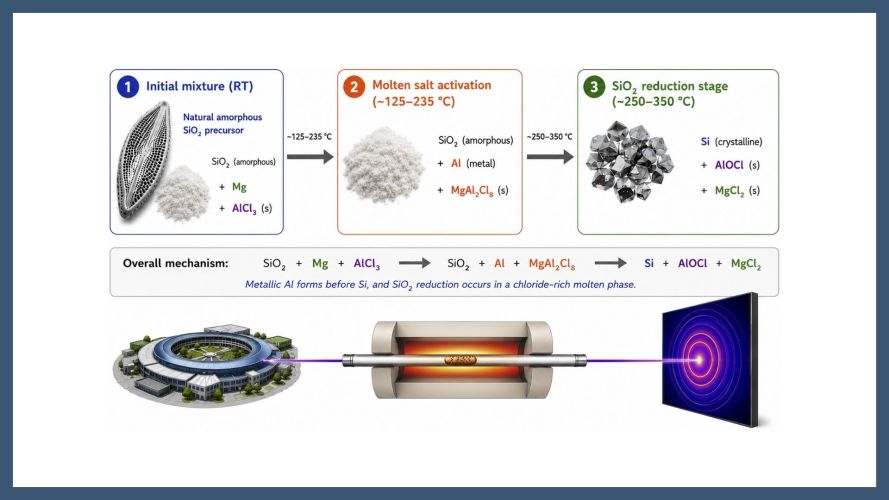
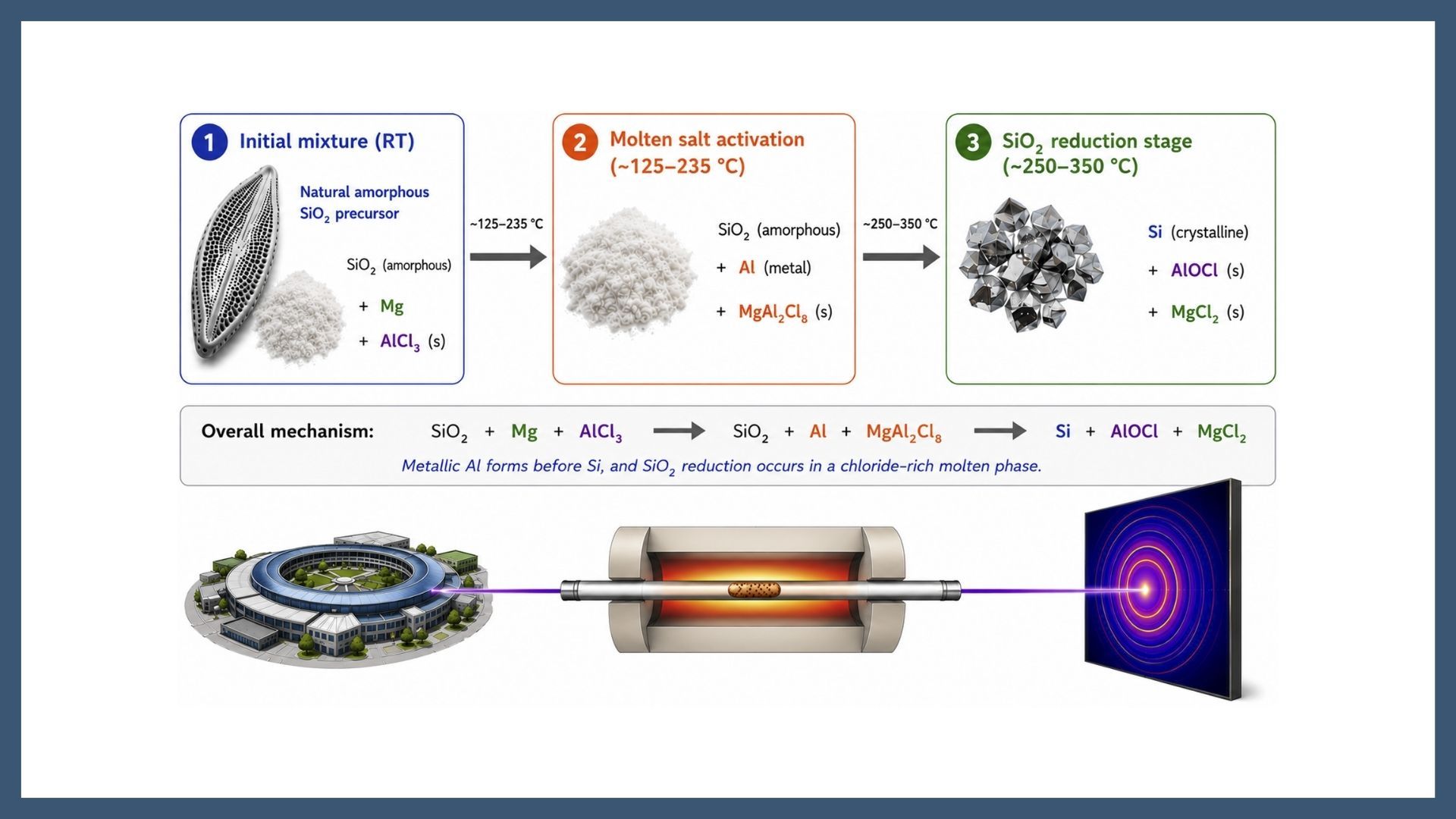
Silicon is a high-capacity anode material, yet its scalable production from sustainable precursors requires low-temperature and controllable synthesis routes. Diatom-derived SiO2 provides an abundant biogenic feedstock, but its conversion to silicon by magnesiothermic reduction (MgTR), typically conducted at 600–900 °C, is limited by the highly exothermic nature of the reaction, which induces local overheating, promotes side-phase formation, and often results in incomplete SiO2 reduction. Here, we elucidate the reaction pathway of AlCl3-assisted MgTR as a strategy to decrease synthesis temperature and improve reduction efficiency. By correlating the heating ramp rate, isothermal hold time, and salt-to-silica ratio with phase evolution and the crystalline silicon fraction, we identify the parameters governing oxygen abstraction and Si formation. Time-resolved in situ synchrotron X-ray diffraction provides direct insight into the reaction mechanism, revealing the early formation of metallic Al, the transient formation of MgAl2Cl8 as an intermediate, and the subsequent crystallization of Si concurrent with the consumption of metallic Al, thereby suggesting that Al acts as an effective reducing agent. Silicon formation proceeds within a chloride-rich molten phase and is achieved at temperatures as low as 250–300 °C. The crystalline silicon fraction is primarily dictated by heating conditions and AlCl3 content, with optimized parameters maximizing the Si fraction while suppressing inactive byproducts. Electrochemical evaluation of the graphite-SiOx electrode blends demonstrates enhanced reversible capacity relative to graphite together with moderate cycling stability, confirming the electrochemical activity of the synthesized material. Overall, this work unveils the mechanistic framework of AlCl3-assisted MgTR and provides synthesis guidelines for the low-temperature conversion of diatom biosilica into silicon-based anode materials.
M4NRG Clean Energy
Low-temperature synthesis of silicon anodes from biosilica via AlCl3-assisted magnesiothermic reduction
Alonso-Sanchez, Pedro; Swensen, Emilie Hvidsten; Thangaian, Kesavan; Vullum, Per Erik; Diadkin, Vadim; Vullum-Bruer, Fride; Campo, Javier; Svensson, Ann Mari; Cova, Federico; Blanco, Maria Valeria
DOI: 10.1039/d6ta02278b

