


A new paper has been published in Cell Reports Physical Science:
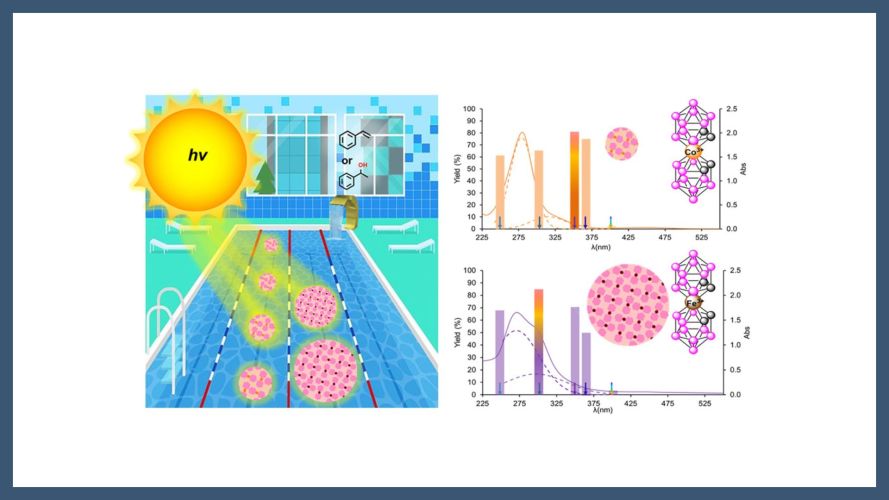
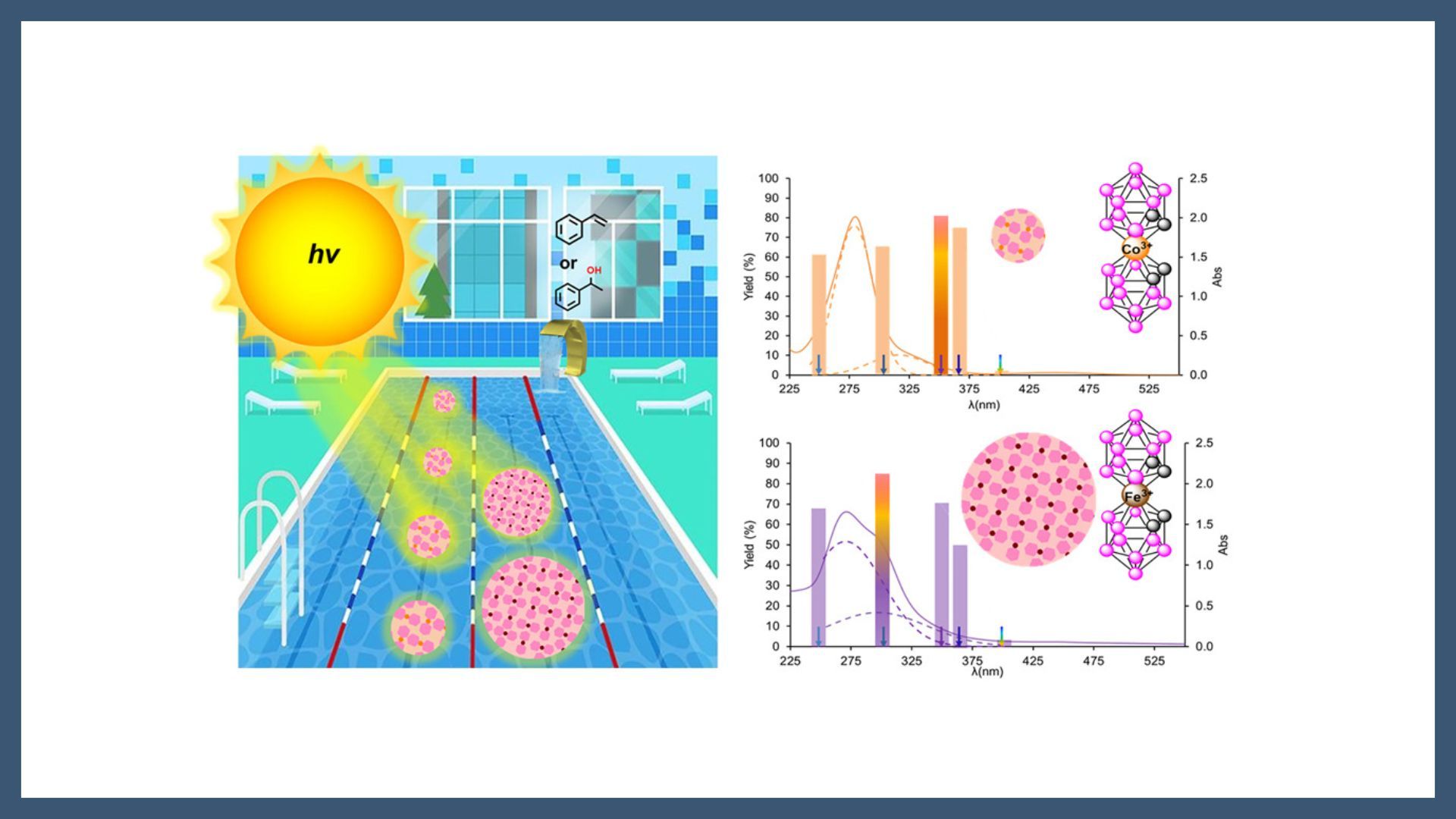
Transition metal (TM) ions 4d6 or 5d6 configurations, typically used in photoredox catalysis, are often rare and expensive. In contrast, abundant first-row TM ions tend to favor metal-centered excited states, limiting their practical photocatalytic use. Here, we present two efficient 3d6 and 3d5 photoredox catalysts, [3,3′-Co(1,2-C2B9H11)2]− and [3,3′-Fe(1,2-C2B9H11)2]−, with identical structures and charges (−1). Despite different electronic configurations, both catalysts deliver comparable performances in alcohol and alkene oxidation in water, even at low catalyst loadings (0.01 mol %). The catalysts are designed to operate in water without additional cosolvents, thanks to the surfactant properties of both θ-metallacarboranes. The impact of irradiating wavelength, explored through quantum chemistry, rationalizes their photocatalytic outcomes. Remarkably, 3d5 or 3d6 systems can match or outperform heavier TM analogs when supported by boron-based ligands, though selectivity differences highlight the role of metal electronic structure. UVA irradiation significantly boosts [o-COSAN]− activity, offering new design insights for earth-abundant photoredox catalysts.
M4NRG Clean Energy
Low-load Θ-metallacarboranes as safe and efficient photoredox catalysts for UVA-driven oxidation in water
Guerrero, Isabel; Abdelgawwad, Abdelazim M. A.; Viñas, Clara; Roca-Sanjua, Daniel; Teixidor, Francesc; Romero, Isabel; Teixidor, Francesc
DOI: 10.1016/j.xcrp.2025.102815

