


A new paper has been published in the Journal of Materials Chemistry C:
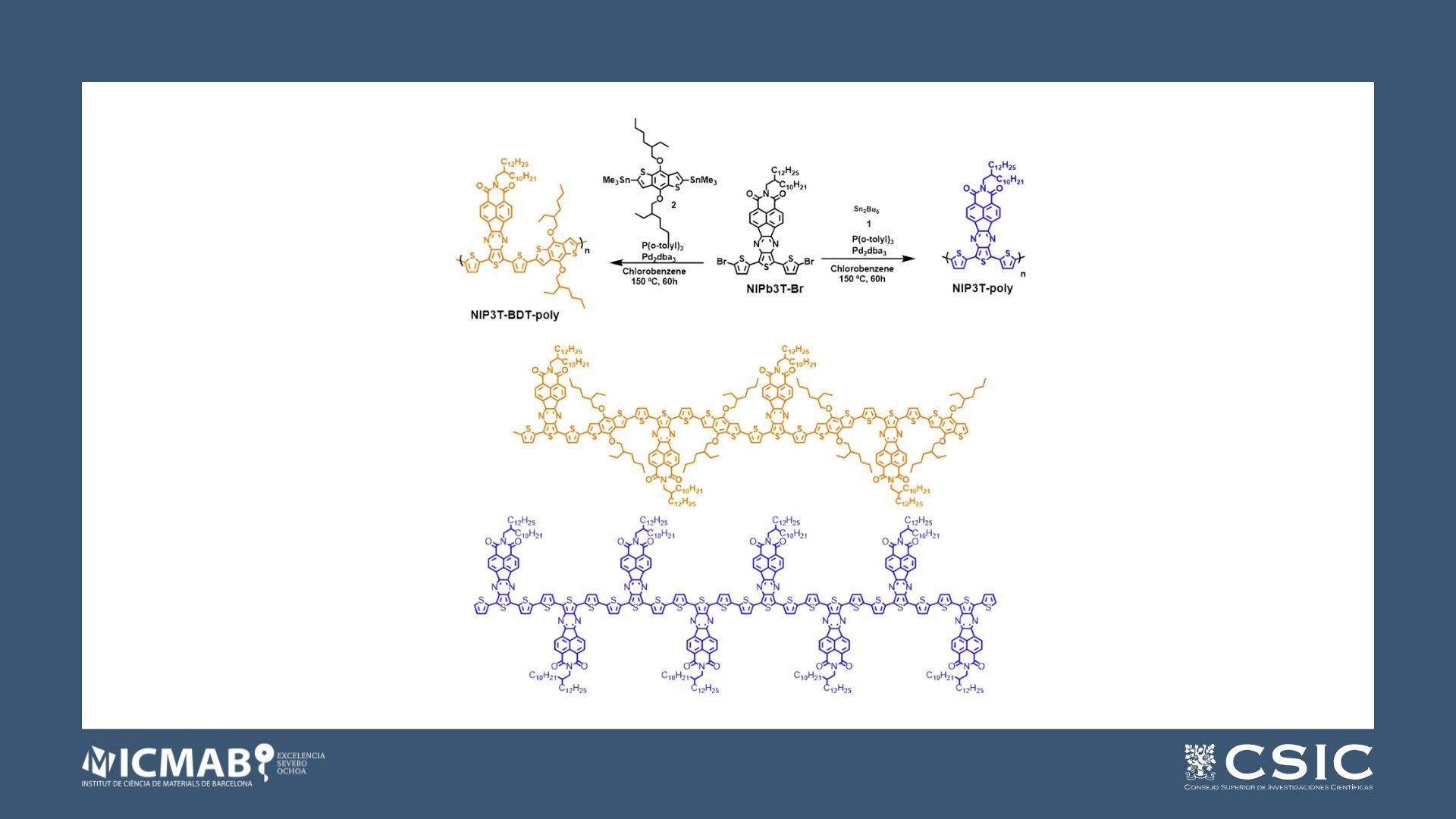
State-of-the-art p-type organic conjugated polymers are mostly thiophene-based semiconductors. Still, novel chemical design and a fresh perspective on different polymer backbones could pave the way for new high-performing materials and a deep understanding of donor–acceptor conjugated assemblies. Herein we designed and synthesized two novel electroactive oligomeric materials based on a donor terthiophene unit endowed with a strong electron-withdrawing naphthalimide unit. This molecular assembly has been polymerized using a palladium cross-coupling reaction with two different linkers, 1,1,1,2,2,2-hexabutyldistannane and (4,8-bis((2-ethylhexyl)oxy)benzo[1,2-b:4,5-b′]dithiophene-2,6-diyl)bis(trimethylstannane), to obtain the target polymers NIP3T-poly and NIP3T-BDT-poly, respectively. Both polymers exhibited an extended absorption up to 1000 nm and higher hole field-effect mobilities of up to 1.8 × 10⁻³ cm2 V−1 s−1, in comparison to the molecular assembly NIP3T, and precisely tuned energy levels that make them compatible with common p-type dopants like 2,3,5,6-tetrafluoro-7,7,8,8-tetracyanoquinodimethane (F4TCNQ). After optimizing the doping level, we obtained a thermoelectric figure of merit up to zT = 0.02 for NIP3T-BDT-poly, comparable with benchmark F4TCNQ-vapor doped polythiophenes.
M4NRG Clean Energy
Low-bandgap oligothiophene-naphthalimide oligomeric semiconductors for thermoelectric applications
Alonso-Navarro, Matias J.; Zapata-Arteaga, Osnat; Riera-Galindo, Sergi; Guo, Jiali; Gutierrez-Fernandez, Edgar; Reparaz, Juan Sebastian; Ramos, Mar; Muller, Christian; Martin, Jaime; Mas-Torrent, Marta; Segura, Jose L. &Campoy-Quiles, Mariano
DOI: 10.1039/D4TC05383D

