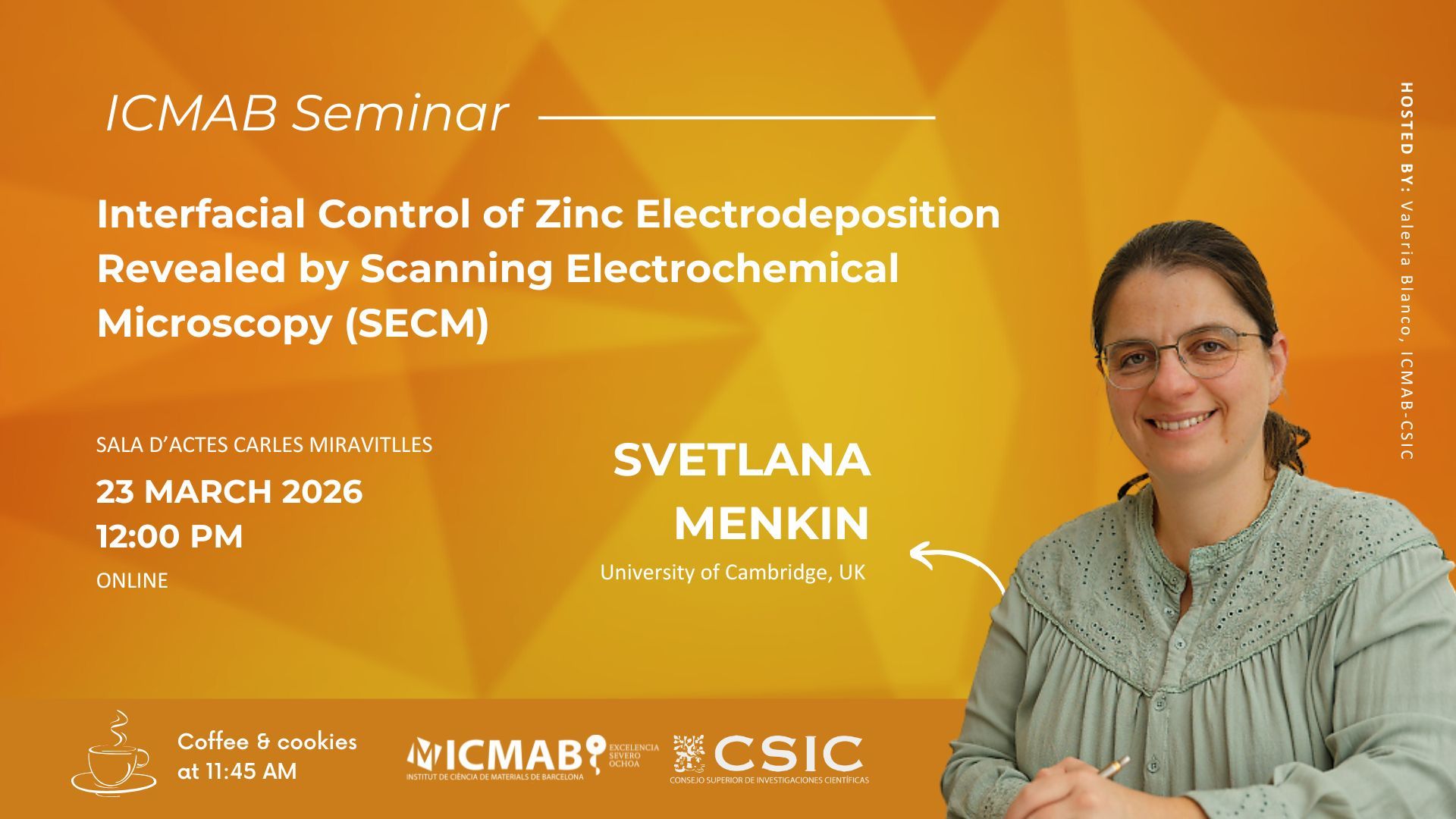
Interfacial Control of Zinc Electrodeposition Revealed by Scanning Electrochemical Microscopy (SECM)
Svetlana Menkin, University of Cambridge, UK
Monday 23 March 2026, 12.00 PM
ICMAB - Sala d'Actes Carles Miravitlles
ONLINE (Register here)
Abstract
Aqueous zinc batteries are attractive candidates for safe, low-cost, and sustainable stationary energy storage. However, their performance is often limited by unstable zinc electrodeposition, surface passivation, corrosion, and parasitic reactions at the anode. In this seminar, I will first introduce the fundamentals of zinc batteries, zinc electrodeposition, and Scanning Electrochemical Microscopy (SECM) to provide the background needed to understand interfacial processes in these systems.
I will then present our recent work using SECM as an operando probe to investigate zinc plating and stripping at the electrode interface. Spatial mapping of charge transport on zinc anodes reveals that electrolyte composition strongly influences surface reactions and the formation of a Zn₄(OH)₆SO₄·xH₂O-based interphase arising from local pH changes. To further regulate zinc deposition, we developed a dual-additive electrolyte that modifies zinc nucleation and growth, suppresses by-product formation, and prevents self-corrosion. This electrolyte enables a 40-fold increase in cycling life compared with the commonly used 1 M ZnSO₄ electrolyte while sustaining a commercially relevant areal capacity of 12.5 mAh cm⁻² at 20 mA cm⁻².
Finally, I will show how SECM can be used to quantify hydrogen evolution during battery cycling, revealing that it contributes less than 1% of the total cathodic current during zinc electrodeposition. Together, these results demonstrate that zinc electrodeposition is largely governed by interfacial surface processes.
Short bio
Dr. Svetlana Menkin is a Royal Society Research Fellow in the Yusuf Hamied Department of Chemistry at the University of Cambridge, where she leads a group of nine researchers developing sustainable battery technologies. She previously completed a postdoctoral position at Cambridge with Prof. Dame Clare Grey. Her research focuses on electrified interfaces in aqueous and non-aqueous batteries, using techniques such as scanning electrochemical microscopy (SECM) and electrochemical impedance spectroscopy (EIS) to investigate metal electrodeposition mechanisms. Her work aims to advance safe, high-energy batteries based on sustainable chemistries including sodium, calcium, and zinc.
Hosted by Valeria Blanco, from the SSC group (Materials for Energy Research Line)
>>If you want to meet the speaker, please contact the host at This email address is being protected from spambots. You need JavaScript enabled to view it..