


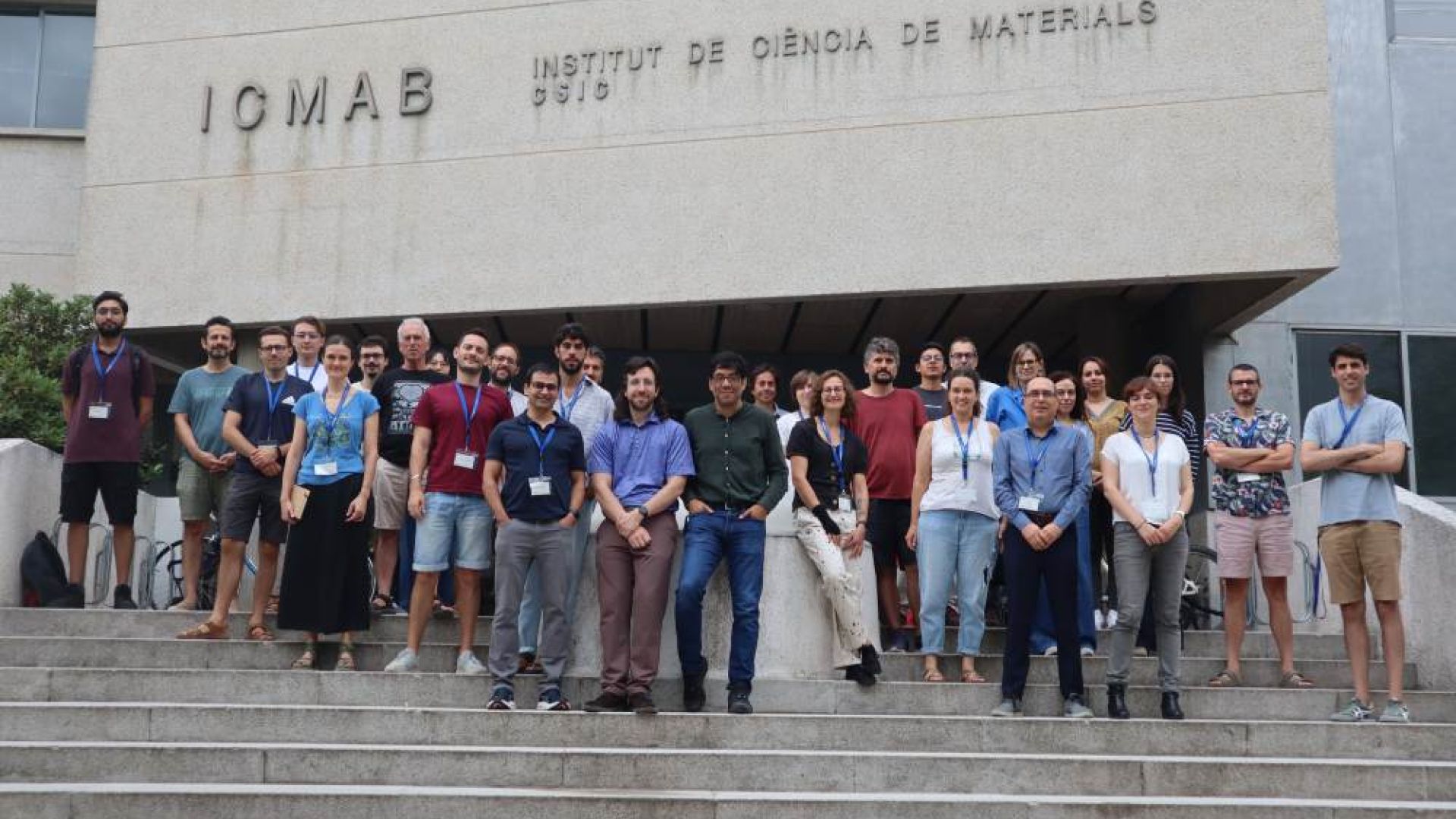
The EELS 2025 school was organised within the program of "International ICMAB Schools on Frontiers in Materials Science and Condensed Matter" by the MULFOX group.
The school addressed the ongoing push for miniaturization in next-generation materials and devices, which in turn drives the need for advanced characterization tools with enhanced spatial and spectral resolution. Electron energy loss spectroscopy (EELS), when combined with aberration-corrected scanning transmission electron microscopy (STEM), stands out as a crucial technique—offering atomic-scale insights into the physical and chemical properties of nanomaterials.
With over 50 participants, both in-person and online, the school was a fantastic experience, with two days full of learning and networking.
The organizers, Jaume Gázquez and Roger Guzmán, ICMAB researchers at the MULFOX group said: "This school was a fantastic opportunity for both students and senior researchers to discover why EELS in STEM stands out as one of the most powerful tools for nanomaterial characterization. Over two days, we explored the fundamentals of EELS and deepen into its cutting-edge applications, showcasing how different techniques can be applied to study a wide range of materials for various purposes. The speakers were outstanding, not only in delivering insightful presentations but also in sparking lively discussions with the audience. It was truly inspiring to see such engagement and knowledge-sharing among participants!" said the organizers.
School agenda highlights
The school started on the 10 July at 9.00 AM with two lectures by Rohan Mishra (Washington University in St. Louis), titled 'General introduction to the electronic structure of materials' and 'Modeling electron energy loss spectra from first principles'. After the coffee break, it was the turn of Jordan Hachtel (Oak Ridge National Laboratory) with the lecture 'Monochromated EELS and You: A Guide to the New Types of Science Enabled by Single-Digit-meV Energy Resolution'. He gave a second lecture after lunch, titled 'When Spatial and Spectral Resolution Aren't Enough: Incorporating Momentum Resolution into Monochromated EELS'. The first day of the school ended with the lecture 'Optical properties of nanomaterials' by Sophie Meuret (Centre d'Élaboration de Matériaux et d'Études Structurales).
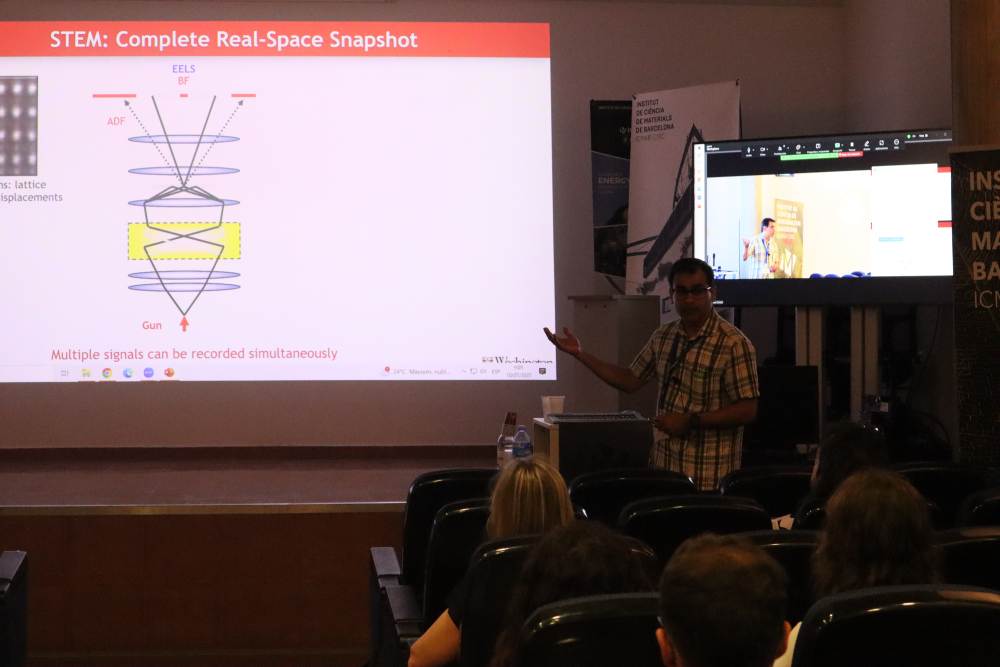
Rohan Mishra was one of the School speakers, ICMAB-CSIC
The second day started with the lecture 'Time-resolved EELS' by Sophie Meuret. After her, Juan Carlos Idrobo (University of Washington) gave two lectures: one before the coffee break, 'Core-loss EELS: Atomic Fingerprints at the Nanoscale', and one after the coffee break, 'Spin, Orbital, and Beyond: The Electron Microscope as Your Personal Pocket-Size Synchrotron'. After lunch, there were three more lectures: the first one by Sorin Lazar (Thermofisher), 'EELS at Very High Energy Losses' and two by Patricia Abellán (Institut des Matériaux de Nantes Jean Rouxel), 'In-situ and Operando EELS in Liquids' and 'Radiation Physics and Chemistry in liquid media'.
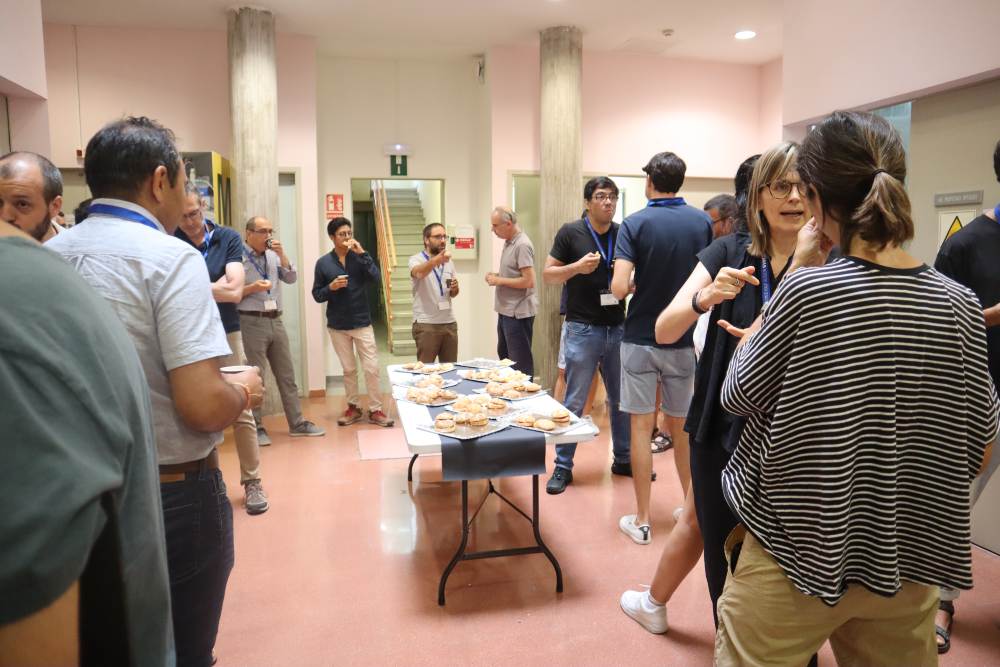
Coffee break at the EELS School, ICMAB-CSIC
Acknowledgements
Huge thanks to the organizers, Jaume Gázquez and Roger Guzmán, for crafting such a well-structured and thought-provoking program. We also thank the participants—both in-person and virtual—for their engaging discussions.
This event was a powerful reminder of how advancements in materials growth and characterization pave the way for groundbreaking innovations. The insights and ideas shared during these two days will undoubtedly inspire new research and collaborations.
More
Before "STEM/EELS at the forefront of condensed matter", previous editions of this school series were "2D materials: oxide membranes, twistronics and beyond”, “Angle Resolved Photoemission Spectroscopy", “Orbital currents in solids" and "Topological Interfaces".
