


Researchers at the Catalan Institute of Nanoscience and Nanotechnology (ICN2) have developed a pioneering method for obtaining various types of organic molecule through a process of molecular 'cutting'. This approach allows the rapid and precise isolation of target molecules, avoiding the slower and more complicated procedures usually associated with traditional chemical synthesis. These results pave the way for the easier and more efficient production of complex molecules, with promising applications in areas such as the development of new materials.
Specifically, the study introduces a method of extracting macrocycles, which are cyclic organic molecules that are already used in several industries, such as food, cosmetics, and drug delivery. To obtain them, the team started with larger porous crystalline structures called COFs (covalent organic frameworks), which contained the desired macrocycles within their molecular framework. COFs are widely studied molecules due to their potential applications in areas such as gas storage.
Clip-off Chemistry: the art of “cutting out” molecules
The technique is based on the concept of clip-off chemistry, developed under the leadership of ICREA Prof. Daniel Maspoch, head of the ICN2 Supramolecular NanoChemistry and Materials Group and lead author of the study. The work was also led by other members of his group, Drs. Inhar Imaz and Jorge Albalad. This strategy relies on materials that already incorporate the target molecules within their structure, which are then selectively "clipped off" and released. The COFs used in the study were designed in advance using simple molecular precursors, with specific chemical bonds incorporated at strategic positions, such as double and triple bonds between carbon atoms which can be selectively broken.
Once the COFs had been synthesised, the next step was to release the macrocycles. To achieve this, the researchers employed ozone gas as a molecular 'scalpel'. This gas is made up of three oxygen atoms and can break these reactive bonds through a process known as ozonolysis. This releases the macrocycles quickly and efficiently, eliminating the need for slow and complex synthesis routes.
As Maspoch explains: 'We design materials that already contain the rings we’re aiming for, using simple building blocks — like LEGO pieces — and then we release them with surgical precision.'
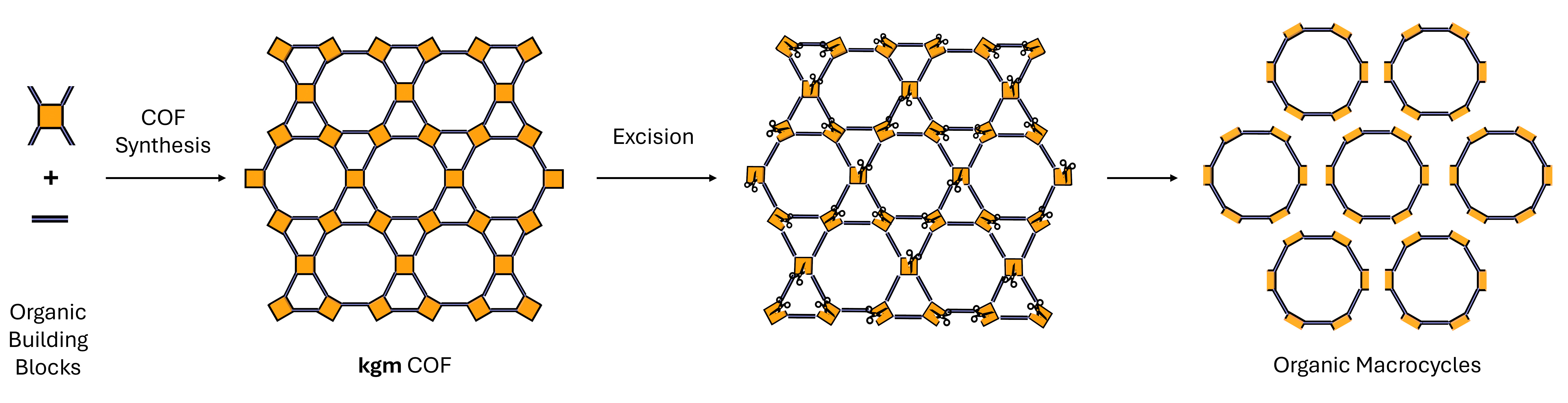 Diagram of the synthesis of COFs and the subsequent release of macrocycles through ozonolysis | ICN2
"The objective of this work was to show that otherwise inaccessible nanostructures (large organic macrocycles) can be synthesized with precision and in high yields through their excision from ordered, extended organic materials." says Dr. Jordi Faraudo, ICMAB researcher at the Soft Matter Theory group.
Faraudo adds: "The structures of the obtained macrocycles are difficult to identify, so our contribution was to perform atomistic simulations of all the synthesized structures (see image below). Our calculations revealed that, once excised from the extended materials, the macrocycles adopt a peculiar twisted boat conformation which is due to torsional distortions around the many amide bonds present at the structure. This result explains the experimental impossibility of crystallization of the obtained structures and it also allows interpretation of experimental characterization data (for example, scanning tunneling microscopy images)."
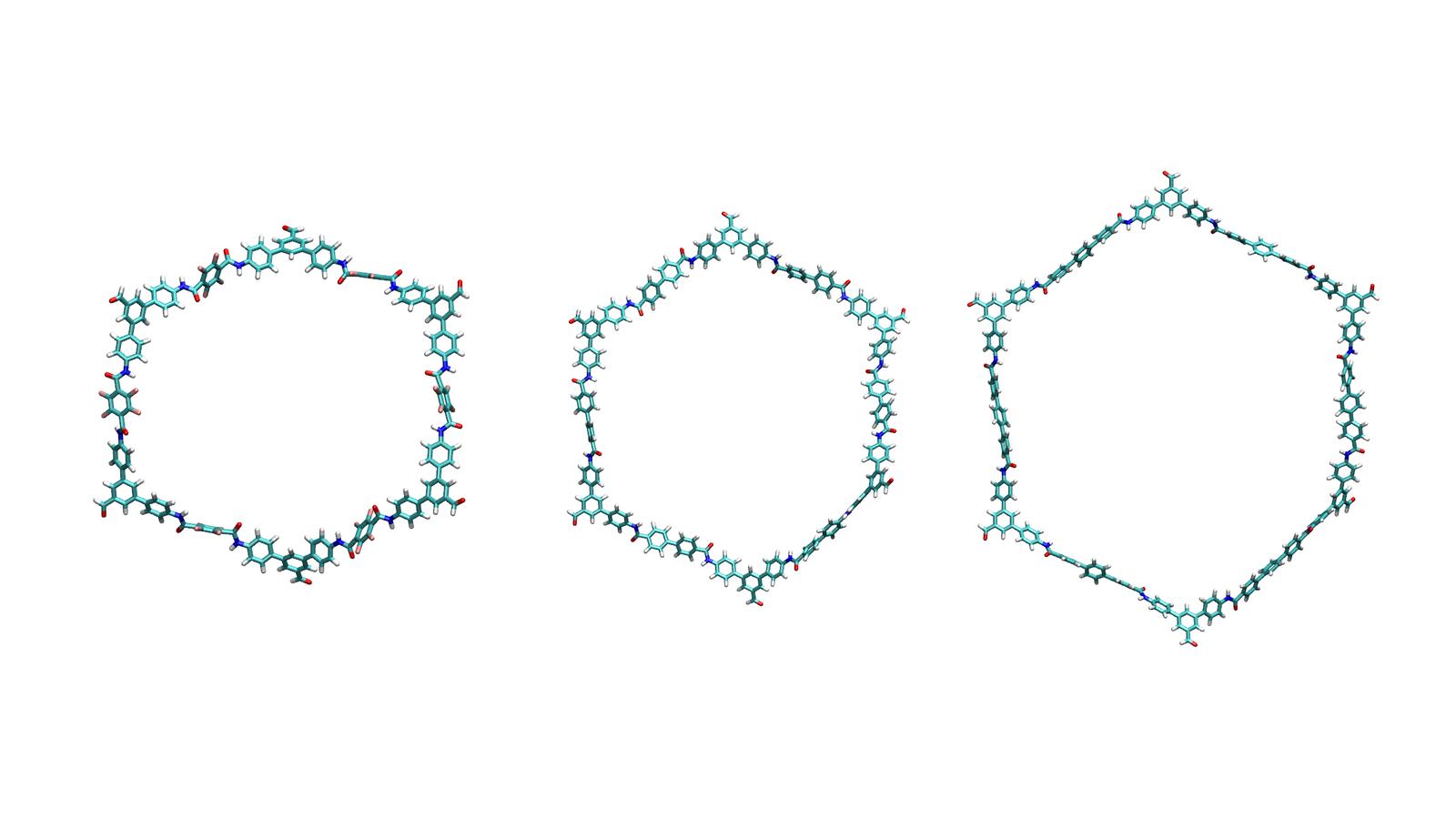
DFT optimized geometry (top view) for some of the macrocycles obtained. All structures are shown in licorice representation, color code: C cyan, N blue, O, red, F pink and H white. Image made with VMD | ICMAB-CSIC
Enormous potential across fields
Using this strategy, the researchers successfully synthesised nine different types of macrocycle, some of which contained up to 162 atoms. These included several chemical structures and various functional groups, such as aldehydes and carboxylic acids, which demonstrates the technique's versatility.
According to the authors: 'This method paves the way for a new and versatile approach to obtaining complex molecules. It has enormous potential for use in diverse fields such as organic chemistry, nanotechnology, and the development of new materials, devices, and biosensors.”
Reference article
Excision of organic macrocycles from covalent organic frameworks
Roberto Sánchez-Naya, Juan Pablo Cavalieri, Jorge Albalad, Alba Cortés-Martínez, Kaiyu Wang, Carles Fuertes-Espinosa, Teodor Parella, Sara Fiori, Esteve Ribas, Aitor Mugarza, Xavi Ribas, Jordi Faraudo, Omar M. Yaghi, Inhar Imaz and Daniel Maspoch*
Science, Vol 388, Issue 6753, pp. 1318-1323, 2025
DOI: 10.1126/science.adw4126.
Read more
Innovative Clip-off Chemistry Enables Fast and Precise Production of Complex Molecules - ICN2