


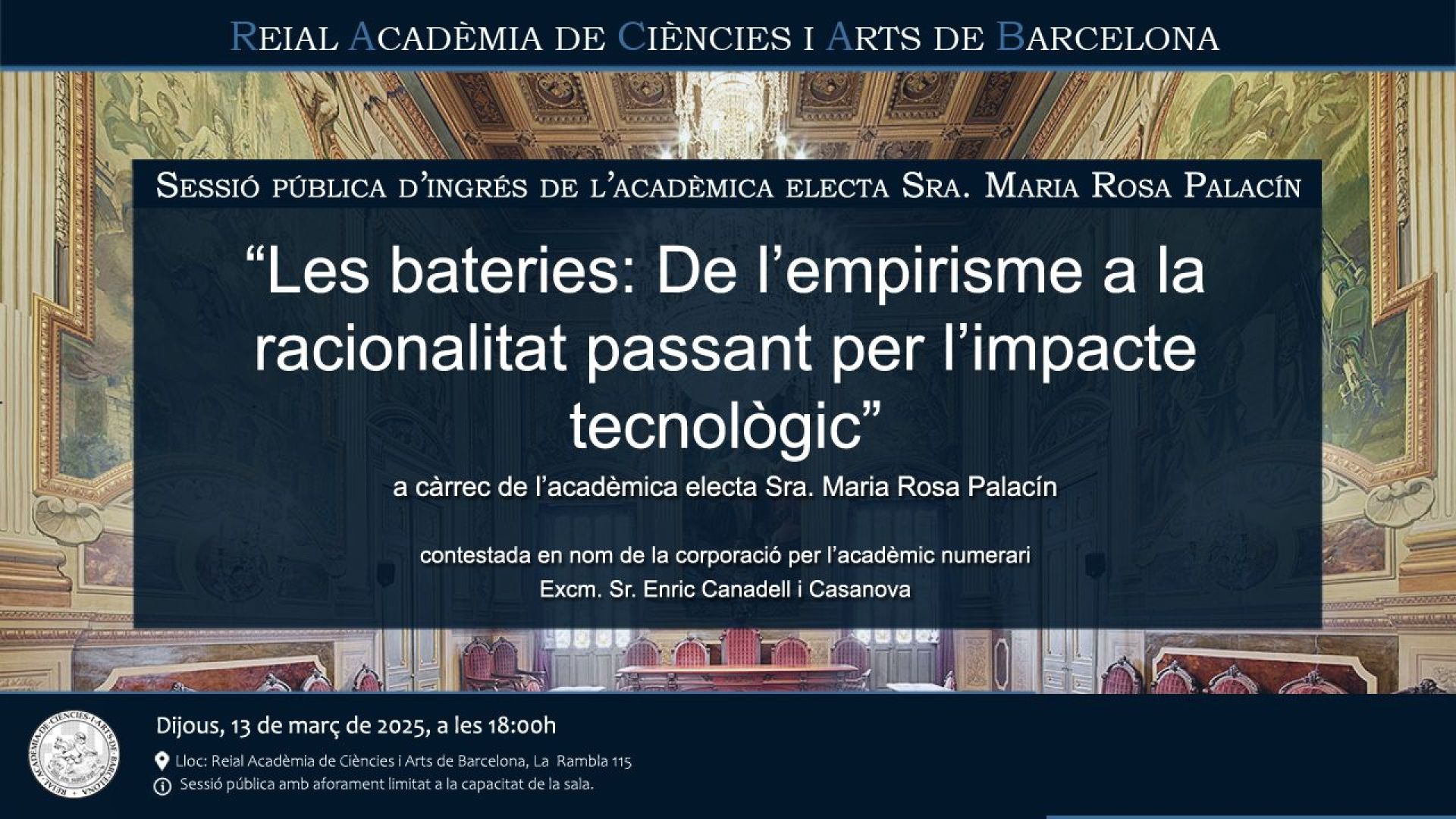
M. Rosa Palacín Peiró was appointed Academic Elect of the Chemistry Section of RACAB on 21 December 2023 on the topic Solid-State Electrochemistry.
Her inaugural lecture will explore the fascinating evolution of batteries, from their early empirical discoveries to the rational design of modern energy storage technologies. Batteries have played a crucial role in technological progress, powering innovations from the electric telegraph to today’s electric vehicles. Palacín, a leading expert in battery research, will highlight key historical milestones, scientific breakthroughs, and the future of sustainable energy storage solutions.
This session will be open to the public, offering valuable insights for scientists, engineers, and anyone interested in the advancements shaping the future of energy storage.
We look forward to seeing you all there as we extend a warm welcome to M. Rosa Palacín at the RACAB.
Details
Sessió pública d'ingrés de la Dra. M. Rosa Palacín “Les bateries: de l’empirisme a la racionalitat passant per l’impacte tecnològic”
a càrrec de l'acadèmia electa Sra. Maria Rosa Palacín,
contestada en nom de la corporació per l'acadèmic numerari Excm. Sr. Enric Canadell i Casanova
Thursday, 13 March 2025
6:00 PM
Reial Acadèmia de Ciències i Arts de Barcelona (RACAB), La Rambla 115, Barcelona
More information
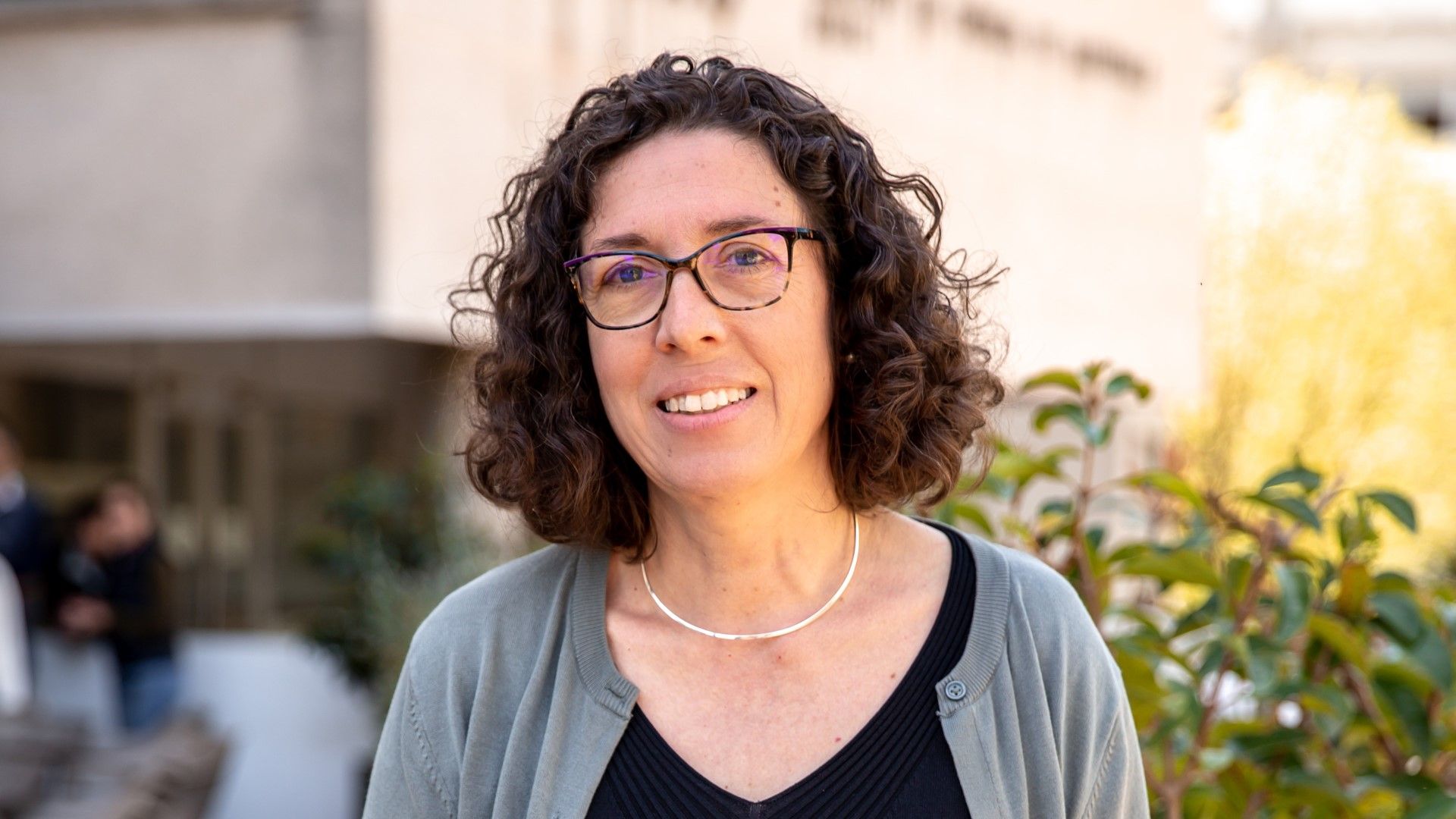
M. Rosa Palacín | ICMAB, CSIC
Chemistry Section of the RACAB
The Chemistry Section of the RACAB is composed of nine full members, and M. Rosa Palacín will occupy a position under the designation "Solid-State Electrochemistry." Electrochemistry has a long-standing tradition within RACAB.
Enric Canadell, who proposed Palacín to become a RACAB member, illustrates us: "In the late 18th century, a distinguished member of this Academy, Dr. Salvà i Campillo, was fascinated by the revolutionary work of Galvani. In 1804, he presented a report to the Academy describing, for the first time, an electric telegraph powered by a Voltaic pile, a highly advanced proposal for its time. Years later, Francesc Domènech i Maranges, who served as president of RACAB, delivered a course on the application of electricity for producing light, and in 1866, he became the first to experiment with electric lighting in Barcelona."
"Dr. M. Rosa Palacín, who presided the International Battery Association between 2021 and 2023, is a renowned expert in battery development. She now becomes part of the legacy established by Salvà i Campillo, Domènech i Maranges, and other RACAB scholars who advanced the field of electrochemistry." explains Canadell, ICMAB-CSIC Ad honorem researcher and also member of the RACAB.
Research Profile of M. Rosa Palacín
When asked Canadell the reason of his proposal, he states that "Although Dr. Palacín's research is fundamentally scientific, it is directed toward technological development, particularly in understanding the mechanisms involved in battery operation. She has studied electrode materials, focusing on the relationships between preparation methods, physical properties, structure/microstructure, and electrochemical performance. She has been a pioneer in researching alternative battery technologies beyond lithium-ion, exploring sodium, magnesium, and calcium-based batteries, which rely on abundant, low-cost elements with minimal environmental impact."
Academic and Professional Trajectory
Her research has had a significant impact, earning her numerous accolades, including:
- Fellow of the Electrochemical Society
- Research Award from the International Battery Association
- Corresponding Member of the Real Academia de Ciencias Exactas, Físicas y Naturales
- Prix Franco-Espagnol from the Société Française de Chimie
- Expert roles in international committees, such as the Basic Research Needs for Electrical Energy Storage Roadmap (Office of Science, US Department of Energy, April 2007) and the Roadmapping Exercise on Materials for the European Strategic Energy Technology Plan in Energy Storage (2010-2011).
The Evolution of Batteries: From Empirical Discoveries to Technological Breakthroughs
You can download here the inaugural speech summary by M. Rosa Palacín (in Catalan), or read it here in English:
Batteries are devices that convert chemical energy into electrical energy, and they are an integral part of our daily lives. In 1799, Alessandro Volta invented the voltaic pile, a revolutionary energy storage device that rapidly found applications in emerging technologies, such as the electric telegraph, pioneered by Francesc Salvà i Campillo. Sixty years later, the first rechargeable battery technology was introduced—the lead-acid battery, which remains in use today. Soon after, nickel-based batteries were developed, becoming the precursors of modern nickel-metal hydride batteries. These early batteries relied on aqueous electrolytes, and the redox reactions occurring at their electrodes often caused significant structural changes. Initially, battery development was driven by empirical experimentation, but over time, advancements in scientific understanding allowed for a more rational approach. A key example of this is the optimization of nickel hydroxide microstructure in nickel-based batteries, where achieving small particle sizes and a high number of structural defects was crucial for maximizing capacity.
The discovery and isolation of lithium enabled scientists to explore its properties. Due to its low weight and high electropositivity, lithium was quickly recognized as a promising electrode material. This advancement was made possible by the development of organic electrolytes, leading to the commercialization of non-rechargeable lithium batteries. The breakthrough in rechargeable lithium-ion technology, which provided significantly higher energy densities than existing battery technologies, was driven by research into intercalation compounds. These materials allow lithium ions to enter and exit their crystalline structure without causing major structural changes, making them highly stable electrodes over numerous charge-discharge cycles. This innovation earned the 2019 Nobel Prize in Chemistry and has continuously evolved since its commercialization in the early 1990s. Today, lithium-ion batteries power portable electronics, electric vehicles, and large-scale energy storage systems. This evolution has led to new approaches, such as blending different electrode materials to optimize performance. While this strategy has been widely implemented in electric vehicle batteries, the fundamental mechanisms behind these improvements remain an active area of research.
The growing demand for larger and more sustainable battery technologies has highlighted the importance of diversifying energy storage solutions. One of the fastest-growing alternatives is sodium-ion batteries, which share chemical similarities with lithium-ion batteries. However, despite these similarities, sodium-based batteries require different electrode materials. For example, instead of graphite (used in lithium-ion batteries), disordered hard carbon, derived from solid pyrolysis, is used as the anode in sodium-ion systems.
Other promising technologies aim to achieve higher energy densities by using metallic electrodes, but their development faces significant challenges. In the case of sodium and lithium metal batteries, issues such as dendritic growth and low electrodeposition efficiency have hindered progress. For other metals, the situation is even more complex, with limited scientific knowledge available. A notable example is calcium batteries, where electrodeposition of calcium metal was achieved only a few years ago, and even then, under highly specific conditions, including strict electrolyte composition and temperature control. The challenges for calcium-ion battery cathodes are similar, as researchers work to improve both capacity and reaction kinetics to make these systems commercially viable.
In this context, current battery research focuses not only on exploring new materials but also on enhancing the performance of existing commercial technologies by studying their redox mechanisms to extend battery lifespan. Both approaches require advanced characterization tools capable of real-time (operando) and correlated analysis during battery operation. Additionally, artificial intelligence (AI) is expected to play a crucial role in material discovery and in handling the massive amounts of data generated by these new characterization techniques—a direction in which researchers are already making significant progress.
Read more
ICMAB - Dr. M. Rosa Palacín, new Elected Academic of RACAB
ICMAB - Enric Canadell will give the welcoming speech at the RACAB on 22 Oct 2020
ICMAB - Biographical Sketch of Carles Miravitlles at the RACAB