


Nobel Prize in Chemistry
The Royal Swedish Academy of Sciences has decided to award the 2024 Nobel Prize in Chemistry with one half to David Baker “for computational protein design” and the other half jointly to Demis Hassabis and John M. Jumper “for protein structure prediction.”
Jordi Faraudo’s research at the Soft Matter Theory group is focused on computational design of molecules, including protein design: “In our computational research we study new materials for biomedical applications and this usually involves modelling how biomolecules (mostly proteins) interact with the materials”.
“As starting point for our research we need to know the structure of these proteins but this information is available from experiments only in a few cases. The contributions from the laureates with 2024 Nobel Prize in Chemistry allow the prediction of these tridimensional structures of proteins based on AI tools and the design of new proteins not found in nature. So their tools are essential in our daily research to ovecome the limited availability of protein structure experimental data” explains Faraudo.
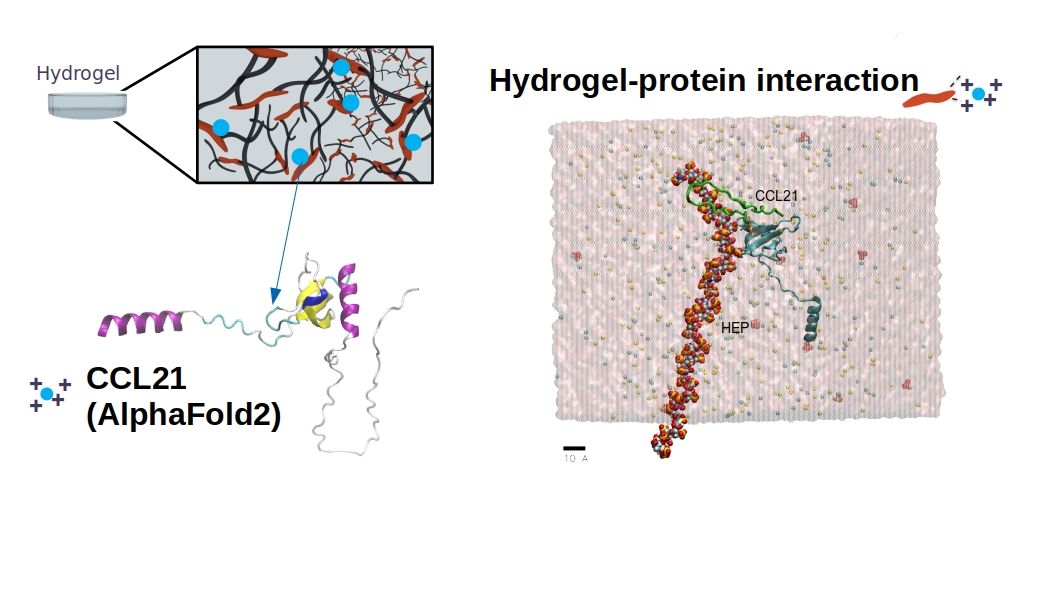
Scheme of a hydrogel containing the human CCL21 protein, image of the CCL21 protein structure generated with AI methods using Google Deepmind’s AphaFold2, Molecular Dyanmics simulation of the hydrogel-protein interaction performed at ICMAB using the AlphaFold2 output. (Simulation performed by Dr Huixia Lu at Softmatter Theory group)
Nobel Prize in Physics
The Royal Swedish Academy of Sciences has decided to award the 2024 Nobel Prize in Physics to John J. Hopfield and Geoffrey E. Hinton “for foundational discoveries and inventions that enable machine learning with artificial neural networks.”
Alberto García, researcher at the Electronic Structure of Materials group comments that “It would seem that this work is not related to physics, but in fact there are subtle and not so subtle connections. Hopfield is a physicist who did work on condensed-matter topics. The "Hopfield network", which is at the foundation of the use of neural networks to process information, has some analogies to a spin glass. The major contribution of Hinton, a computer scientist, was the backpropagation algorithm, but in his toolbox there were physics-inspired concepts such as Boltzmann machines”.
For García, “the true importance of the work for all branches of science is that machine learning enables accelerated discovery (e.g. in protein folding, the subject of the Chemistry Nobel prize, or in materials design), the uncovering of patterns (e.g. for disease screening), and generally provides an unprecedented boost to the efficiency of data exploration”.
As a relevant example at ICMAB, research in the group of Mariano Campoy-Quiles, the Nanostructured Materials for Optoelectronics and Energy Harvesting (NANOPTO) group, combines high-throughput experiments with machine-learning to screen materials and optimize devices for organic solar cells.
"The team is currently using these tools to develop different photovoltaic technologies targeting applications such as agrivoltaics, in-door photovoltaics, and multijunciton solar cells. For each case, the team aims at finding the best materials and processing conditions navigating the large parameter and material space in a very efficient manner" explains Campoy-Quiles.
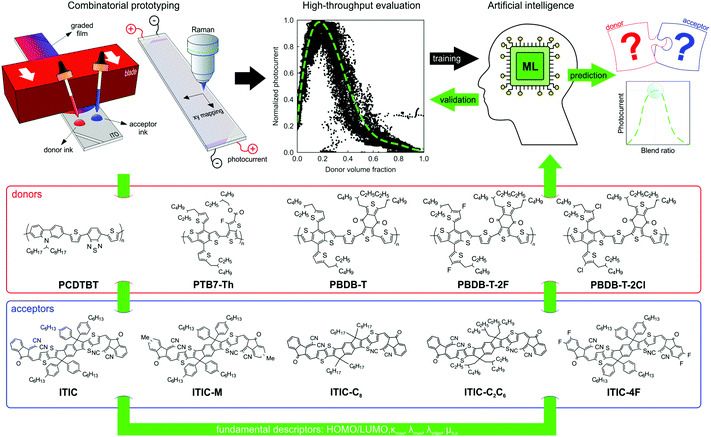
The photocurrent–composition prediction workflow for binary organic photovoltaic blends: First, generation of parametric libraries by blade coating on functional devices; second, the high-throughput photovoltaic characterization by means of co-local Raman spectroscopy and photocurrent imaging; third, AI algorithms are trained on the experimental datasets to make predictions of the photocurrent–composition dependence for materials in and outside of the training dataset (Figure 1 of DOI: 10.1039/D0EE02958K)
Nobel Prize in Physiology or Medicine
The Royal Swedish Academy of Sciences has decided to award the 2024 Nobel Prize in Physiology or Medicine to Victor Ambros and Gary Ruvkun for the discovery of microRNA and its role in post-transcriptional gene regulation.
Anna Laromaine, in the group of Nanoparticles and Nanocomposites, uses C. elegans to study nanomaterials toxicity and evaluate other properties. “The laureates used the same 1-mm-long nematode, C. elegans, and specifically, two mutant strains of worms, lin-4 and lin-14, that displayed defects in the timing of activation of genetic programs during development”.
Laromaine explains: “Ambros identified that the lin-4 gene produced an unusually short RNA molecule that lacked a code for protein production. These surprising results suggested that this small RNA from lin-4 was responsible for inhibiting lin-14. Ruvkun showed that it is not the production of mRNA from lin-14 that is inhibited by lin-4. The regulation appeared to occur at a later stage in the process of gene expression through the shutdown of protein production. Experiments also revealed a segment in lin-14 mRNA necessary for its inhibition by lin-4. The two laureates compared their findings, which resulted in a breakthrough discovery. The short lin-4 sequence matched complementary sequences in the critical segment of the lin-14 mRNA. Ambros and Ruvkun performed further experiments showing that the lin-4 microRNA turns off lin-14 by binding to the complementary sequences in its mRNA, blocking the production of lin-14 protein. A new principle of gene regulation, mediated by a previously unknown type of RNA, microRNA was discovered”.
“Interestingly, since the work was published in this tiny worm, the unusual mechanism of gene regulation found was considered a peculiarity of C. elegans, likely irrelevant to humans and other more complex animals. However, this changed when Ruvkun´s research group discovered another microRNA encoding the let-7 gene that is highly conserved and present throughout the animal kingdom”.
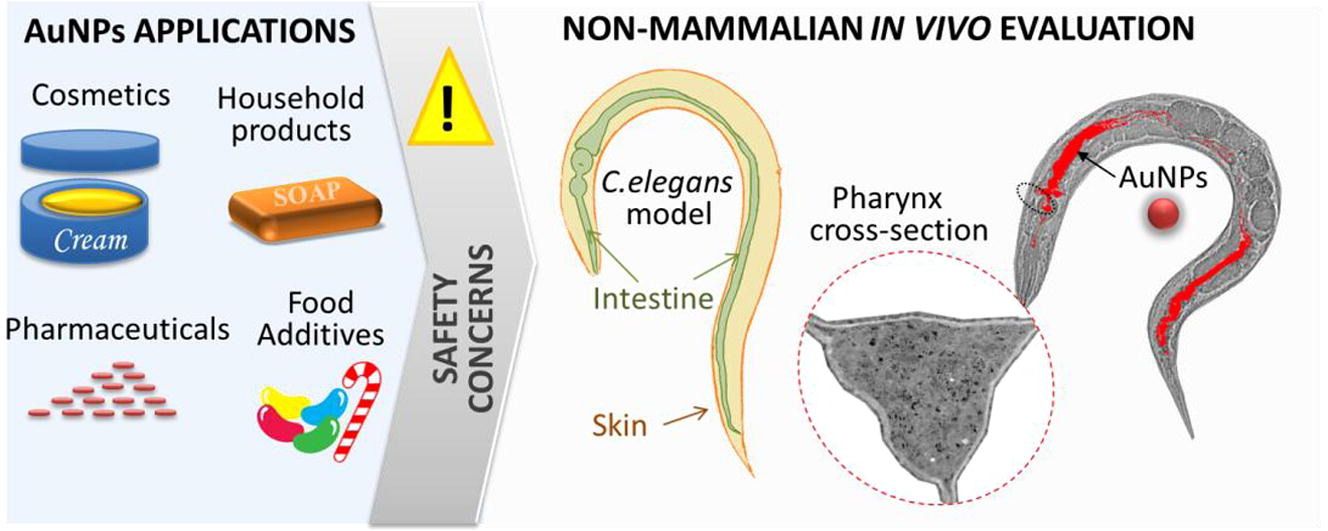
In vivo evaluation of different products using C. elegans (Graphical Abstract of DOI:10.1016/j.actbio.2017.01.080)
“In our laboratory, in Nanoparticles and Nanocomposites group, we are using this small worm to evaluate materials, nanomaterials, polymers, early stages of the Parkinsons disease, or even stressors (such as electromagnetic fields ) and understand if they affect the life cycle or biology of C. elegans or how this organism affects the materials we synthesized. This nematode is considered helpful in research because it is a small model, has a fast life cycle, the genome is completely sequenced, and has some biological/physiological properties that have some homology to humans; therefore, it could be an initial/ early step in translational research”.
Take a look at this video of the NextGem project, in which researcher Pol Alonso explains how they use C. elegans to study the effect of electromagnetic fields.
For more information about the three Nobel Prizes commented here, visit the Nobel Prize website, which includes invaluable information to read and understand the main science behind them:
- Nobel Prize in Physics (Press Release, Popular Information)
- Nobel Prize in Chemistry (Press Release, Popular Information)
- Nobel Prize in Physiology or Medicine (Press Release)