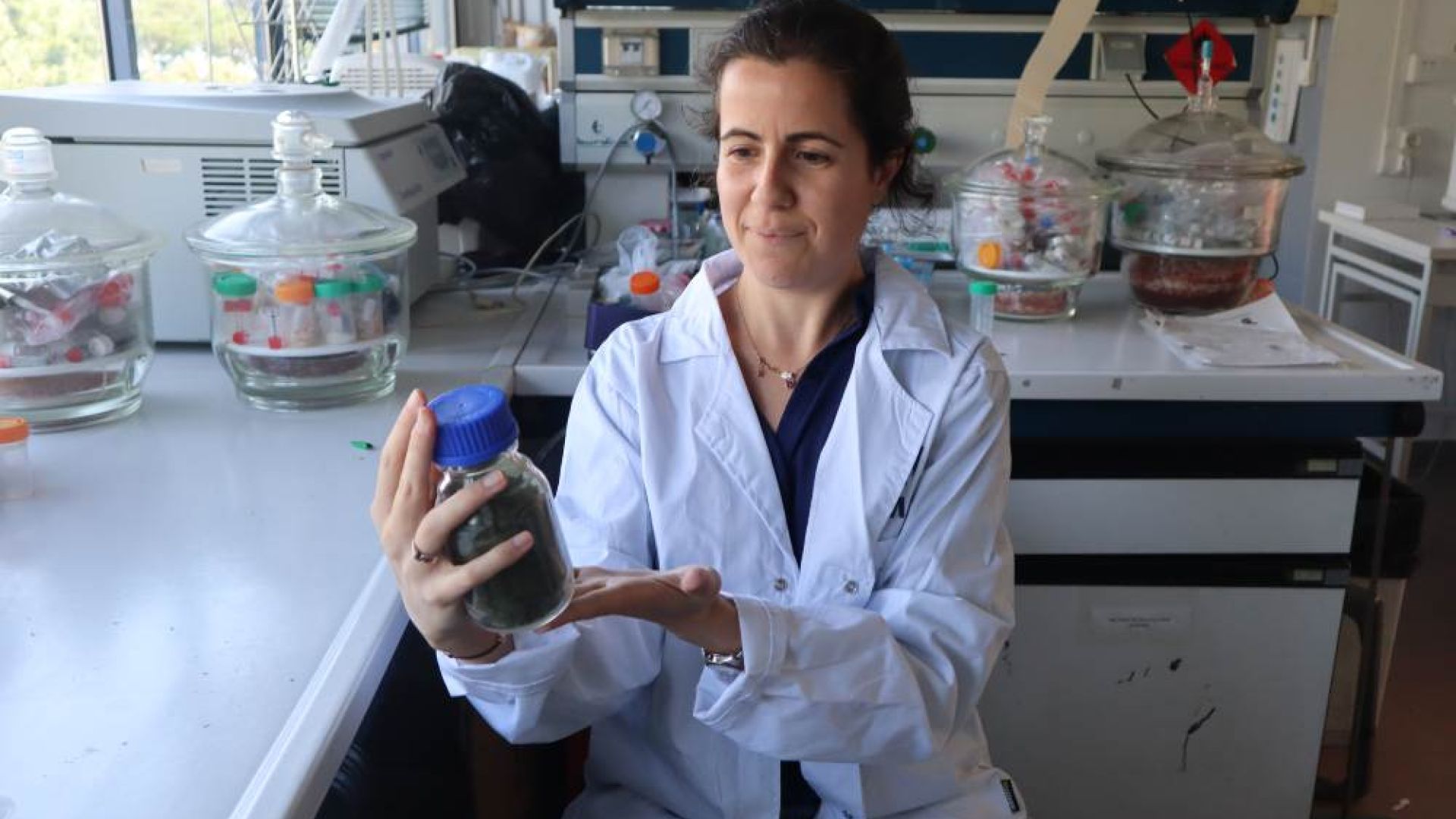
Valeria Blanco started as a Ramón y Cajal researcher (2023 call) at ICMAB, and now is Tenured Scientist at the Solid State Chemistry - Battery Research Group (SSC-Battery).
The Fundación BBVA Leonardo grants are awarded by the Fundación BBVA. The scholarship was named after Leonardo Da Vinci, since its essence is to support knowledge, regardless of whether it involves scientific or creative inquiry. In the 2025 edition, the BBVA Foundation has increased the maximum funding for selected projects to 50,000 € per scholarship, 25 % more than the amount previously awarded.
SUSTnano: Harnessing diatom biology to engineer sustainable high-performance battery materials
SUSTnano pioneers a novel interdisciplinary strategy to design sustainable high-performance materials by bridging two previously disconnected fields: nanostructured battery materials and diatom biology. Diatoms—unicellular microalgae—naturally grow nanostructured silica (SiO₂) shells (frustules) with species-specific architectures and tunable nanoscale properties.
Valeria Blanco explains that "Marine biology has shown that frustule morphology can be modulated by environmental stimuli, a phenomenon known as morphological plasticity. Yet, this biological design tool remains untapped in materials science. SUSTnano proposes to exploit diatom morphological plasticity as a rational engineering methodology to tailor the nanoscale structure of SiO₂ and ultimately synthesize high-capacity Silicon (Si) negative electrodes for Lithium-ion batteries. This concept offers an alternative to costly synthetic nanostructuring methods, replacing energy-intensive processing with biologically grown, application-specific nanostructures."
Blanco adds: "The goal of this project is to establish diatom morphological plasticity as a powerful methodology for controlling the structure of biologically grown SiO2 at the nanoscale, and to demonstrate that it can be used to produce outperforming nanostructured Si-based anodes for Li-ion batteries."
Lithium-ion batteries are the cornerstone of modern energy storage, powering everything from mobile phones and laptops to electric vehicles and grid-scale systems. Their widespread adoption is driven by their high energy density, long cycle life, and reliable performance. Currently, graphite is the standard anode material, but its limited capacity (372 mAh g⁻¹) and critical raw material status pose challenges for future applications. Silicon offers a much higher capacity (~3600 mAhg⁻¹) and is widely regarded as the most promising alternative. However, its commercial deployment is hindered by severe volume expansion during cycling and the need for costly nanostructuring to maintain stability. Existing synthesis methods for tailored Silicon nanostructures are energy-intensive, hazardous, and unsustainable.
Valeria affirms that "SUSTnano addresses this bottleneck by developing biologically grown, application-specific nanostructures for use in high-performance Silicon anodes. This bio-enabled approach replaces conventional fabrication with a sustainable alternative. While initially focused on Si-based Li-ion batteries, the methodology opens new avenues for material design across diverse fields, offering a foundation for broader innovation in nanomanufacturing."
"The Leonardo scolarship" adds Valeria "will make it possible to explore how a biological phenomenon like morphological plasticity in diatoms could offer a more sustainable way to design nanostructured materials of technological relevance—starting with silicon anodes."
Congratulations, Valeria!
Leonardo Grants 2025 support 60 groundbreaking personal projects across ten fields of scientific research and cultural creation
The evaluation committees for the 12th edition of the BBVA Foundation’s Leonardo Grants have selected 60 highly innovative projects spanning a broad range of disciplines in scientific research and cultural creation. These are individual initiatives led by professionals at a pivotal stage in their careers—researchers and creators aged between 30 and 45—an intermediate phase with significant potential for growth.
The areas of the program are: Basic Sciences (Physics, Chemistry, Mathematics); Biology and Biomedicine; Environmental and Earth Sciences; Engineering; Computer Science and Data Science; Social Sciences; Humanities; Visual Arts; Music and Opera; Literary Creation and Performing Arts.
Read more
Las Becas Leonardo 2025 impulsan 60 innovadores proyectos personales en diez áreas de la investigación científica y la creación cultural - Red Leonardo
Previous BBVA Leonardo Grants at ICMAB
Mariona Coll and Ignasi Fina awarded with a Leonardo Grant (BBVA) to develop innovative and sustainable scientific projects
BBVA Leonardo Grant for Leonardo Scarabelli