


Since its foundation in 1986, ICMAB has been strongly committed to the training of new generations of researchers. Each thesis defended at the institute represents years of effort, knowledge, and collaboration, and reflects ICMAB’s contribution to science and to society.
Over nearly four decades, 450 PhD fellows have developed their research at ICMAB, many of whom have continued their careers in academia, industry, and research centers all over the world. This trajectory highlights the institute’s mission to combine excellent scientific research with the training of highly skilled professionals.
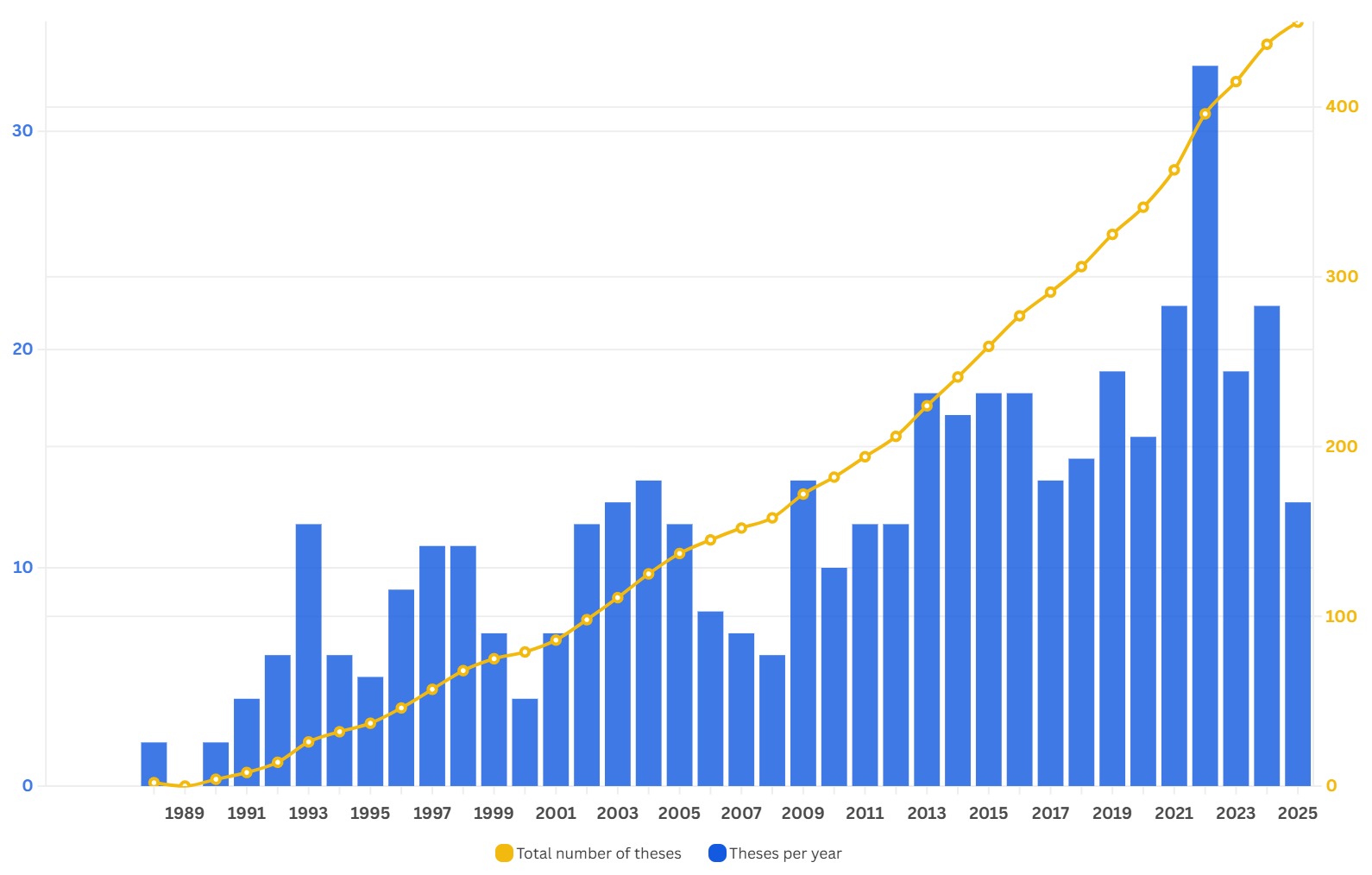
Graph representing the number of theses per year and the accumulated value | ICMAB-CSIC
David Amabilino, ICMAB Director, emphasizes:“Every PhD thesis is a journey of learning nad discovery built with passion, patience, perseverance, and collaboration. We celebrate the achievements of all the individuals, that are supported by the research groups, technicians, administrative and other support staff in the ICMAB. Reaching 450 is not only a number – it symbolizes the growing strength of our scientific community and the impact of ICMAB on materials science research."
This milestone is a moment to congratulate all past, present, and future PhD students who make ICMAB a hub for knowledge and innovation.
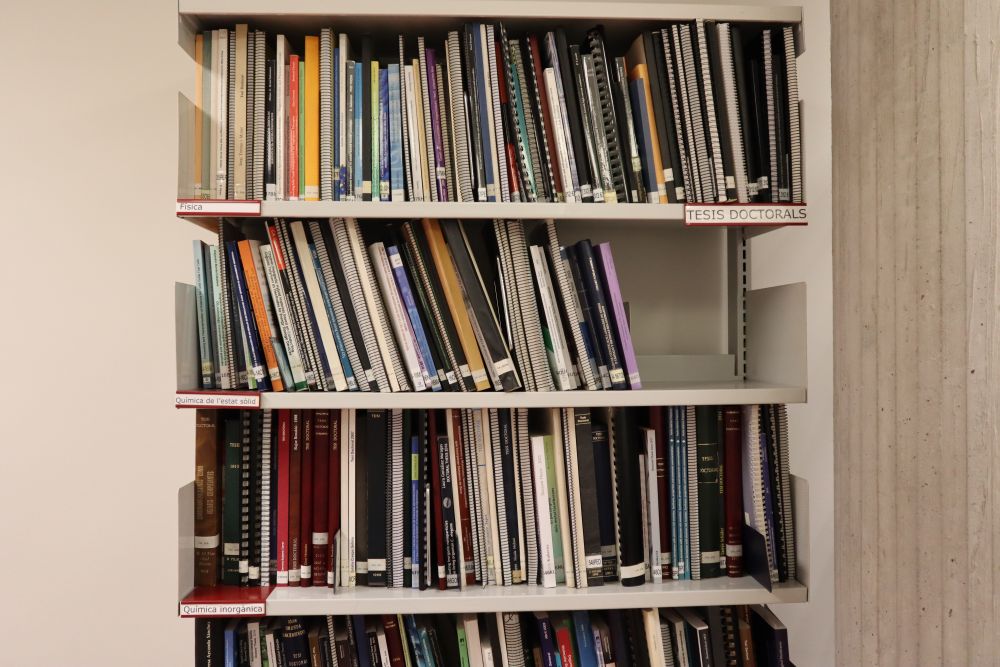
You can read all past theses at the ICMAB library Manuel Cardona | ICMAB-CSIC
Nearly 12% of ICMAB PhD graduates continue their careers at the institute as researchers, technicians, or support staff
A significant number of past PhD candidates now contribute directly to the institute as researchers, technicians, or research support staff, demonstrating the long-lasting impact of their training and the continuity of excellence at ICMAB:
As permanent researchers at ICMAB (Tenured Scientists, Research Scientists, or Research Professors), there are or have been: Clara Viñas and Felip Sandiumenge (1991); Concepción Domingo and José Luís García-Muñoz (1992); Xavier Granados, Lourdes Fàbrega, and José Vidal (1993); M. Rosa Palacín (1995); Rosario Núñez and Nora Ventosa (1996); Anna Roig (1998); Imma Ratera and Marta Mas-Torrent (2002); Riccardo Rurali (2003); Gerard Tobías Rossell and Gervasi Herranz (2004); Anna Laromaine and Anna Palau (2005); Martí Gich, Vega Lloveras, and Arántzazu González (2006); Mariona Coll (2007); Joffre Gutiérrez, Núria Crivillers, and Sebastián Reparaz (2008); Judith Guasch and Ignasi Fina (2012); Roger Guzmán (2013); and Stefania Sandoval (2016).
As scientists at ICMAB performing research or technical tasks without a permanent track position, there are: Ignasi Mata (2003); Roxana Vlad (2011); Muling Zeng (2014); Bernhard Dörling and Ashley Black (2017); Bernat Mundet (2018); Guillem Vargas (2020); Judit Tomsen, Víctor Fuentes, P. Rogger Palacios, and Saúl Estandía (2021); Isabel Guerrero (2022); and Pol Sallés (2023).
As technicians in our Scientific Equipment Platforms, there are: Judith Oró (2008); Marcos Paradinas (2014); Bernat Bozzo and Anna Esther Carrillo (2016); Ferran Vallès (2019); Alejandro Borrás (2022), and Adrià Pacheco and Marc Martínez (2023).
As project managers or research support staff, there are: Laura Cabana (2015) and Eulàlia Pujades (2024). Finally, as researchers linked with ICMAB-CSIC spin-offs, there are: Miquel Nuez (2022) and Miquel Casademont (2024). In total, nearly 12 % of ICMAB's PhD graduates have continued their career at ICMAB (most of them after a postdoc or some time abroad).