


A new paper has been published in the journal Applied Materials Today:
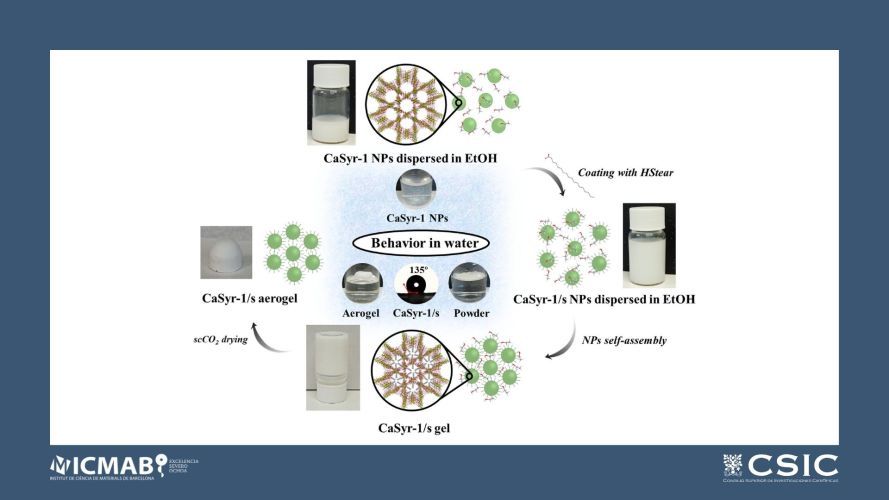
The preparation of highly porous metal organic frameworks (MOFs) chemically resistant to water is essential for the forthcoming use of these materials as adsorbents in applications of gas separation under moisture or for wastewater remediation. However, most of the synthesized MOFs have a framework with low thermodynamic stability against water. MOFs modification performed in this work aims to modify the water behavior by addressing kinetic factors affecting the dissolution reaction rate. For this purpose, a post-synthetic process is designed to functionalize MOF particles on the surface with a hydrophobic compound, particularly, stearic acid. The microporous bioMOF CaSyr-1, recently synthesized in our laboratories, was selected as a case study. Pristine CaSyr-1 transforms in water into a second crystalline phase, CaSyr-2 with a non-porous structure resolved in this work. An external surface coating method was chosen to prevent the bioMOF from water-induced degradation, while preserving the internal empty volume to a large extent, thus almost not affecting the adsorption capacity.
The developed synthetic method allows the straightforward assembly of the composite CaSyr-1/stearate into a monolithic aerogel with a multimodal porosity. The significant enhancement of the kinetic stability of the hydrophobized CaSyr-1 with respect to the parent bioMOF was demonstrated by structural and morphological analysis. Textural properties and adsorption capacities of CaSyr-1/stearate were evaluated with different adsorbates, including N2, CO2 and H2O. In particular, significant water adsorption was attained in the coated MOF without affecting the integrity of the framework. Besides, water adsorption works as an effective activation method for the composite by displacing stearic acid adsorbed inside CaSyr-1 pores. As a consequence, CO2 adsorption at room temperature in the water-activated sample was enhanced by a factor of two with respect to the vacuum-activated sample, reaching and uptake of 31 cm3 of CO2 per gram of adsorbent.
M4NRG Clean Energy
Hydrophobic post-functionalization of a water instable bioMOF: Effect on CO2 and water adsorption
Albert Rosado, Alejandro Borrás, Fabián Suárez-García, Oriol Vallcorba, Ana M. López-Periago, José A. Ayllón, Concepción Domingo
Applied Materials Today, Volume 42, February 2025, 102573

